
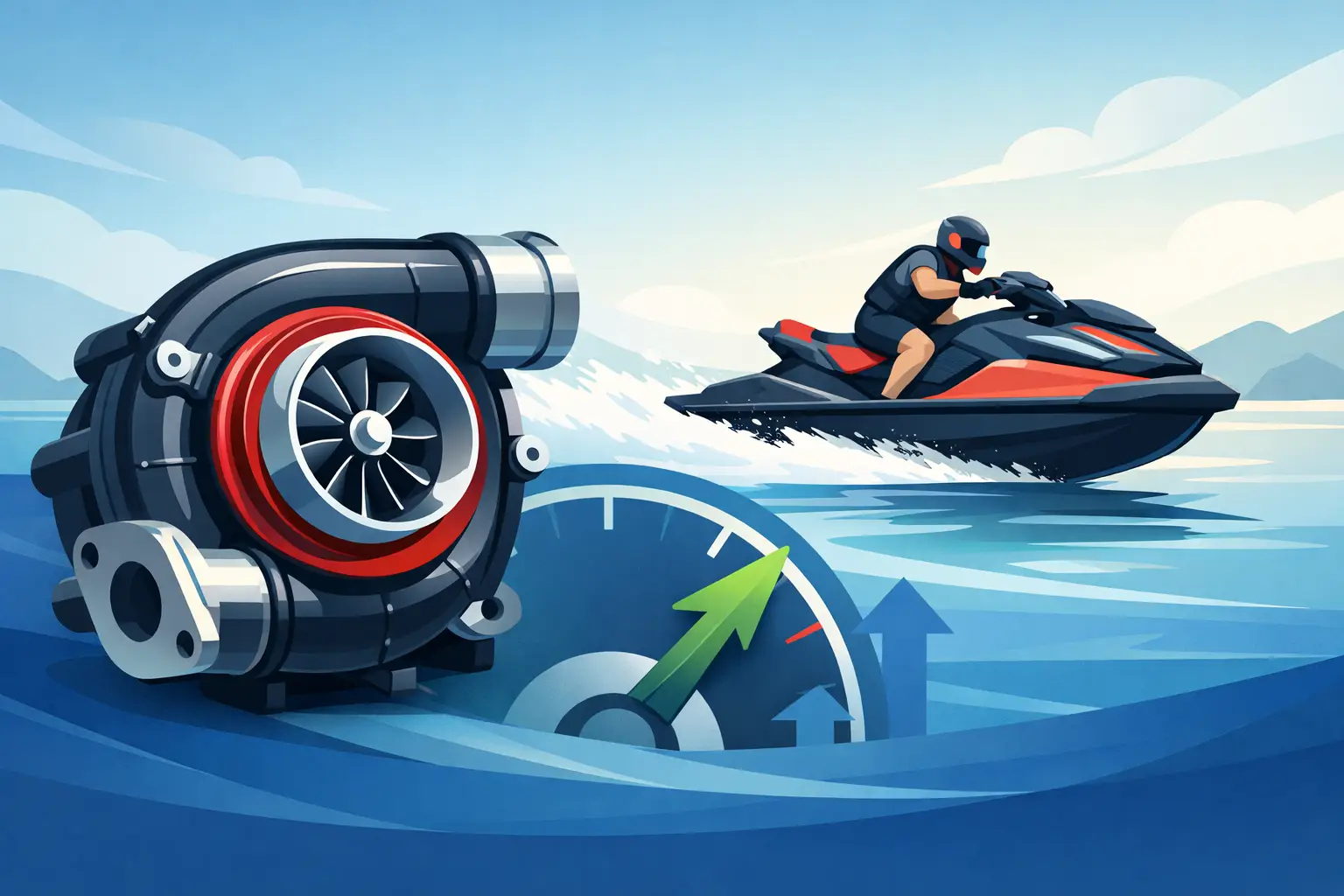
A RIVA Sea-Doo 325 XX-charger is not a bolt-on shortcut to a fast, reliable ski. It is a serious airflow upgrade for riders who have already outgrown a basic tune and want stronger acceleration, harder mid-range pull and more top-end potential from a supercharged Sea-Doo platform. Installed as part of the right package, it can transform the way a ski carries speed. Installed without the supporting hardware and calibration, it can create expensive problems quickly.
For Sea-Doo owners chasing genuine performance, the question is not simply whether the XX-charger makes more boost. The real question is whether the complete ski, fuel system, cooling system, intake path and ECU calibration are ready to use that airflow safely.
What the RIVA Sea-Doo 325 XX-charger changes
The supercharger is the heart of a forced-induction Sea-Doo build. Its job is to force more air into the engine than atmospheric pressure alone can supply. More air gives the engine the opportunity to burn more fuel, and that is where the power gain comes from.
The RIVA Sea-Doo 325 XX-charger is aimed at riders who want more capacity than a standard supercharger can comfortably deliver. In practical terms, it is built for a higher-output combination where the factory charger becomes the restriction. The benefit is not just a peak horsepower number. A properly matched charger can improve the way the ski responds when you roll into the throttle, pulls through rough water and holds speed under load.
That matters on the water. A ski that looks impressive on a dyno sheet but runs hot, surges, detonates or loses belt reliability is not a finished performance build. The target is usable power that can be repeated pass after pass.
The exact result depends on the Sea-Doo model, engine condition, fuel quality, riding load, impeller choice and supporting modifications. A lightweight race setup and a recreational ski carrying a full tank, an icebox and a passenger will not respond in the same way. Good workshop advice starts with how you actually use the machine.
The XX-charger needs a matched package
A high-flow charger moves the whole build forward. That means every restriction and weak point around it becomes more relevant. On a mild setup, a factory component may be adequate. Once airflow and cylinder pressure rise, adequate is no longer the standard.
ECU calibration is non-negotiable
The ECU needs to know what the engine is receiving. A calibration developed for a standard charger may not command the right fuel delivery, ignition timing, throttle strategy or safety limits for an XX-charger configuration. Running a major supercharger upgrade on an unsuitable tune is one of the quickest ways to turn a performance project into an engine repair.
A proper ECU tune is not simply about making the largest possible number. It should be calibrated around the fuel you can access consistently, the boost level, intake temperature, injector capacity and intended use. Australian pump fuel quality can vary, particularly when travelling for a ride day or racing away from home. Building in a sensible margin is smart reliability, not leaving power on the table.
Fuel delivery must keep up
More air demands more fuel. If the fuel system reaches its limit, the engine can run lean under load. That is dangerous territory in a supercharged marine engine, where sustained throttle use, heat and cylinder pressure can expose a weak setup fast.
Depending on the power target, this may involve higher-capacity injectors, fuel-system upgrades and confirmation that fuel pressure remains stable when the engine is working hard. The right parts depend on the model and build specification. Guessing based on what worked in someone else’s ski is not a strategy.
Intake and intercooling affect consistency
A charger cannot perform at its best if it is fed through a restrictive intake or forced to work with excessive intake temperatures. A freer-flowing intake can support the charger, while an effective intercooler setup helps control charge-air temperature and retain power over repeated runs.
Heat management is especially relevant in Australian conditions. A ski that feels strong for one early-morning blast may behave very differently after repeated hard pulls on a hot afternoon. Lower, more consistent intake temperatures give the tune a better foundation and reduce the chance of the engine operating outside its safe window.
The driveline needs to use the power
More engine output does not automatically equal more speed. The pump, impeller, wear ring and hull setup determine how efficiently that power reaches the water. An impeller that worked well with a factory charger may over-rev, cavitate or fail to load the engine correctly once power increases.
This is where a performance build becomes a system rather than a shopping list. Impeller pitch, pump condition and ride plate or sponson setup need to suit the rider’s goal. A ski built for brutal closed-course acceleration can feel very different from one intended for long river runs or offshore riding.
Is the RIVA Sea-Doo 325 XX-charger right for your ski?
The XX-charger makes the most sense when the owner has a clear power target and is prepared to support it properly. It is generally a better fit for serious enthusiasts, racers and high-output recreational riders than for an owner who only wants a little extra throttle response with minimal maintenance commitment.
If your Sea-Doo is stock, mechanically unknown or overdue for servicing, start there. Compression and leak-down checks, supercharger inspection, fault-code diagnostics, cooling-system checks and a close look at the pump can reveal whether the base platform is ready. Adding power to an engine with an existing issue rarely hides the issue. It usually makes it more expensive.
It is also worth being honest about your riding style. A high-output charger setup can be brilliant for a rider who regularly runs hard and understands the maintenance involved. For casual family use, a less aggressive charger and tune package may deliver a better balance of response, running cost and reliability. Bigger is not automatically better if the ski never gets used in the range where the upgrade shines.
Reliability is built into the job
A serious Sea-Doo performance build should be treated like a precision mechanical package. Charger installation requires correct clearances, quality fasteners, accurate torque procedures, belt alignment and a careful inspection of associated components. The details matter because supercharger speed, heat and load place real demand on the system.
After installation, maintenance does not stop. Keep an eye on belt condition, clamp security, oil condition, cooling performance and fault codes. Any new noise, boost issue, hesitation or change in top speed deserves attention before it develops into a larger failure. A performance ski gives clear signals when something is not right, but only if the owner does not ignore them.
Regular servicing is also the right time to review the tune and hardware combination. If you change injectors, intake components, impeller pitch, intercooling or fuel type, the calibration may need to change with it. A tune is part of the build, not a one-time file that suits every future modification.
Choosing the right build path
Before ordering an XX-charger, define the finish line. Are you chasing a reliable high-performance recreational ski, a lake racing setup, offshore acceleration or an all-out race build? The answer determines the most sensible supporting parts and how aggressively the engine should be calibrated.
At VTECHTUNED JETSKI PERFORMANCE, we assess the complete package rather than fitting a headline part in isolation. That means checking the condition of the ski, discussing your fuel and riding conditions, selecting compatible hardware and setting the calibration up for measurable power with reliability in mind. For riders on the Central Coast, that workshop approach can save the frustration of repeated trial-and-error changes.
The RIVA Sea-Doo 325 XX-charger can be an outstanding piece of a properly engineered Sea-Doo build. Give it the airflow, fuel, cooling, driveline setup and calibration it deserves, then maintain the ski like the high-performance machine it has become. That is how stronger acceleration turns into power you can trust every time you leave the ramp.



