
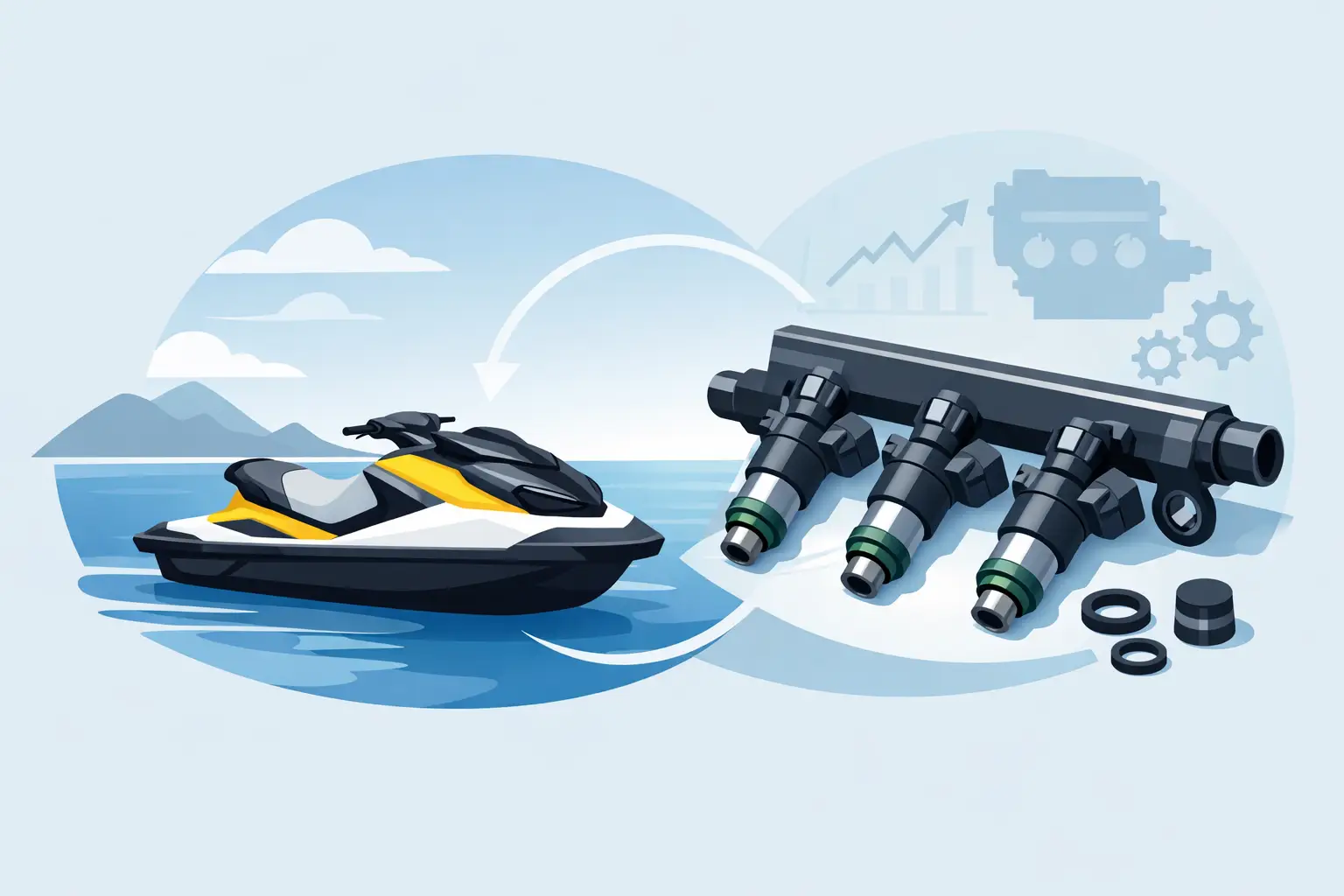
More boost, more airflow and more aggressive ECU calibration all place greater demand on a Sea-Doo fuel system. A Sea-Doo VT1100 injector kit is designed for builds that have reached the point where standard injectors can no longer supply fuel with the control and headroom required for reliable performance. It is not a bolt-on shortcut to horsepower. It is a supporting upgrade that must match the engine, fuel supply and calibration.
For a serious Sea-Doo owner, that distinction matters. An injector that is too small can leave an engine running lean at high load. An injector that is far too large, or poorly calibrated, can make starting, idle and part-throttle operation difficult. The right setup delivers clean fuel control from the ramp through to wide-open throttle, with a tune built around the hardware actually fitted.
What a Sea-Doo VT1100 Injector Kit Does
The VT1100 designation generally refers to a high-flow injector configuration suited to heavily modified forced-induction Sea-Doo applications. Injector flow capacity is commonly expressed in cubic centimetres per minute. A higher-flow injector can deliver more fuel during the same injector pulse width than a smaller unit, giving the ECU and tuner the fuel volume needed when engine demand climbs.
That demand rises quickly once a supercharger is producing more boost, the intake is flowing better, the intercooler has been upgraded or the engine is being pushed harder for racing and high-speed riding. At that point, factory injectors may approach an excessive duty cycle. Put simply, they are being held open for too much of the available injection window to maintain the commanded air-fuel ratio.
A quality injector kit gives the tune more room to work. Rather than forcing the standard injectors to operate at their limit, it provides fuel capacity with a safer margin. This is particularly valuable in hot weather, during long hard pulls and on machines that see repeated full-throttle use.
That said, injector capacity alone does not create power. It supports the power potential of the rest of the package. If your Sea-Doo is close to standard, fitting oversized injectors without the right calibration can create more problems than it solves.
When VT1100 Injectors Are the Right Move
The decision should be based on the whole build, not a parts list seen online. A Sea-Doo VT1100 injector kit can make sense when your existing fuel injectors are nearing their safe operating limit, or when planned upgrades will substantially increase airflow and boost.
Common situations include a supercharger upgrade, a higher-boost pulley arrangement, a free-flowing intake and intercooler package, performance camshafts, port work or a built engine intended to run harder than an OEM bottom end. It may also be appropriate for a race-oriented setup where fuel demand must stay controlled through sustained high rpm operation.
Fuel type matters as well. Different fuels require different fuel volume for the same power target. If a build is being calibrated for a fuel that demands more flow than premium pump fuel, injector sizing needs to reflect that from the beginning. A tuner cannot compensate for inadequate injector capacity with software alone.
For a recreational machine with modest upgrades, a VT1100 kit may be unnecessary. Bigger is not automatically better. The best injector is the one that provides sufficient headroom while retaining precise low-pulse-width control for cold starts, idle, no-wake zones and everyday riding.
Signs the Existing Fuel System Needs Attention
A machine should be properly diagnosed rather than upgraded on guesswork. Data logging can reveal injector duty cycle, commanded versus actual air-fuel ratio, fuel pressure behaviour, intake temperature and knock-related activity under load.
Warning signs can include a lean reading at high rpm, fuel pressure that falls away under boost, inconsistent power after a long run, spark plugs showing signs of excessive heat, or a tune that has reached its sensible injector pulse-width limit. None of these symptoms automatically mean injectors are the sole fault. A restricted fuel filter, weak pump, wiring issue, contaminated fuel or a calibration problem can produce similar results.
That is why testing before parts replacement saves money. Fitting bigger injectors to mask a failing fuel pump is not a reliable repair.
The Supporting Parts Matter Just as Much
An injector kit has to work within a complete fuel system. Before increasing injector size, check that the pump can maintain pressure and volume at the intended power level. Fuel lines, connectors, filters and the fuel rail must also be in sound condition. Any restriction upstream of the injectors limits the benefit of the upgrade.
The injectors must also be correct for the engine and fuel rail. Physical fitment, connector style, injector length, seal quality and spray pattern all matter. An injector that fits electrically but has the wrong dimensions or sealing arrangement can create leaks, poor atomisation or inconsistent cylinder-to-cylinder fuelling.
Installation should be clean and methodical. Injector bores and seals need inspection, old O-rings should not be reused if they are damaged or flattened, and the system should be leak-checked before the ski is run. Fuel leaks in an enclosed engine bay are not a minor issue.
A fresh fuel filter and an assessment of fuel quality are worthwhile at the same time. Performance hardware deserves clean, consistent fuel. A tank contaminated with water or stale fuel can turn a well-built package into an expensive diagnosis.
ECU Calibration Is Not Optional
Once a Sea-Doo VT1100 injector kit is installed, the ECU calibration must account for it. High-flow injectors do not behave like standard injectors at low and high pulse widths. The tune needs accurate injector characterisation so the ECU knows how much fuel is being delivered across the operating range.
This includes injector scaling, latency or dead-time compensation, idle fuelling, transient enrichment and full-load fuel targets. A setup that looks acceptable at wide-open throttle can still have poor manners if these areas are ignored. Hesitation off idle, rich cruising, difficult hot starts and an unstable idle are usually signs that the calibration needs proper attention.
A professional tune is also where the real reliability benefit is found. The goal is not to chase the richest possible mixture or the biggest dyno number. It is to achieve controlled fuel delivery appropriate to the boost level, intake temperature, fuel used and intended riding conditions.
Remote tuning can be effective when the mechanical package is known and quality logs are supplied. For complex builds, workshop diagnosis and calibration provide the advantage of checking fuel pressure, mechanical condition and electronic data together. At VTECHTUNED, that end-to-end approach helps prevent a hardware choice from becoming a tuning compromise.
Choosing the Kit for Your Build Goal
Start with an honest power target and intended use. A weekend ski used for quick lake runs has different requirements from a race machine that spends extended time at high rpm. Build margin matters, but so does rideability.
Ask whether the engine is standard internally, what supercharger and boost level are fitted, whether the intercooler and intake have been upgraded, what fuel will be used, and whether the current pump has verified flow capacity. Those answers determine whether VT1100 injectors are sensible, excessive or only one part of a larger fuel-system plan.
It is also worth considering where the build is heading. If a higher-boost supercharger, cams or internal engine work are planned soon, selecting injectors with appropriate future headroom can avoid buying components twice. But future-proofing should remain practical. Do not build around a theoretical power target that may never happen if it compromises how the ski runs now.
Fit It Once, Tune It Properly
A Sea-Doo performance build is only as dependable as its fuel control. The right injector kit gives a modified engine the fuel capacity it needs, but the outcome depends on correct fitment, a healthy fuel system and calibration matched to the exact combination.
Before ordering injectors, have the current setup assessed and make the upgrade decision from real data. That approach protects the engine, sharpens throttle response and gives you confidence to stay on the throttle when the water opens up.



