
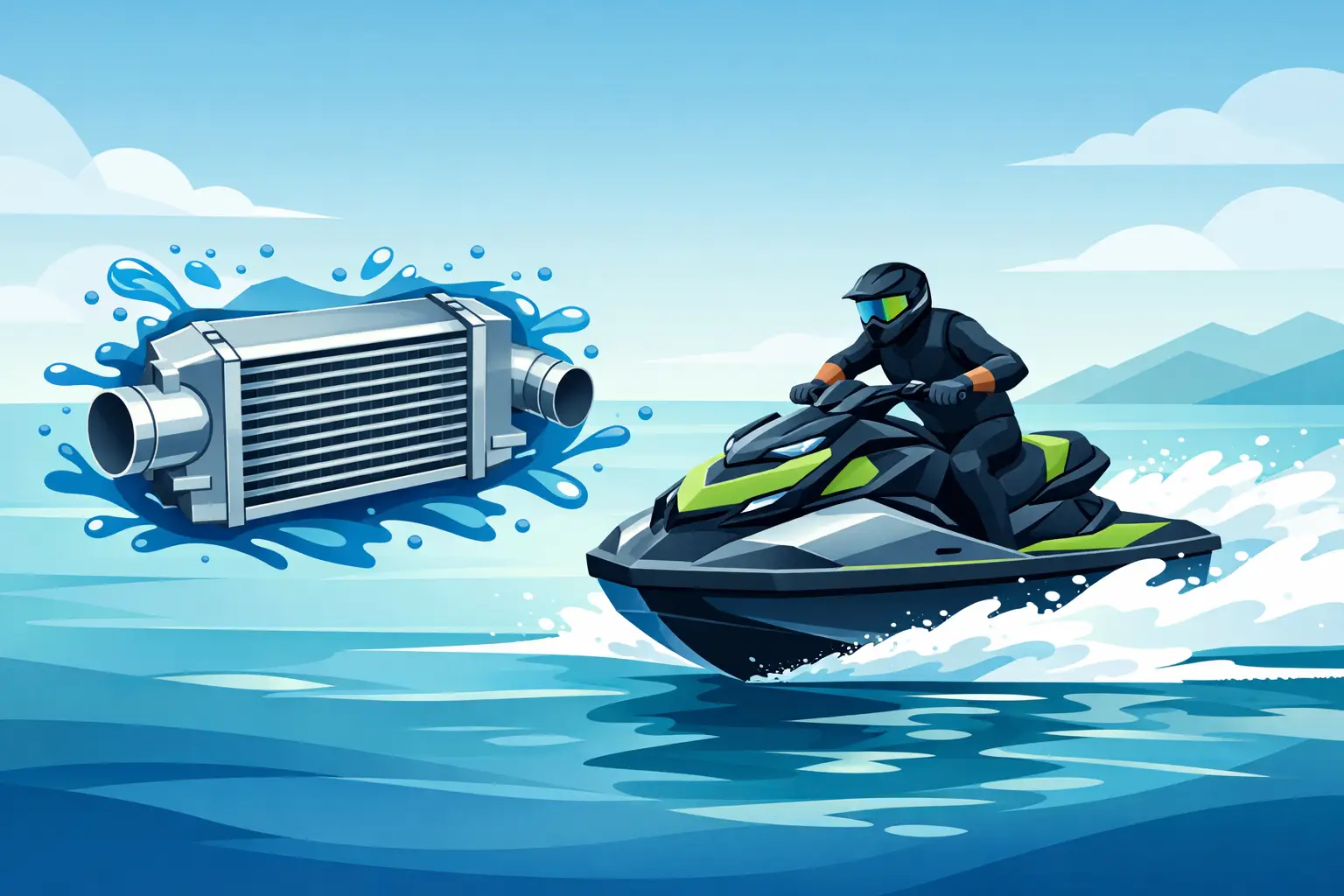
A Sea-Doo 300 can feel brutally quick for one hard pass, then noticeably softer after repeated pulls, rough-water riding or a long summer session. That is the problem a Fizzle Supercooler Sea-Doo 300 upgrade is designed to address: controlling the heat in the compressed intake charge so the engine can deliver more repeatable performance when it is working hardest.
For riders building beyond basic bolt-ons, an intercooler is not a cosmetic part and it is not a guaranteed horsepower number in isolation. It is a supporting system that helps protect the consistency of a tuned package. The real value comes from lower intake air temperatures, reduced heat soak and a stronger margin for calibration, fuel and boost decisions.
Why Sea-Doo 300 charge-air temperature matters
The supercharger on a Sea-Doo 300 compresses intake air before it enters the engine. Compression generates heat. As charge-air temperature rises, the air becomes less dense and less favourable for making dependable power. The ECU may also respond to unfavourable operating conditions by reducing performance to protect the engine.
On a standard recreational ski ridden conservatively, the factory cooling arrangement can be perfectly adequate. The conversation changes when the ski has an ECU tune, supercharger upgrades, higher boost targets, freer-flowing intake and exhaust components, or spends its life being ridden hard. Those combinations produce more heat, and heat management becomes part of the performance build rather than an afterthought.
Heat soak is especially relevant in Australian conditions. A ski that has been idling in a marina, repeatedly launched for drag passes, or run hard through warm salt water does not experience the same conditions as a brief dyno pull. Consistency on the water is what matters. A package that stays sharp over a full session is more useful than one impressive number achieved once.
What the Fizzle Supercooler Sea-Doo 300 changes
A Fizzle Supercooler is a high-capacity intercooler solution intended for high-performance Sea-Doo applications. Its role is to transfer heat out of the pressurised intake charge before that air reaches the engine. More effective cooling can provide a denser intake charge and help the engine operate more consistently under sustained load.
That does not mean fitting an intercooler automatically makes every Sea-Doo 300 dramatically faster. The result depends on the complete setup. A stock ski may show its benefit mainly through improved repeatability in hot conditions. A properly tuned ski with supporting airflow and supercharger modifications can make better use of the cooler charge air and may hold power more effectively through repeated acceleration runs.
The important distinction is between peak power and usable power. Riders often chase the biggest advertised figure, but a ski that does not fall away when it gets hot is faster in real use. It is also easier to tune safely because the calibration is working with more controlled intake temperatures.
It supports a package, not a shortcut
An intercooler should be viewed as one component in a matched system. If the ski has an aggressive tune but restricted airflow, marginal fuel supply, a worn supercharger clutch, leaking hoses or an unresolved cooling issue, fitting a Supercooler will not correct those faults.
Likewise, pushing boost without confirming the condition of the engine is a poor trade. Compression condition, service history, oiling, supercharger maintenance and fault-code checks should be handled before a performance upgrade is expected to carry the load. Reliability is built into the package from the first inspection, not added after something fails.
When this upgrade makes sense
The strongest case for a Fizzle Supercooler is a Sea-Doo 300 that is moving into a serious performance combination. This includes skis receiving ECU calibration, supercharger changes, intake upgrades, exhaust work or other hardware aimed at increasing airflow and power. It also makes sense for riders who repeatedly run their ski hard and want more stable performance in warm conditions.
For race-focused or speed-conscious owners, charge-air cooling provides valuable headroom. It helps give the tuner a more predictable operating environment, although the final calibration must still be written for the exact setup, fuel quality and intended use. A tune that is right for one ski is not automatically right for another simply because both use the same intercooler.
There are situations where the money may be better spent elsewhere first. If a Sea-Doo is overdue for a major service, has a poor-running issue, needs a supercharger rebuild or shows signs of water intrusion, solve that foundation work first. The same applies to owners whose ski remains completely stock and is used for occasional family cruising. A Supercooler is premium hardware, and its best return comes when the rest of the build is ready for it.
Installation details that affect the result
Intercooler installation is not a job to rush. The component has to be fitted cleanly, the intake tract sealed correctly and the cooling circuit checked thoroughly. A minor boost leak can cost power, create inconsistent throttle response and make tuning diagnosis frustrating. A hose routed poorly can rub through. A clamp that is not correctly positioned can become a problem at boost.
The ski should also be assessed for the condition of its intake plumbing, clamps, cooling lines and related hardware before installation. Old soft hoses and tired fittings do not become reliable because a premium intercooler has been added around them. Good workmanship means treating the intercooler system as part of the entire forced-induction path.
After fitment, pressure testing is worthwhile. So is confirming that there are no leaks, restrictions or abnormal readings when the ski is operating. On a tuned machine, calibration review is essential. Lower charge temperatures and changed airflow characteristics may require the ECU tune to be checked or revised so the engine receives the fuel and ignition strategy it needs.
At VTECHTUNED, that end-to-end approach matters: hardware selection, professional fitment, diagnostics and calibration should work together rather than being handled as unrelated jobs.
Matching the Supercooler to your build
Before ordering any intercooler package, confirm your exact Sea-Doo model, year, engine configuration and intended supporting modifications. Sea-Doo 300 platforms have variations across model years, and build choices such as intake setups, supercharger configuration and exhaust hardware can affect what is suitable and how it is installed.
Be honest about how the ski is used. A closed-course racer, a jet boat owner, a lake rider doing repeated top-speed passes and an owner towing a wakeboarder all place different demands on the engine. A race build may prioritise maximum cooling capacity and tuning headroom. A fast recreational setup may focus on dependable throttle response and a sensible power level that can be maintained season after season.
Fuel needs to be part of the discussion too. Higher-performance calibrations are only as safe as the fuel they are designed to run. If a tune expects a particular premium fuel quality, that requirement is not optional. Chasing performance while using inconsistent or unsuitable fuel is an expensive way to find the limit of an engine.
Maintenance still matters after the upgrade
A Supercooler reduces one source of stress. It does not remove the need for disciplined maintenance. Flush the ski properly after salt-water use, inspect hose connections and clamps during scheduled servicing, and pay attention to changes in starting, idle quality, throttle response or top speed.
If the ski begins to feel lazy after it has been running for a while, do not assume the intercooler is at fault. Check the whole picture: cooling flow, fault codes, supercharger condition, spark plugs, fuel delivery, air leaks and tune suitability. Proper diagnostics beat parts swapping every time.
For owners pushing their Sea-Doo 300 hard around the Central Coast or travelling to race events, keeping clear records of service work and modifications is equally valuable. It makes fault-finding faster and helps ensure future changes are based on what is actually fitted to the ski.
A Fizzle Supercooler is best treated as performance insurance for a serious forced-induction build: it gives the engine a cooler, more controlled charge to work with, but the lasting result comes from correct installation, a matched tune and the discipline to maintain the ski properly after the power goes up.



