
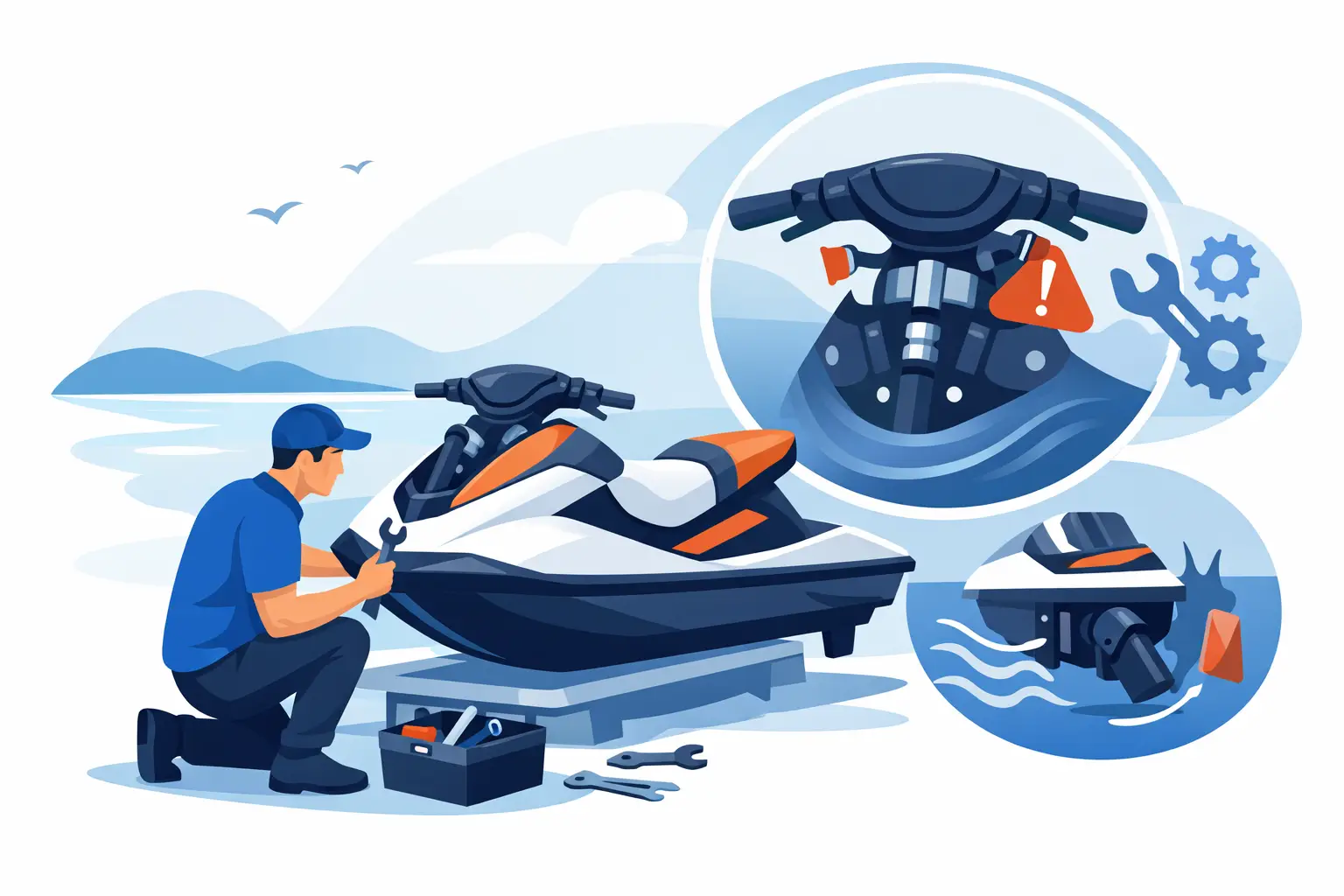
A ski that will not track straight at speed, feels vague through turns, or suddenly develops heavy steering is not a minor annoyance. PWC steering issues can quickly become a rider-safety problem, especially on supercharged, modified or race-oriented machines that load the hull and pump harder than a stock recreational ski.
The key is to separate a genuine steering fault from a handling complaint. A stiff handlebar, excess free play or a nozzle that responds late points to a mechanical problem. A ski that steers normally but skips, porpoises or pushes wide through a corner may instead have a hull, pump, setup or ride-style issue. The repair approach is different, and guessing can waste time and parts.
PWC steering issues: start with the feel at the bars
Before pulling panels or ordering components, take notice of exactly what the ski is doing. The details matter. Is the steering heavy only after the ski has sat in salt water? Does it have a dead spot around centre? Does the handlebar move normally while the nozzle barely moves? Has the issue appeared after a collision, trailer incident, fibreglass repair or performance upgrade?
A healthy PWC steering system should feel positive and consistent from lock to lock. There should be no binding, grinding, excessive play or change in effort through the steering range. With the engine off and the ski securely supported, turning the handlebars should move the steering nozzle immediately and smoothly.
If the steering is stiff, do not assume a quick spray of lubricant will fix it. Many modern steering cables are sealed assemblies, and forcing unsuitable lubricant into them can trap contamination or mask a cable that is already failing internally. A cable that has started to corrode or fray needs proper assessment, not a temporary workaround.
The most common causes of poor PWC steering
Corroded or damaged steering cable
Salt, moisture and age are hard on steering cables. Internal corrosion can make the cable feel heavy, notchy or increasingly difficult to move. Damage is often worse near tight bends, cable ends and areas where the outer sheath has split or rubbed through.
A cable can also become stiff after a ski has been stored for a long period. This is common on machines that look tidy externally but have missed regular flushing, cleaning and inspection. If the cable will not move freely once disconnected from the steering nozzle or handlebar linkage, replacement is usually the reliable repair.
Loose linkage, worn joints or missing hardware
Free play at the handlebars is commonly caused by wear in the steering linkage rather than the cable itself. Check the handlebar pivot, steering shaft, cable ends, nozzle arm and connecting hardware. A loose fastener, worn ball joint or damaged retaining clip can make the ski feel delayed or unpredictable when turning.
This deserves immediate attention. Even if the nozzle still moves, movement lost through worn components reduces precision. On a high-performance Sea-Doo, Yamaha or Kawasaki, that vague response becomes far more noticeable when the water is rough or the ski is accelerating hard out of a turn.
Bent steering nozzle or pump-area damage
A hard impact with a ramp, trailer, submerged object or another ski can bend the nozzle, damage the steering arm or crack the surrounding pump hardware. Sometimes the damage is obvious. Other times, the nozzle looks close enough until it is compared against its full left and right travel.
A bent nozzle may cause restricted movement, uneven steering lock or a ski that pulls to one side. Damage around the jet pump can also alter how the ski responds under power. This is why impact repairs need more than a visual check of the hull.
Handlebar or steering-column faults
If the handlebars feel loose, knock over bumps or sit off-centre while the nozzle is straight, inspect the upper steering assembly. Depending on the model, the issue may involve the handlebar clamp, steering shaft, bushings, pivot hardware or an internal linkage.
Do not overlook the simple checks. A handlebar that has shifted after a crash or aggressive riding session can feel like a serious steering fault, but it may only need correct alignment and torqueing. The opposite is also true: repeatedly tightening a loose assembly without finding the worn part can lead to further damage.
Handling changes mistaken for steering failure
Not every complaint is a failed steering component. A damaged ride plate, bent intake grate, worn sponson, poor pump condition or incorrect hull setup can make a ski push through turns or feel unsettled. So can a poorly matched performance package.
More boost, sharper ECU tuning and stronger acceleration expose weaknesses that were barely noticeable at stock power. If a ski has recently received engine work, pump upgrades or handling hardware, the steering system and the full hull setup should be inspected as one package. Power is only useful when the ski remains predictable and controllable.
A proper inspection before repairs
Start with the ski out of the water, engine off and securely positioned. Turn the handlebars through their full range while watching the nozzle. Look for a delayed response, limited movement, rubbing, cable stretch or a nozzle that does not reach equal travel in both directions.
Next, inspect the steering cable route. Look for crushed sections, split outer casing, corrosion around cable ends and contact with sharp edges or hot components. Check every visible fastener and retaining point at the handlebar end and pump end. If there is play, identify where it begins rather than tightening everything blindly.
Then isolate the system if required. A technician can disconnect the relevant linkage points to determine whether resistance comes from the cable, handlebar assembly or nozzle pivot. This step saves money because it prevents replacement of a good cable when the actual problem is a seized nozzle pivot or damaged steering arm.
Finally, inspect the hull and jet pump area for evidence of impact. Cracks, stress marks, distorted brackets and damaged pump components all matter. If the ski has been in an accident, has struck something at speed or is part of an insurance claim, a detailed inspection report is the sensible next move.
Repair choices that protect reliability
Minor alignment issues, correctly identified loose hardware and replaceable bushings can often be repaired efficiently. A corroded steering cable, bent nozzle or cracked pump-area component is different. These parts need replacement or professional repair so the ski returns to a known, dependable condition.
Use quality components suited to the exact make, model and year. PWC steering systems are not an area for improvised fittings, generic cable substitutions or hardware of unknown grade. Correct fitment, correct cable routing and secure fastening are essential.
After any steering repair, verify full and equal nozzle travel, handlebar alignment and secure operation before the ski goes back on the water. A controlled test ride should begin at low speed, then progress only after the steering response is confirmed. This is particularly important after fibreglass work, pump removal or performance upgrades that have changed the ski’s balance and load characteristics.
For Central Coast riders, a specialist workshop inspection is worthwhile when the fault is intermittent, the ski has collision damage, or the machine is a modified performance build. VTECHTUNED can diagnose steering, pump and handling concerns alongside the mechanical condition of the whole ski, rather than treating one symptom in isolation.
When to stop riding immediately
Do not ride the ski if the handlebars bind, the nozzle does not move in direct response to input, the steering cable is visibly damaged, or there is major play in the linkage. The same applies if the ski pulls sharply, has suffered a hard impact or feels unstable at speed after a repair.
A rider can sometimes compensate for a minor handling quirk. They cannot safely compensate for steering that may jam, disconnect or respond late. The risk increases in chop, around other vessels and when throttle is applied hard.
Preventing future steering faults
Regular servicing is the best defence. After salt-water use, flush the cooling system as specified for the model, wash the ski thoroughly and pay attention to the pump and steering-nozzle area. Avoid directing high-pressure water into seals, cable ends and sensitive pivot points.
During routine maintenance, inspect the visible steering hardware for corrosion, movement and damage. If the ski lives near the coast, is launched often from ramps, or sees regular rough-water riding, inspect it more frequently. Small signs of corrosion or free play are much easier to deal with before they become a seized cable or damaged nozzle assembly.
A fast PWC should feel planted, direct and predictable every time you squeeze the throttle. If yours feels anything less than precise, get the steering system checked before the next hard ride.



