
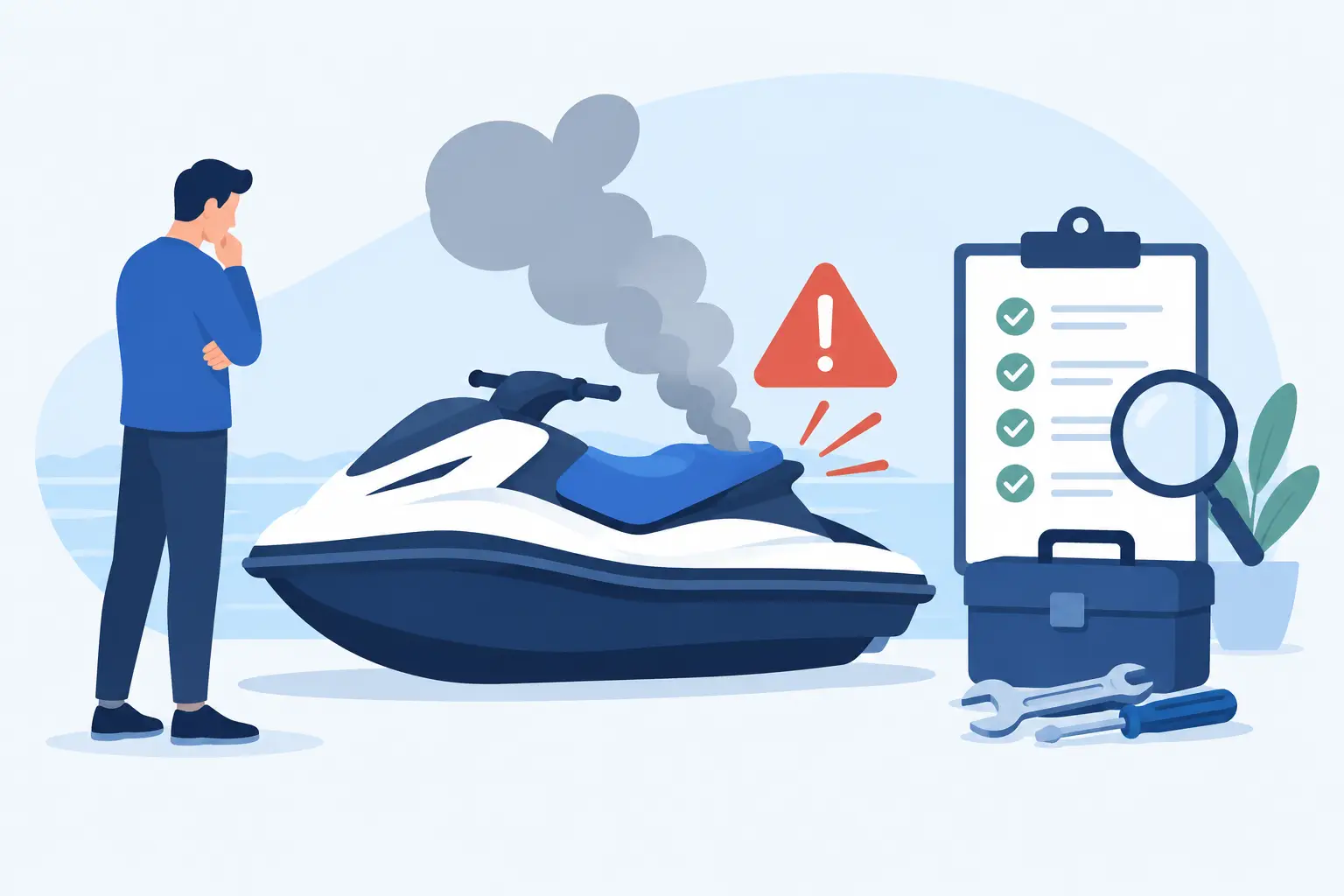
A sharp bang through the intake, a pop in the exhaust, or a ski that coughs and refuses to clear its throat is not a normal performance feature. If you are asking, why does PWC backfire, the short answer is that combustion is happening in the wrong place or at the wrong time. The longer answer matters, because the cause may be as simple as a worn spark plug or as serious as a lean condition, incorrect cam timing or water ingestion.
On a modern Sea-Doo, Yamaha or Kawasaki four-stroke, a backfire should be treated as a fault to diagnose, not a noise to ride through. Continuing to ride can turn a relatively small ignition or fuelling issue into damaged valves, melted pistons, a failed supercharger setup or an expensive engine rebuild.
What “backfire” actually means on a PWC
Riders often use backfire to describe any bang, crackle or cough. The sound and when it occurs give useful clues. A true backfire is combustion travelling back through the intake tract. It can pop the intake, damage a flame arrestor or airbox, and may be accompanied by a kickback during cranking.
An afterfire happens in the exhaust system. Unburnt fuel enters the hot exhaust and ignites, creating a bang or repeated popping. It is commonly noticed on deceleration, after lifting off the throttle, or when restarting a hot engine.
The distinction is useful, but neither noise should be ignored. Your PWC needs the correct mixture, a reliable spark, accurate mechanical timing and adequate compression. Take one of those away and combustion becomes unpredictable.
Why does PWC backfire under load, on start-up or off throttle?
The operating moment narrows the diagnostic path. A ski that backfires only while cranking is different from one that breaks down at wide-open throttle. Note whether the engine is cold or hot, whether the fault began after a service or modification, and whether the machine has recently been submerged, stored for months or run on questionable fuel.
Spark and ignition faults
A weak, intermittent or incorrectly timed spark is one of the most common causes. A fouled plug may fire inconsistently, allowing fuel to pass into the exhaust before it ignites. A failing coil can do much the same under cylinder pressure, even if the engine appears acceptable at idle.
Plugs that are old, incorrectly gapped, wrong for the application, oil-fouled or water-contaminated deserve immediate attention. High-performance and supercharged engines are particularly demanding on plugs and coils. A component that survives casual cruising can fail once boost, heat and cylinder pressure rise.
Electrical connections also matter in a marine environment. Corrosion in coil connectors, poor grounds, damaged wiring and low battery voltage can produce erratic spark and difficult starting. Do not assume a battery is healthy because the starter still turns. Cranking voltage can drop far enough to upset ECU operation and ignition performance.
Lean fuelling and air leaks
A lean engine runs hot, can hesitate or surge, and may backfire through the intake. The mixture can go lean because of restricted fuel delivery, contaminated fuel, an injector issue, a blocked filter, a weak fuel pump or an air leak after the airflow measurement point.
On modified machines, the calibration is just as important as the hardware. A larger intercooler, intake, injector set, supercharger wheel or exhaust component changes airflow and fuelling requirements. Bolting on parts without matching ECU tuning can create a dangerous air-fuel ratio, especially at high rpm.
Air leaks are not always obvious. Split hoses, loose clamps, intake manifold gasket leaks and disturbed fittings after workshop work can all introduce unmetered air. If a backfire appeared immediately after an intake or intercooler installation, inspect the complete system before repeatedly trying to start the engine.
Excess fuel and incomplete combustion
Too much fuel can also cause exhaust afterfire. The engine may load up, run roughly, smell strongly of petrol and emit dark or sooty deposits. Leaking injectors, a failed sensor, incorrect calibration, restricted airflow and repeated unsuccessful starting attempts can leave excess fuel in the cylinders and exhaust.
Flooding is especially relevant after a machine has been tipped, ingested water, or had a starting issue. Do not keep cranking a flooded PWC until the battery is flat. Fuel dilution can reduce oil protection, while water contamination can cause far more severe internal damage.
Timing, compression and mechanical faults
If ignition and fuelling basics check out, the investigation needs to go deeper. A slipped timing chain, damaged camshaft components, incorrect valve timing after an engine build, or a failed crank or cam position sensor can cause a violent backfire and no-start condition.
Low compression is another possibility. Burnt valves, valve-seat problems, ring damage, piston damage or head-gasket faults prevent the cylinder from containing the combustion event properly. These faults may bring hard starting, uneven idle, excessive crankcase pressure, loss of power or an engine that backfires under throttle.
This is not an area for guesswork. Compression and leak-down testing, scan-tool data, timing verification and inspection by a PWC specialist provide answers without throwing unnecessary parts at the ski.
Exhaust leaks, water issues and normal decel pops
A minor pop on overrun is not always a major failure. Some performance exhaust configurations and aggressive ECU calibrations can produce occasional exhaust crackle when the throttle closes. That said, a loud bang, repeated popping, flames, power loss or a new symptom is not something to call normal simply because the ski is modified.
Exhaust leaks can draw oxygen into the exhaust, allowing unburnt fuel to ignite. Check clamps, joints, hoses and components that have recently been removed or replaced. Marine exhaust systems also rely on correct water flow. Overheating, blocked cooling passages, damaged hoses or water entering where it should not can create faults that quickly become costly.
If there is any chance the engine has ingested water, stop trying to start it. Water does not compress. Attempting to crank a water-filled cylinder can bend a connecting rod or damage the engine beyond a straightforward repair. Get the ski assessed before further cranking.
A sensible diagnostic process before parts are replaced
The fastest repair is rarely achieved by replacing plugs, coils, injectors and sensors at random. Start with a clear fault history and a visual inspection. Look for loose intake piping, damaged wiring, water in connectors, fuel leaks, unusual hose routing and evidence of recent work.
Next, scan for fault codes and live data where the platform allows it. Check battery condition, spark plugs and coil operation, then verify fuel quality and fuel pressure. Old fuel is a regular troublemaker in skis that sit between rides, particularly after seasonal storage.
For a persistent issue, the workshop should test compression and leak-down, inspect ignition timing signals, confirm injector behaviour and check mechanical cam timing where required. On a modified PWC, the ECU calibration and every supporting component must be assessed as one package. A tune that was right before an upgrade may no longer be safe after it.
Avoid extended driveway testing. A PWC cooling system and exhaust setup are designed around proper water supply, and incorrect flushing procedures can cause damage. Follow the manufacturer procedure for your model, keep run time short, and never use land testing as a substitute for a controlled on-water diagnosis.
When to stop riding immediately
Park the ski and arrange inspection if the backfire is accompanied by a check-engine warning, hard starting, fuel smell, overheating, misfire, loss of power, intake popping or any suspicion of water ingestion. The same applies when the issue occurs at boost or wide-open throttle. High cylinder pressure leaves little margin for a lean mixture or weak spark.
For Central Coast riders, VTECHTUNED can diagnose the complete system rather than treating the symptom alone – from standard service faults through to ECU-calibrated performance combinations, engine builds and race-focused setups.
A PWC that starts cleanly, pulls hard and shuts down without bangs is not luck. It is the result of correct fuel, spark, mechanical condition and calibration working together. Record exactly when the noise happens, resist the urge to keep riding through it, and get a proper diagnosis before a small fault turns into a major build.



