
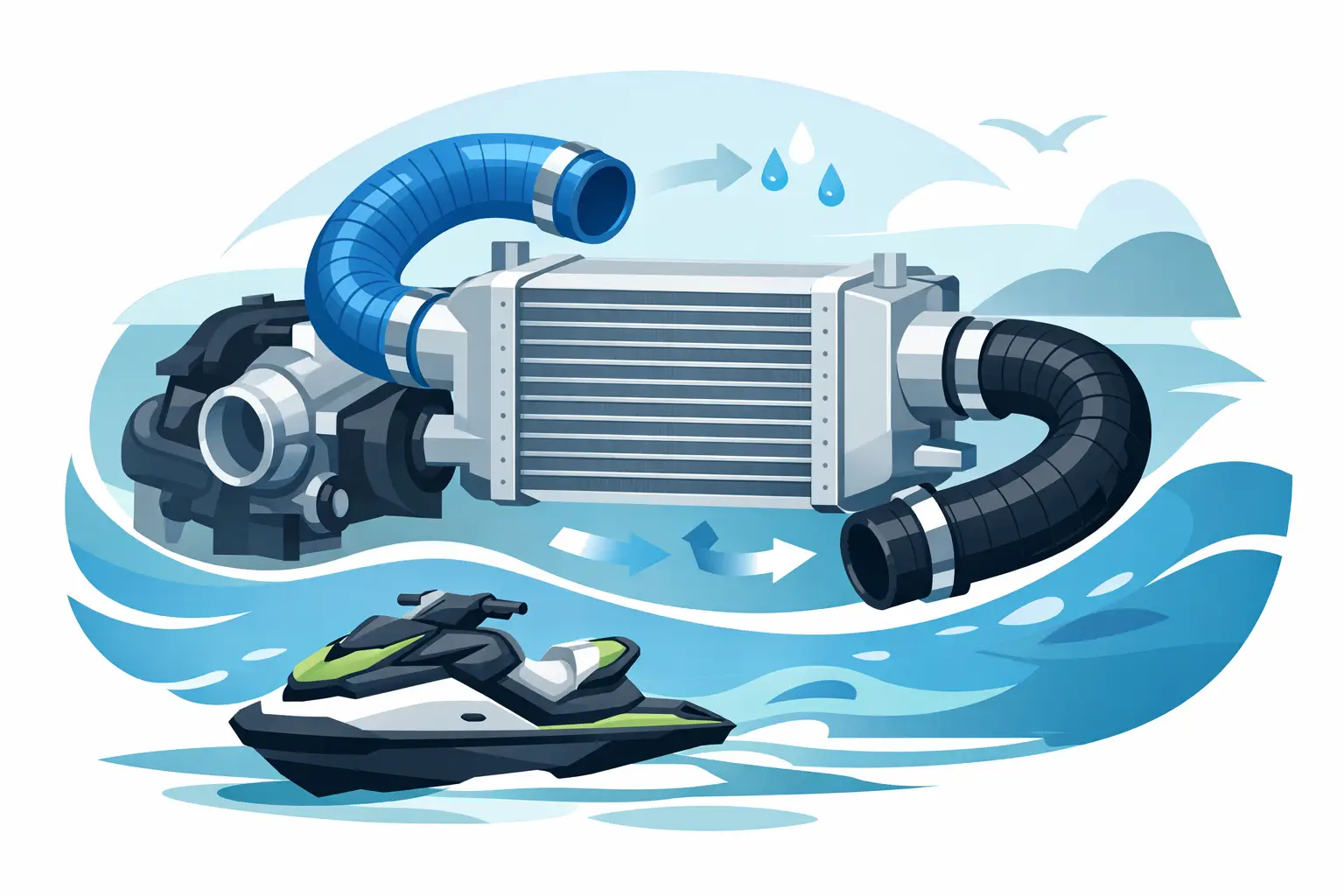
A 325-powered Sea-Doo can make serious cylinder pressure quickly, which means the plumbing between the supercharger, intercooler and intake is no longer a minor detail. Fizzle Sea-Doo 325 intercooler hoses are intended for owners who want a purpose-built hose solution for this high-output platform, particularly where boost, heat and hard riding expose the limits of factory-style connections.
On a standard recreational ski, a hose issue may first appear as a small loss in throttle response. On a tuned 325, it can become a boost leak, inconsistent power delivery, fault codes, limp-mode behaviour or a ride that simply does not pull the way it should. Good intercooler hoses are about holding pressure, managing heat and keeping the charge-air system stable when the engine is working hard.
Why intercooler hoses matter on a Sea-Doo 325
The intercooler system cools compressed intake air before it enters the engine. Cooler, denser air supports consistent combustion and gives the ECU a more predictable environment to work with. The hoses connecting this system must cope with boost pressure, heat cycles, vibration, water exposure and movement within a compact engine bay.
As boost rises, any weakness at a hose, joiner or clamp becomes more noticeable. A hose can soften, swell, split or gradually work its way off a pipe. Even without an obvious tear, a poor seal can bleed boost under load. The ski may idle normally and feel acceptable on a short test run, then fall flat during a sustained wide-open pass.
This is why an intercooler hose upgrade is often sensible alongside ECU tuning, supercharger changes, intercooler upgrades or other airflow modifications. It supports the system around the performance parts rather than asking ageing or marginal plumbing to do a bigger job than it was designed for.
What Fizzle Sea-Doo 325 intercooler hoses are designed to address
Fizzle is well known in the Sea-Doo performance space for components aimed at genuine forced-induction use, not cosmetic engine-bay changes. A dedicated hose kit is designed around the routing, connection points and operating demands of the relevant 325 application.
The key benefit is controlled fitment. Correctly formed hoses reduce unnecessary stress at bends and help the hose sit naturally on its mating pipe. That matters because a hose forced into position can twist as the engine moves, concentrate load at the clamp edge or slowly pull away from the sealing surface.
Material quality also matters. Performance-grade silicone hose construction is commonly chosen for its resistance to repeated heat cycling and pressure, but a quality hose alone does not guarantee a reliable result. The condition of the intercooler fittings, clamp selection, hose routing and installation procedure all determine whether the system stays sealed.
For a stock 325 used for normal cruising, replacement hoses are not automatically a mandatory first modification. If the original components are in excellent condition and the ski is unmodified, there may be higher-priority service work to address. For tuned skis, race builds, high-hour machines or owners chasing dependable hard-running performance, upgraded hoses are a far more practical investment.
Fitment is more than matching a model name
Before ordering or fitting intercooler hoses, confirm the exact Sea-Doo model, year, engine configuration and current intercooler arrangement. A ski may have factory plumbing, an aftermarket intercooler, custom pipework or previous workshop modifications. Those details can affect hose diameter, length, bend angle and the style of clamp required.
This is particularly relevant when a ski has been modified by more than one owner or workshop. It is common to find a mix of factory and aftermarket parts, altered hose routing or clamps that have been overtightened in an attempt to solve an earlier leak. The right solution starts with identifying what is actually on the ski, rather than assuming every 325 has the same layout.
Check the mating surfaces as carefully as the hose itself. A corroded, scratched or oil-coated pipe bead can compromise a new hose. Likewise, a cracked intercooler outlet, loose joiner or distorted clamp will not be fixed by installing premium silicone plumbing over the top of it.
Installation checks that prevent boost leaks
Intercooler hose installation is straightforward in principle, but details matter. The engine should be cool, the hose connections should be clean and each hose should sit fully over the retaining bead before final clamp tension is applied.
Avoid using oil or greasy lubricants to force a hose onto a fitting. They can make installation easier in the moment but may encourage the hose to slip under pressure. If a small amount of assembly lubricant is needed, use a product appropriate for the application and keep it away from the sealing area wherever possible.
Once installed, inspect these four areas before the ski goes back on the water:
- Confirm every hose is fully seated past the pipe bead, with no rolled or pinched edge.
- Position clamps behind the bead rather than directly on it or at the very end of the hose.
- Check clearance to sharp brackets, hot components and moving parts that could rub through the hose over time.
- Inspect adjacent connections, including intercooler fittings and intake plumbing, because a leak elsewhere can mimic a hose problem.
Clamp tension deserves common sense. Too loose and the connection can lift under boost. Too tight and the clamp can cut into the hose or distort the fitting. Tighten evenly, then recheck after the first heat cycle and again after a proper ride. A system that remains dry, clean and correctly aligned is much easier to monitor than one covered in residue and squeezed into a poor routing path.
Signs your intercooler plumbing needs attention
A boost leak is not always dramatic. Owners often notice a change in feel before they find visible damage. The ski may feel lazy through the mid-range, surge at full throttle or lose top-end speed compared with previous rides. On a tuned engine, inconsistent boost can also make calibration results less repeatable.
Physical inspection can reveal swelling, surface cracking, soft sections, abrasion marks, oily residue around a joint or a hose that has crept away from its original position. A hose that repeatedly pushes off is a warning to inspect the full connection – not just tighten the clamp harder. Look for excessive boost, poor clamp placement, an unsuitable hose size, missing beads or contamination on the fitting.
Pressure testing is the professional way to locate a suspected leak. It identifies issues that are hard to spot by eye and saves replacing parts based on guesswork. For modified Sea-Doos, this should be part of a broader diagnostic approach that also considers intake condition, supercharger health, ECU calibration and engine data.
When an upgrade makes the most sense
The strongest case for Fizzle Sea-Doo 325 intercooler hoses is a ski that is already making more power or is about to. ECU tuning and airflow upgrades increase the demand placed on every part of the charge-air tract. Installing hoses during related work also reduces duplicated labour, since access is often easiest when the intercooler or intake system is already apart.
They also make sense during preventative maintenance on a high-hour ski, especially if the original hoses show ageing, have been removed repeatedly or operate in hot conditions. Saltwater riders should be particularly thorough with inspections. Salt does not only affect metal fittings – it can hide underneath connections, accelerate corrosion and make future servicing more difficult.
For owners who want the cheapest possible fix, a generic hose may appear tempting. The trade-off is usually fitment certainty. A universal straight or elbow hose may not follow the correct path, may place load on a fitting and can create clearance problems once the engine bay is closed. On a high-performance PWC, purpose-built parts and careful installation are cheaper than chasing an intermittent boost leak after a weekend on the water.
Build the system, not just the power
Intercooler hoses will not create horsepower on their own. What they can do is protect the consistency of the power your 325 already makes. That is valuable on any modified Sea-Doo, where strong acceleration depends on the entire system holding together under load.
At VTECHTUNED, we see the best results when supporting components are chosen with the same care as the headline upgrades. If your 325 is being tuned, serviced or prepared for harder riding, inspect the charge-air plumbing while the ski is apart. A clean, properly sealed intercooler system gives the engine the stable airflow it needs to perform properly, ride after ride.



