
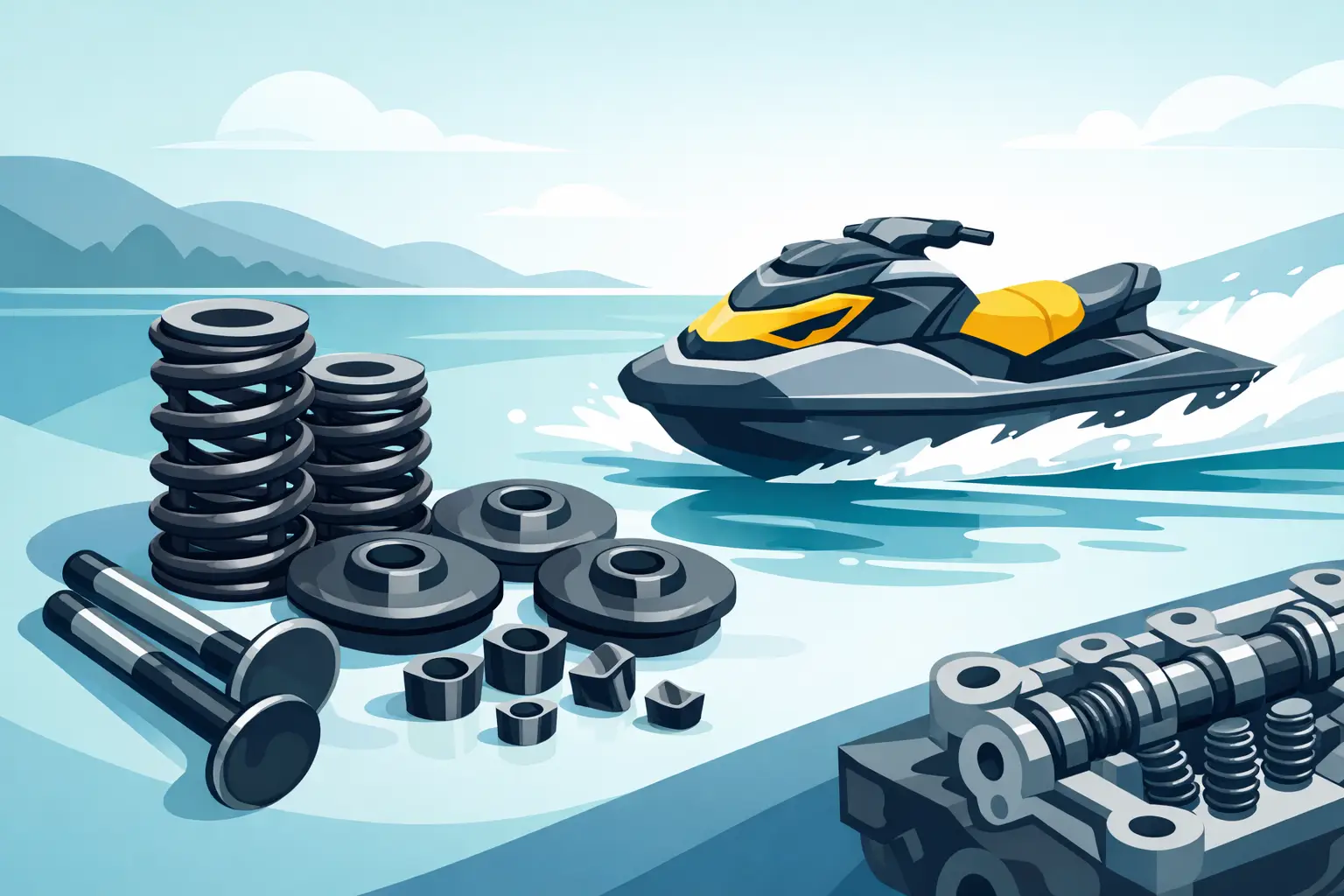
A Sea-Doo that pulls hard through the mid-range but starts falling away near the top of the rev range is not always short on boost, fuel or tune. In a serious engine build, the VJP springs retainer kit Sea-Doo owners consider can be the component that keeps the valvetrain stable when cylinder pressure, camshaft lift and rpm rise together. It is small hardware with a major job: controlling the valves accurately so the engine can make repeatable power without pushing its limits blindly.
For standard recreational use, factory valvetrain components are designed around factory cam profiles, intended rpm and conservative service life. Once the combination moves into ECU tuning, larger supercharger setups, upgraded cams, higher boost or race use, that original margin can disappear quickly. A spring and retainer upgrade is not a headline-grabbing modification like a blower or intercooler, but it is often what makes the rest of the package reliable.
What a VJP springs retainer kit does in a Sea-Doo build
Valve springs close the intake and exhaust valves after the camshaft opens them. Retainers lock the spring assembly to the valve through the retainers and locks, keeping every component located correctly as the engine cycles at speed. At high rpm, the spring must close the valve fast enough to follow the camshaft profile while managing the force created by moving valvetrain mass.
When spring control is insufficient, valve float can occur. The valve no longer follows the cam lobe as intended, which can reduce power, create unstable running and, in a severe case, lead to contact between the valve and piston. On a boosted Rotax engine, where combustion pressure and cylinder temperatures are already demanding, that is not a risk worth treating as an afterthought.
A VJP spring and retainer package is generally considered when a build needs valvetrain control beyond the factory design window. The exact reason varies. A rider may be fitting an aftermarket camshaft, raising the rev limit under a properly developed ECU calibration, or building an engine intended to hold power through sustained high-speed riding. The key is that springs and retainers support the complete combination. They are not a bolt-on cure for a poor tune, worn head or unsuitable camshaft.
When the VJP springs retainer kit for Sea-Doo makes sense
The right time to upgrade is determined by the engine specification, not by a single power figure. A well-maintained, stock Sea-Doo used for family riding does not automatically need an aftermarket valvetrain kit. Spending money where it is not required can add cost without delivering a meaningful result.
The case becomes stronger when the cylinder head is apart for a performance build or repair and the ski has supporting modifications. Higher-lift or more aggressive camshafts increase the demand on spring control. A raised rev limiter can expose a factory spring to speeds it was not intended to manage. More boost and a more efficient intake or exhaust combination can also encourage owners to chase rpm when the engine needs a properly matched valvetrain first.
For race builds and high-output jet boats, the decision is often straightforward. Those engines experience repeated full-load operation, not occasional short bursts. A matched spring and retainer package provides greater confidence that the head is prepared for the duty cycle. That confidence matters when an engine has forged internals, port work, upgraded fuelling and hours of labour invested in it.
There is a trade-off. More spring pressure is not automatically better. Excessive pressure can add load to cam lobes, buckets and related components, increasing wear and friction. The goal is sufficient seat pressure and open pressure for the camshaft and intended rpm, with correct installed height and coil-bind clearance. This is why choosing parts from a catalogue without checking the full build specification is a gamble.
Fitment is more than the Sea-Doo model name
Sea-Doo fitment needs to be checked at engine level. The model badge on the hull is a starting point, but it does not tell the full story. Rotax engine generation, cylinder head configuration, camshaft choice, previous machine work and the parts already fitted all affect whether a particular kit is suitable.
Before ordering or installing a VJP springs retainer kit, confirm the exact engine application and the manufacturer’s specifications. Check whether the kit is designed for the standard valve size, whether it is intended for a particular cam profile, and whether it requires any associated parts or machining. If the head has been rebuilt before, do not assume it is still at a standard installed height.
This is particularly important with second-hand skis. It is common to find a modified supercharger, an ECU tune or aftermarket intake hardware on a Sea-Doo with no clear record of internal work. A proper inspection prevents a new valvetrain package being fitted around unknown components or an unsuitable calibration.
Installation checks that protect the engine
A valve spring installation is precision engine work, not a quick service item. The cylinder head needs to be clean, measured and assembled with the right tools. The spring’s installed height must be checked, along with seat pressure, open pressure and clearance to coil bind at full valve lift. Retainer-to-seal clearance and valve-to-piston clearance may also need checking, particularly with a performance camshaft or machined head.
The valves, guides, seats and stem seals deserve attention at the same time. A new spring kit cannot compensate for worn valve guides, damaged valves or poor seat sealing. If the head is already off, this is the point to establish a known baseline rather than rushing the assembly to get back on the water.
After assembly, valve clearances must be measured and adjusted where the engine design requires it. The ECU calibration should then match the completed combination. A higher rpm limit should only be used where the valvetrain, fuelling, boost control and cooling system all support it. Raising the limiter because the engine has upgraded springs alone is poor build strategy.
At VTECHTUNED, this type of upgrade is best approached as part of an engine plan. The workshop can assess the intended use of the ski, the existing modifications and the required supporting work before the head goes back together. That is a better path than fitting a premium part and hoping the rest of the package keeps up.
Signs the valvetrain needs attention
Valvetrain problems are not always obvious from the seat. A loss of top-end power, a change in mechanical noise, inconsistent compression, difficult starting or unstable running at high rpm can all justify investigation. None of these symptoms proves the springs are at fault, however. Ignition, fuel delivery, boost leaks, supercharger condition and ECU calibration can create similar complaints.
The sensible approach is diagnosis before parts. Compression and leak-down testing, inspection of the engine oil and filter, scan data, boost readings and a review of the current tune help narrow the fault. If the cylinder head needs to come off, measuring the existing valvetrain tells the real story.
For riders building for speed, preventative replacement can still be the right call. If the engine is being rebuilt around cams and boost, fitting matched valvetrain components before a failure is far cheaper than repairing a piston, valve, head and cylinder after one.
Build for the way you ride
A VJP springs retainer kit is valuable because it protects control where a performance Sea-Doo works hardest: at high rpm, under load and with no room for marginal parts. But the best setup depends on whether the ski is a fast weekend machine, a closed-course race build or a jet boat that spends long periods at throttle.
Choose the kit for the engine, camshaft and rpm target, then install and tune it with the same level of care. That is how a Sea-Doo delivers the sharp response and sustained power riders want, while keeping reliability at the centre of the build.



