
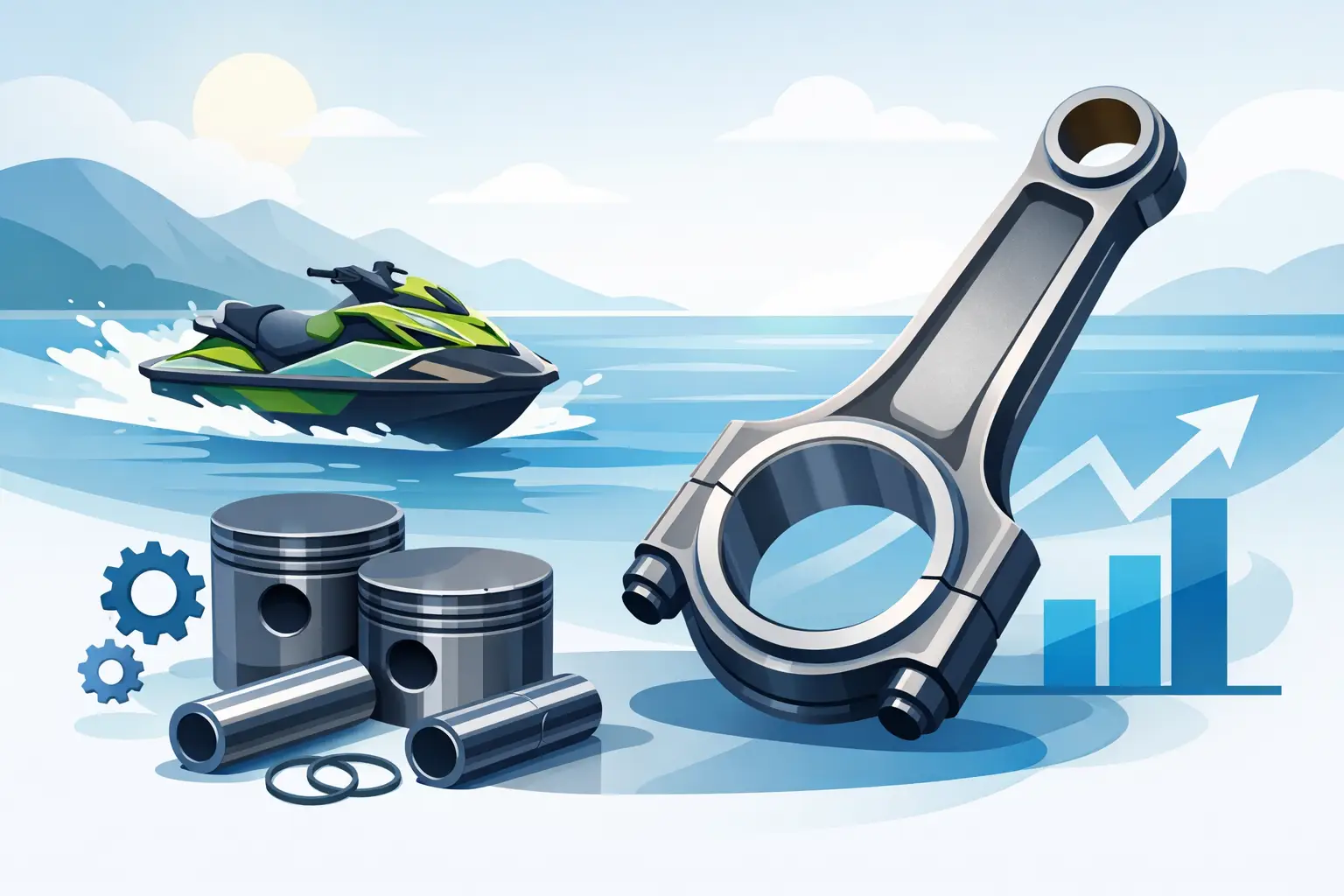
A stock Sea-Doo 300 can feel brutally quick, right up until boost, heat and cylinder pressure move beyond what a factory bottom end was designed to handle. Molnar Sea-Doo 300 1630 rods are a serious upgrade for owners building an engine with a clear performance target, not simply chasing a parts list.
For a recreational ski that receives regular servicing and sensible ECU calibration, forged rods may be unnecessary. For a high-boost supercharged setup, race build, jet boat conversion or an engine already being stripped for repair, they can be one of the most important reliability decisions in the build.
What Molnar Sea-Doo 300 1630 rods are for
The connecting rod carries enormous load on every combustion event. In the 1630 ACE platform, that load rises sharply when boost pressure, ignition timing, rev limit and airflow are increased. The rod must handle compressive force when the cylinder fires, tensile load as the piston changes direction at high rpm, and the ongoing stress of heat cycles in a marine engine.
Molnar connecting rods are selected by builders looking for a stronger forged internal component than an OE-style rod in applications where cylinder pressure is no longer close to stock. They are not a bolt-on horsepower part. Their value is in giving the bottom end a greater safety margin when the rest of the package is built and calibrated to make more power.
That distinction matters. A rod upgrade does not create boost, improve intercooler efficiency or correct a poor tune. What it does is remove a common concern from the equation when the engine is being asked to work harder than standard.
When forged rods make sense in a Sea-Doo 300 build
The right time to fit rods is usually when the engine is already apart. If a motor needs a crankshaft repair, has piston damage, requires a rebuild after water ingestion, or is being converted into a dedicated performance package, upgrading the internals while access is available is often smarter than paying for the labour twice.
They are especially relevant where the plan includes increased supercharger output, aggressive ECU tuning, higher engine speed, aftermarket camshafts or sustained hard riding. A ski used for short bursts on flat water sees a different load profile to a race ski that repeatedly runs at full throttle or a jet boat carrying greater weight for extended periods. The required build specification depends on how the machine is actually used.
There is also a budget consideration. A strong set of rods is an investment, but a forged rod set alone does not make a complete high-power bottom end. If the budget cannot cover the matching machine work, bearings, fasteners, piston selection, fuel system capacity and professional calibration, it is better to set a realistic power goal than fit premium rods into an incomplete package.
Stock power versus built-engine power
For a standard Sea-Doo 300 with factory boost and a conservative tune, preventative maintenance has more immediate value than internal modifications. Fresh oil, correct supercharger servicing, a healthy cooling system, sound wear rings and a proper diagnostic check protect the owner’s investment every time the ski is launched.
Once the goal shifts to substantial gains over stock, the conversation changes. Increased cylinder pressure can expose the weakest part of the combination, and that weak point is not always the rod itself. Detonation, lean fuelling, excessive inlet air temperature, poor oil control and an over-rev event can damage even high-quality hardware. Built-engine reliability comes from treating every part of the system as connected.
The details that must match the rod set
A connecting rod is not an interchangeable item just because it is listed for a 1630 platform. Before assembly, the builder must confirm the exact application, rod length, crank journal size, piston pin size, bearing dimensions and fastener specification. Model year and engine configuration should be checked rather than assumed.
The crankshaft needs close inspection for journal condition, runout and bearing clearances. The bores need measuring, not guessing, and piston-to-wall clearance must suit the piston manufacturer’s requirements and intended use. Ring end gaps, deck height, compression ratio and valve-to-piston clearance all become more critical as the build becomes more aggressive.
Rod bolt procedure also matters. Premium rods rely on correct fastener preparation and tightening method. Depending on the manufacturer’s instructions, that may involve a specified torque value, stretch measurement or both. Reusing questionable fasteners, applying the wrong lubricant or treating critical measurements as a rough guide can undermine the entire engine build.
This is why performance internals belong in a measured, documented assembly process. A clean workbench is not enough. Reliable engines are built with calibrated measuring equipment, correct clearances and a clear understanding of the load the engine will see on the water.
Molnar rods are one part of the reliability package
A well-planned Sea-Doo 300 1630 engine build normally considers the rotating assembly, pistons, bearings, crankshaft condition and oiling system together. It also considers the components outside the block that decide whether the engine survives: supercharger configuration, intercooling, injectors, fuel supply, exhaust flow and ECU calibration.
Fuel quality deserves particular attention for Australian riders. A tune that looks safe on one fuel blend or during a cool test session may not remain safe during a hot summer day, after heat soak, or when fuel quality varies between marinas and service stations. Calibration needs enough margin for real-world conditions, not just a single clean data log.
Cooling is equally important. The 1630 platform lives in a confined marine environment where sustained throttle can build heat quickly. A performance build should be assessed as a complete thermal system. Intake air temperature, coolant condition, intercooler performance and water flow restrictions all deserve attention before more boost is added.
Build for the rider, not the internet
A competitive closed-course rider may accept shorter inspection intervals and a more focused race calibration. An owner who rides offshore, carries passengers or spends full days on the Central Coast wants strong acceleration with a much wider reliability buffer. Neither approach is wrong, but they require different parts choices and different tuning decisions.
The best specification is the one that matches the rider’s use, budget and maintenance habits. There is little value in building for an extreme power figure if the ski will run hot, be serviced inconsistently or operate on fuel that does not support the calibration.
Installation quality decides the result
Fitting rods requires a full engine teardown and careful reassembly. The crankcase must be clean, bearing surfaces protected, oil passages inspected and all critical tolerances recorded. Once the engine is assembled, the job is still not finished. The supercharger needs to be correctly configured, the fuel system verified, the tune matched to the hardware, and the ski checked under load.
A proper post-build process includes conservative initial operation, oil and filter inspection where applicable, data logging and checks for faults, leaks or abnormal temperatures. There is no shortcut around validation. Marine engines are expensive, and performance combinations can reveal a small issue very quickly.
At VTECHTUNED, the goal is not to sell an internal component in isolation. It is to match the hardware, machine work and ECU calibration to a usable performance outcome, then support that build with proper servicing and diagnostics.
Should you upgrade now or wait?
If your Sea-Doo 300 is healthy, near stock and used recreationally, spend first on servicing, diagnostics and the upgrades that suit your actual riding. If the engine is already apart or you are committing to a serious boosted package, Molnar Sea-Doo 300 1630 rods are worth considering as part of a properly engineered bottom end.
The strongest build is rarely the one with the longest modification list. It is the one where every component has a purpose, every clearance is checked, and the calibration respects the conditions your ski will face on the water.



