
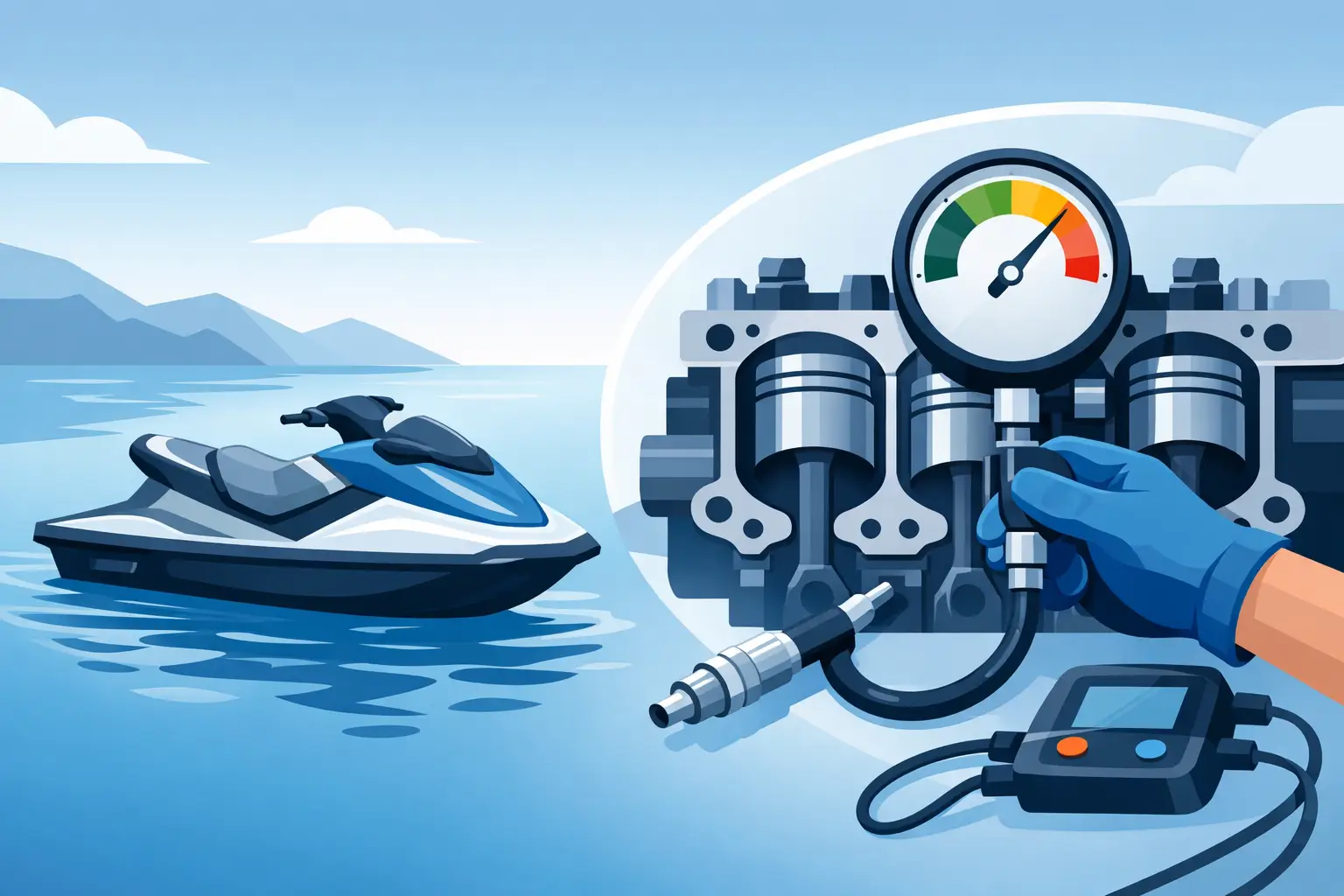
A hard-starting ski, a flat top end or an engine that suddenly feels rough under load is not a problem to guess at. PWC compression testing is one of the fastest ways to check whether the engine can properly seal, build cylinder pressure and make the power it should. For a stock recreational ski or a boosted race build, the result gives your diagnostic process a solid starting point.
Compression numbers alone do not tell the whole story. They need to be read alongside service history, fault codes, cranking speed, plug condition, oil consumption and how the ski performs on the water. Used properly, though, a compression test can identify an engine that needs attention before a small issue becomes a failed piston, damaged valve or expensive rebuild.
What PWC compression testing actually checks
Every four-stroke PWC engine relies on the piston rings, cylinder walls, valves and head gasket to seal the combustion chamber. As the starter turns the engine over, the piston compresses the air in each cylinder. A compression gauge measures the peak pressure generated during those cranking strokes.
Healthy cylinders should produce consistent readings. The exact figure varies by platform, test equipment, altitude, battery condition and engine temperature, which is why chasing a generic number found online can send owners in the wrong direction. What matters most is the manufacturer specification and the difference between cylinders.
A low reading may point to worn rings, a damaged piston, a burnt valve, a valve that is not seating, cylinder damage or a head-gasket issue. Two cylinders that are both low can also suggest a testing issue, slow cranking speed or incorrect cam timing. That is where experienced diagnosis earns its keep.
For performance skis, compression testing matters even more. Higher boost, aggressive ECU calibration, increased rev limits and hard riding all place greater demand on cylinder sealing. A modified supercharged Sea-Doo, Yamaha or Kawasaki may still run well enough to launch off the trailer while carrying an issue that becomes obvious only under sustained load.
When should you test a PWC engine?
Compression testing is sensible whenever there is a meaningful change in the way the ski starts, idles or pulls. It is also a smart baseline check before buying a used PWC, fitting performance parts, undertaking an engine build or finalising a tune.
Warning signs include a noticeable loss of acceleration, difficult hot or cold starts, misfires, uneven idle, excessive crankcase pressure, oil smoke, contaminated plugs or a sudden reduction in top speed. Water ingestion, overheating and a belt or timing-related failure also justify testing before the ski is ridden again.
A pre-purchase test can be particularly valuable, but it should not be treated as a complete inspection. A seller can warm an engine, fit fresh plugs or clear a fault code before viewing. Compression results need to sit alongside a diagnostic scan, visual inspection, service records, pump and driveline checks, and a proper on-water assessment where possible.
How a proper compression test is performed
The basic job sounds simple: remove the spark plugs, fit a gauge and crank the engine. On a modern PWC, the method matters. Incorrect preparation can produce misleading readings or create unnecessary risk around fuel, ignition and electronic systems.
The engine is usually brought to operating temperature first, provided it is safe to do so and the fault does not indicate a serious internal problem. A warm engine gives a more realistic result because the components have expanded to normal running clearances. It is then shut down and allowed to be handled safely.
Fuel delivery and ignition must be disabled so the engine cannot start during cranking. The plugs are removed, the battery is checked for strong charge, and the throttle is held open where the manufacturer procedure requires it. The gauge is fitted to one cylinder at a time, and the engine is cranked for a consistent number of revolutions until the reading stabilises.
Consistency is the key. Each cylinder must be tested under the same conditions with the same gauge. Recording results rather than relying on memory helps identify a pattern. If one cylinder is substantially lower than the others, that is a result worth investigating. If every cylinder reads lower than expected, check test method, battery condition and equipment before assuming the engine is worn out.
Modern electronic throttles and ECU-controlled systems can complicate the process. Some platforms need scan-tool support or a manufacturer-specific procedure to disable injectors and manage throttle position correctly. This is not the place for improvised wiring or repeated cranking with plugs disconnected and no plan.
Avoid dry-running mistakes
A compression test requires cranking, not a prolonged engine run. If the ski needs to be run for warm-up or follow-up checks, use the correct flush connection and follow the platform-specific water procedure. PWC exhaust systems and cooling arrangements are not the same as a car engine on a driveway.
Keep cranking time controlled, especially on a ski with a weak battery. Slow cranking lowers readings and can make a healthy engine look suspect. A quality battery or external support unit protects the starter and gives more reliable data.
Reading compression results without jumping to conclusions
The first question is not simply, “What number did it make?” It is, “How close are the cylinders to each other, and does the reading match this engine’s known condition?” A modest variation may be normal. A clear outlier deserves further testing.
For example, one low cylinder on an otherwise even engine can indicate localised ring, piston or valve trouble. If the low cylinder improves sharply after a small amount of oil is introduced for a controlled wet test, ring sealing may be the likely issue. If it barely changes, the fault may sit around the valves, head gasket or cylinder head.
That said, a wet test is only a clue. Too much oil can skew the number, and it should not replace further inspection. On an engine with direct injection, supercharging or a suspected mechanical failure, the safest next step is often a leak-down test and targeted inspection rather than more guesswork.
Compression test versus leak-down test
Compression testing shows how much pressure a cylinder builds while cranking. A leak-down test shows where it is losing pressure. The engine is positioned at top dead centre on the compression stroke, regulated air is introduced into the cylinder, and the technician listens for the escape path.
Air heard at the intake can indicate an intake valve that is not sealing. Air at the exhaust points towards an exhaust-valve issue. Air from the crankcase breather can suggest ring or piston damage, while bubbles in the cooling system may raise concern about head-gasket or cylinder-head sealing.
Neither test replaces the other. Compression testing is quick and useful for initial fault finding. Leak-down testing takes more setup but offers better direction when results are questionable or an internal engine issue is suspected. On a high-value performance build, using both tests is often the smarter move.
What causes low compression in a PWC?
There is no single answer, because the cause depends on engine design, maintenance history and how the ski has been used. Overheating can distort components or damage a head gasket. Detonation from unsuitable fuel, excessive boost or an incorrect calibration can damage pistons and rings. Saltwater corrosion, poor storage practices and water ingestion can also affect valves, bores and internal surfaces.
Neglected oil changes, blocked cooling passages and extended operation with an active fault are common contributors. So is assuming a modified ski can be serviced like a standard weekend runabout. More power means smaller margins. The correct oil, fresh plugs, cooling-system checks, fuel quality and calibration verification all matter.
A single poor compression result does not automatically mean an engine rebuild. It does mean the ski should not be repeatedly ridden hard until the cause is understood. Continuing to apply boost and load to a cylinder with damaged sealing can turn a repairable problem into a major parts bill.
Get a useful baseline before performance work
Before fitting a supercharger upgrade, camshafts, injectors or a performance tune, confirm the engine underneath is healthy. Power parts cannot fix poor cylinder sealing. In fact, they can expose it quickly.
At VTECHTUNED JETSKI PERFORMANCE, compression testing is best treated as part of a complete diagnostic picture. A careful assessment can include scan data, mechanical inspection and leak-down testing where required, then provide a clear path forward: service the ski, repair the fault, or build an engine that matches the intended power level.
If your PWC has lost its edge or you are planning to push it harder, test first. Good compression does not guarantee every component is perfect, but it gives you the confidence to make the next decision based on evidence rather than hope.



