
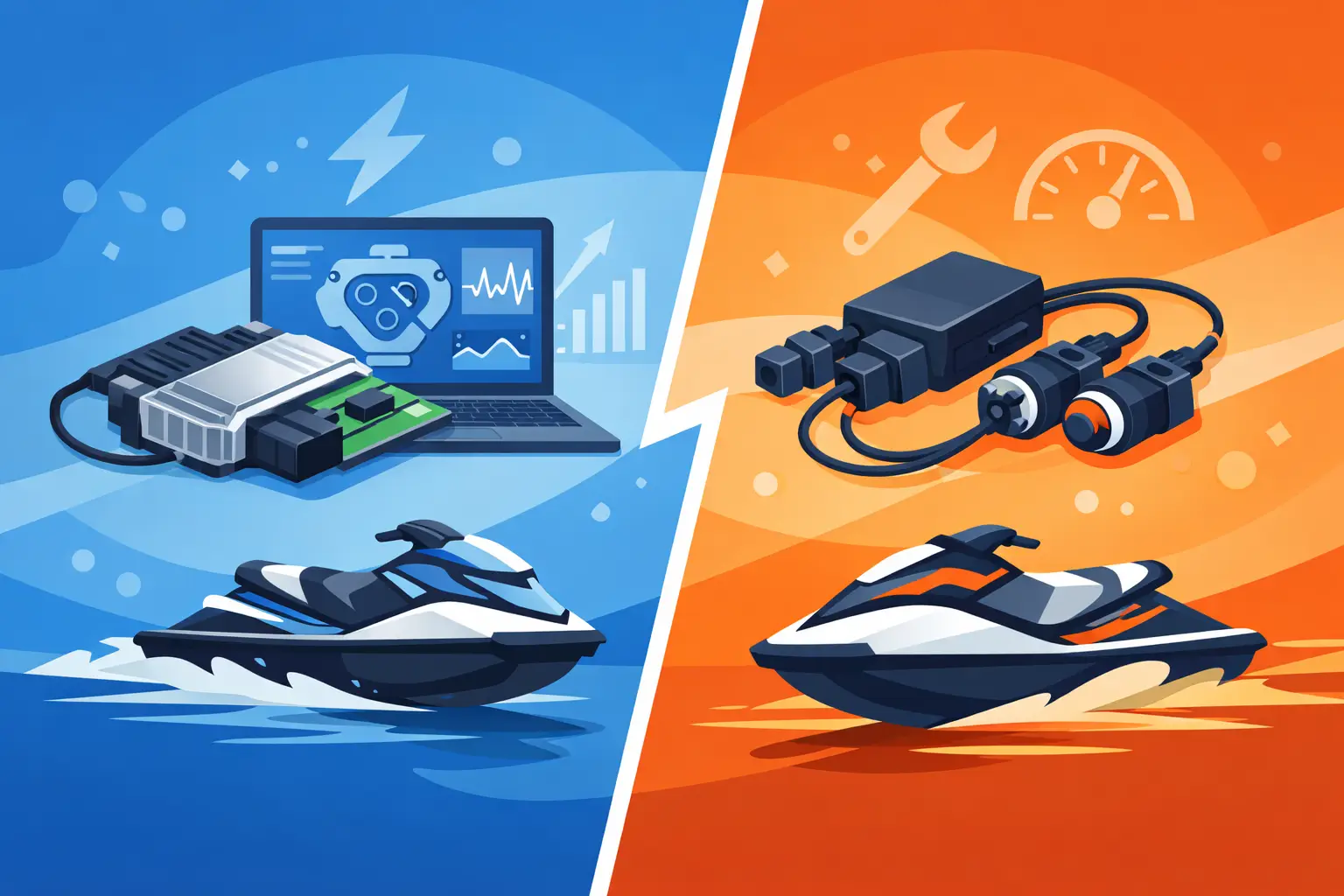
A PWC that feels flat off the throttle, hits a limiter too early or fails to use the hardware bolted to it is not short on potential – it is short on calibration. The PWC ECU flash versus piggyback decision matters because both can alter how a Sea-Doo, Yamaha or Kawasaki performs, but they do it in very different ways. Choosing the wrong path can leave power on the table, create inconsistent running, or make future diagnostics harder than they need to be.
For a stock recreational ski, the best answer may be neither. For a supercharged machine with an intercooler, intake, exhaust or impeller upgrade, tuning is usually the step that turns a collection of parts into a properly matched package. The right choice depends on the model, the modifications, fuel quality, rider goals and how much control is required over the final result.
PWC ECU Flash Versus Piggyback: The Core Difference
An ECU flash changes the programming inside the factory engine control unit. The ECU remains the brain of the ski, but its calibration is revised to suit the machine. Depending on the platform and available tuning solution, this can adjust fuel delivery, ignition timing, boost-related strategies, throttle behaviour, RPM limits, speed limiters, fan control, fault strategies and other factory parameters.
A piggyback is an external module installed between the ECU and selected engine sensors or injectors. Rather than rewriting the factory ECU calibration, it intercepts and modifies signals. For example, it may alter the signal the ECU sees from a pressure sensor or add and remove injector pulse width to change fuelling.
That distinction sounds simple, but it affects every part of the ownership experience. A flash is generally a more integrated calibration solution. A piggyback can be a useful supplementary tuning tool where extra adjustment is needed, where the stock ECU cannot be flashed in the required way, or where a specific race setup benefits from live changes.
Why an ECU Flash Is Often the Cleaner Performance Solution
On many modern PWCs, an ECU flash offers the most complete route for a stage-one or stage-two performance package. It allows the calibration to be built around the ski rather than working around the stock software. If the engine is moving more air through a freer-flowing intake and exhaust, or producing more boost through supercharger changes, the ECU can be recalibrated to command fuel and ignition more appropriately across the rev range.
The benefit is not just peak horsepower. A well-developed flash can improve throttle response, remove unwanted factory restrictions where appropriate, sharpen acceleration and make the ski more predictable under sustained load. That last point matters on the water. A PWC does not operate like a car on a quick road pull. Load changes with water conditions, rider input, pump setup, heat soak and how hard the ski is being ridden.
Factory ECUs also manage far more than fuel. They monitor temperatures, sensor plausibility, safety systems and operating modes. A correctly configured flash can retain and work with those systems rather than simply trying to override signals from outside the ECU.
For owners who want a strong, reliable recreational or performance setup, this cleaner integration is usually the appeal. There is no extra control box to mount, no additional wiring connections exposed to the marine environment, and fewer variables when a technician needs to diagnose an issue later.
That does not mean every flash is equal. A generic file loaded without confirming the ski’s hardware, fuel, engine condition and intended use is not precision tuning. The calibration needs to match the actual build. A stock supercharged Sea-Doo on 98 RON fuel requires a different approach from a built race engine running an upgraded fuel system and aggressive boost.
Where ECU Flashing Has Limits
An ECU flash is limited by the access available for that exact ECU and model year. Some platforms have restricted factory software, while others may need specialised equipment, bench work or an ECU exchange process. Certain advanced race combinations can also exceed the adjustment range that is practical within the original ECU strategy.
Reflashing can affect manufacturer warranty and may not be legal for every waterway, competition class or registration requirement. Riders should understand the rules that apply to their ski and where they operate it. Removing speed or RPM restrictions without addressing the pump, driveline, cooling system and engine package is also a fast way to create expensive problems.
When a Piggyback Makes Sense
Piggyback systems have earned their place in high-performance marine tuning. On the right build, they provide an additional layer of adjustment that can be valuable for a competition ski, a highly modified forced-induction package or a platform with limited ECU access.
Their main strength is flexibility. Some units allow changes to fuelling or boost-related compensation without rewriting the factory ECU. This can be useful when testing mechanical changes, compensating for major injector or airflow differences, or refining a setup that lives well beyond basic bolt-on modifications.
For serious racers, a piggyback may also provide practical tuning access between test sessions. If a ski is being developed around changing boost levels, different impeller loads or race-day conditions, external adjustment can be part of the package. The key word is package. It should be supported by accurate data, suitable fuel delivery, correct spark plugs, healthy compression, appropriate cooling and a pump setup that keeps the engine operating where the tuner expects it to.
A piggyback is not automatically the cheaper shortcut to a proper tune. The unit itself, installation time, wiring quality and dyno or water testing can quickly add up. On a marine engine, every extra connector and wiring join needs to be installed properly and protected from moisture, vibration and heat.
The Trade-Offs With Piggyback Tuning
Because a piggyback modifies signals rather than changing every relevant ECU table, the factory ECU may still make decisions based on values it expects to see. If the tune is poorly configured, this can lead to inconsistent drivability, fault codes, undesirable safety intervention or fuelling that is acceptable in one part of the rev range but not another.
This does not make piggybacks unreliable by definition. It means they require careful selection and professional installation. A race-oriented solution in experienced hands is very different from a universal box fitted to a ski with unknown engine health and no proper validation.
There is also a diagnostic consideration. When a PWC arrives with a running issue, an external tuning device adds another system that must be checked. For a workshop, that is manageable when the installation is tidy, documented and suited to the build. It becomes a headache when wiring has been cut, spliced poorly or hidden under layers of corrosion protection and cable ties.
Match the Tune to the Hardware, Not the Hype
The most common mistake is choosing tuning before defining the build. Start with what the ski has now and what it needs to do. A recreational rider chasing sharper response and safe gains from an intake, exhaust and impeller does not necessarily need the same equipment as a rider building a closed-course race ski.
An ECU flash is commonly the better starting point when the aim is a clean, integrated calibration for sensible bolt-on upgrades. It suits owners who want the ski to start, idle, cruise and pull hard with factory-like manners while using the available performance hardware properly.
A piggyback can be the right call when the project requires more adjustment than the stock ECU can provide, when ECU access is limited, or when a race build needs an external tuning layer as part of a wider engine-management strategy. In some high-end builds, the answer may be both: a flashed ECU for broader factory control and a piggyback for specific supplementary adjustment. That should never be assumed. It needs to be engineered around the platform.
Fuel is part of the equation too. Australian 98 RON pump fuel can support many performance packages, but its quality, storage condition and availability matter. A calibration built for fuel that is not consistently available to the owner is a poor long-term choice. The same applies to riders who launch at different locations, store their ski for extended periods or regularly operate in hot conditions.
What Should Be Checked Before Tuning
Before changing software or fitting a control module, the ski needs a health check. Tuning cannot repair a worn supercharger clutch, weak fuel pressure, contaminated intercooler, failing sensor, damaged pump or tired engine. More power will usually expose the weak point faster.
A proper assessment considers service history, compression or leak-down results where relevant, fault codes, fuel system condition, charging voltage, cooling performance and the condition of the jet pump and driveline. On supercharged models, boost hardware and intercooler condition deserve close attention. There is little value in commanding more power if the engine is ingesting hot air or the pump is cavitating under load.
This is where a specialist workshop adds real value. VTECHTUNED can assess the complete combination – engine, fuel system, electronics and pump – rather than treating tuning as a file upload or a box sale. The goal is measurable performance that remains reliable enough for how the ski will actually be used.
Make the Decision With a Clear End Goal
If your ski is a well-maintained recreational machine with planned bolt-ons, an ECU flash will often deliver the most complete and tidy result. If it is a serious race project with heavily modified airflow, fuelling and boost requirements, a piggyback may have a genuine role. Neither option is automatically better in isolation.
The smartest upgrade is the one that suits the exact ski, the fuel in its tank and the rider holding the bars. Get the mechanical foundation right first, then choose the calibration strategy that lets the package make power with control, consistency and confidence on the water.



