
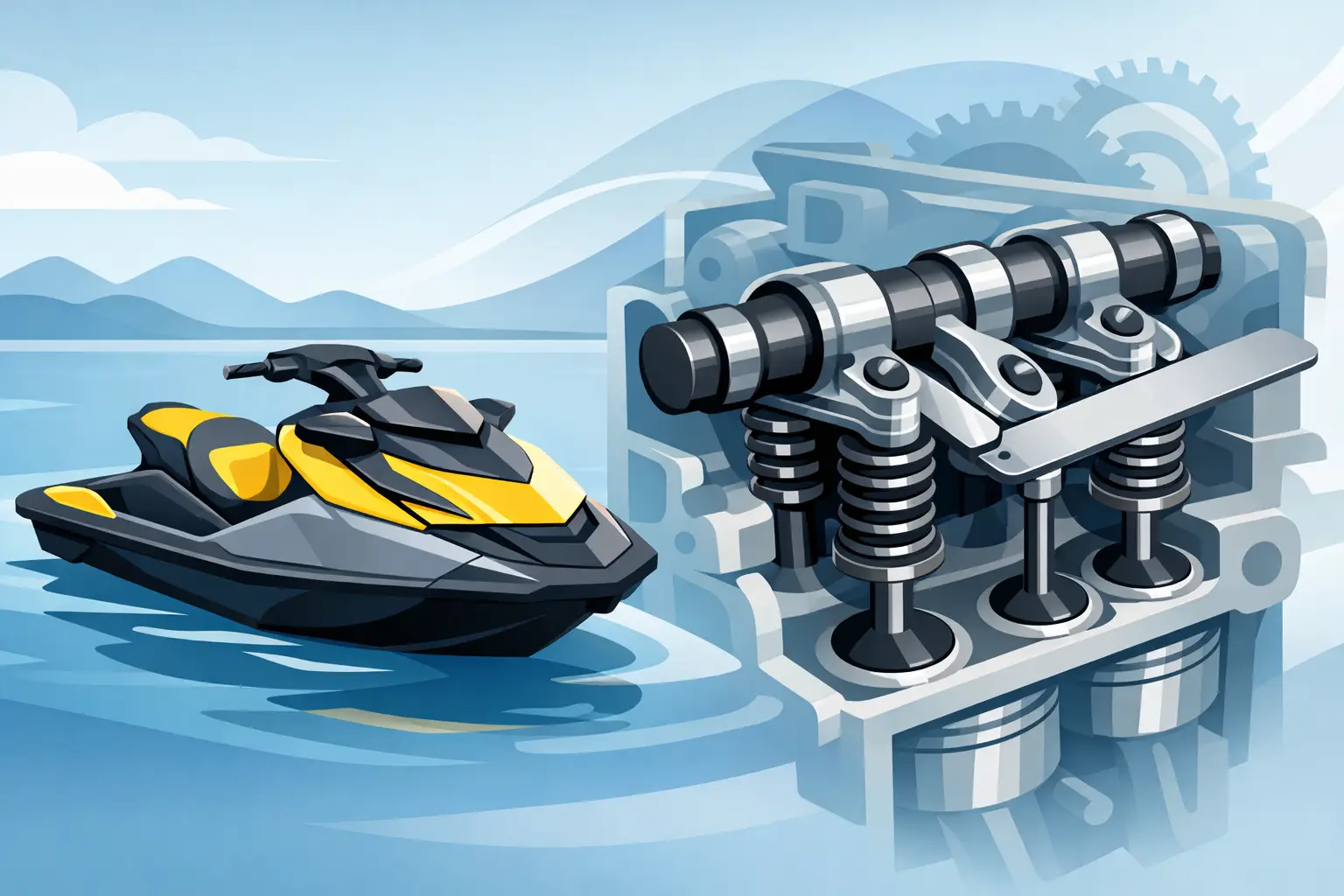
A Sea-Doo 1630 valve clearance guide matters most before a small valvetrain issue becomes a costly cylinder-head or engine-build job. The 1630 ACE platform is capable of serious power, especially in supercharged RXT-X, RXP-X, GTX and FishPro applications, but it rewards accurate servicing. Valve clearances that are too tight or too loose can affect starting, idle quality, cylinder sealing, camshaft life and reliability under sustained load.
For a standard recreational ski, valve clearance is not a casual maintenance item to chase at every service. For a tuned machine, a ski with increased boost, aggressive camshafts, high operating hours or an unknown history, it deserves far more attention. The right approach is measured diagnosis, correct specifications for the exact model, and clean, methodical assembly.
What valve clearance does on a Sea-Doo 1630
Valve clearance is the small cold-engine gap between the camshaft lobe and the valvetrain that allows the valves to fully close as components expand with heat. On the 1630 ACE, that gap is set through a shim-under-bucket arrangement. It is precise and durable, but adjustment is not a quick external screw adjustment.
Too much clearance usually creates mechanical ticking and can alter valve timing events slightly. It may also increase impact loading across the cam lobe, bucket and related components. Too little clearance is generally the bigger risk because a valve may not fully seat once the engine reaches operating temperature. That can reduce compression, make hot starting difficult and, in severe cases, damage the valve and seat.
A supercharged Sea-Doo does not live an easy life. High cylinder pressure, long full-throttle runs, heat soak and modified calibration all place greater demand on the entire engine. Clearances alone do not make power, but correct clearances protect the airflow, compression and mechanical stability that power depends on.
When should you check Sea-Doo 1630 valve clearance?
There is no one interval that fits every 1630-powered Sea-Doo. A low-hour, stock ski that starts cleanly, idles properly and has documented servicing is a different proposition to a boosted ski that sees hard launches, rough water and extended high-rpm use.
A clearance inspection becomes sensible when the cylinder head or cam cover is already being accessed for related work, after an engine rebuild, following a valve, camshaft or piston upgrade, or when diagnosing an unexplained performance issue. It is also worthwhile on a newly purchased high-performance ski with incomplete history. Guesswork is expensive when an engine has already been modified by someone else.
Pay attention to warning signs. A persistent top-end tick, difficult hot starts, reduced compression, a rough idle, misfire under load or an unexplained drop in top speed should not be dismissed as normal PWC behaviour. Those symptoms can come from many areas including spark, fuel, supercharger, intercooler or ECU calibration, so valve clearance should form part of a proper diagnostic process rather than becoming the automatic answer.
Before measuring: accuracy starts with preparation
The engine must be completely cold. Measuring a warm engine gives misleading results because aluminium, valves and cam components expand at different rates. Leave the ski long enough to reach ambient workshop temperature, not merely until the cooling system feels cool.
Use the workshop information that matches the exact model year, engine variant and camshaft configuration. Factory clearance specifications, measurement positions and torque procedures must be verified against the relevant Sea-Doo service documentation. This is particularly important on modified engines. Aftermarket camshafts may have their own clearance requirements, and those requirements take priority over assumptions based on a standard engine.
Before the cam cover comes off, clean the surrounding area carefully. Sand, salt residue and loose debris have no place near an open cylinder head. Remove components in a controlled order, label fasteners where necessary and inspect the cover seal and breather connections as you go. A rushed reassembly can create an oil leak or vacuum issue that was not there before.
You will need quality metric feeler gauges, a way to rotate the engine by hand, a recording sheet, correct hand tools and access to the appropriate shim sizes if adjustment is required. If cams are being removed, the job also demands accurate timing tools or timing references, a torque wrench and strict control of the cam chain. This is specialist engine work, not a place for improvised methods.
Sea-Doo 1630 valve clearance measurement procedure
With the cam cover removed, inspect first and measure second. Look for scoring on cam lobes, abnormal wear marks, discolouration from heat, damaged buckets, loose hardware or signs of poor lubrication. A clearance number means little if a cam lobe is already compromised.
Rotate the engine by hand in its normal direction until the cam lobe for the valve being measured is positioned on its base circle. In simple terms, the lobe nose must point away from the bucket so it is not applying lift. Insert the feeler gauge squarely between the lobe and bucket. The correct blade should move with light, consistent drag, not force its way through and not fall through with no resistance.
Record every valve individually. Do not rely on memory and do not record only the valves that appear outside specification. A complete inlet and exhaust map gives a far better picture of the engine. It can reveal a single suspect valve, a pattern across one cylinder, or evenly changing clearances that may simply need correction after high hours.
Measure twice if a result sits close to a limit. Check that the engine has not moved from the base-circle position, that the gauge is clean and that the reading is not influenced by an angle or side load. Precision comes from repeatable measurements, not from forcing the thickest gauge into the gap.
If a clearance is out of specification
An out-of-spec measurement does not automatically mean parts have failed. The next step is to determine why the clearance has changed and whether one valve or the full set requires adjustment. On a shim-under-bucket valvetrain, adjustment usually involves removing the camshaft or camshafts, lifting the bucket, identifying the installed shim and calculating the replacement shim required to achieve the specified clearance.
This is where mistakes become expensive. Cam timing must be preserved exactly, the cam chain must remain controlled, bearing caps must return to their original positions and torque sequences must be followed. Incorrect timing can create poor running at best and internal contact at worst. Never rotate the crankshaft independently with the cams removed unless the approved procedure specifically permits it.
Use the measured clearance and installed shim thickness to calculate the required new shim. Do not select a shim by guesswork. After installing the new shim, reassemble correctly, rotate the engine by hand through multiple full cycles and recheck every adjusted valve. The final recorded measurement is the one that matters.
If clearances have tightened significantly, particularly on one cylinder, investigate beyond the shim selection. Valve seat recession, overheating history, detonation, poor fuelling or sustained over-rev can all contribute. A performance engine needs the underlying cause addressed before it returns to hard riding.
Modified 1630 engines need a different mindset
A conservative tune and standard boost place one level of demand on the valvetrain. Increased boost, aftermarket cams, raised rev limits, stronger valve springs and race use place another. The goal is not to pull an engine apart constantly. The goal is to establish a service plan that matches how the ski is actually used.
For high-output applications, valve clearance checks work best alongside compression or leak-down testing, oil-condition review, spark-plug reading and an assessment of tune health. Together, those checks show whether the engine is sealing, fuelling and surviving as intended. Looking at one number in isolation can hide the real issue.
A workshop that understands Sea-Doo tuning can also assess whether the engine’s cam, spring, limiter and boost combination makes sense as a package. More power only counts when it remains repeatable on the water, not when it produces one fast pass before creating a repair bill.
Know when to hand the job over
A capable owner can remove covers, inspect carefully and take accurate measurements with the right information. Adjustment is a higher-risk task because it crosses into cam timing and internal engine assembly. If the history is unclear, measurements are inconsistent, cams show wear or the ski is a serious performance build, professional diagnosis is the smart spend.
At VTECHTUNED, valve-train work can be assessed as part of a broader 1630 service, fault diagnosis or engine-build plan, rather than treated as a disconnected job. That matters when the ski has tuning, boost upgrades or reliability concerns that need a complete answer.
Record the results, retain the shim details and use the next ride as confirmation that the engine starts cleanly, idles properly and pulls hard. Careful valve-clearance work is not glamorous, but it is one of the details that keeps a fast Sea-Doo fast and dependable.



