
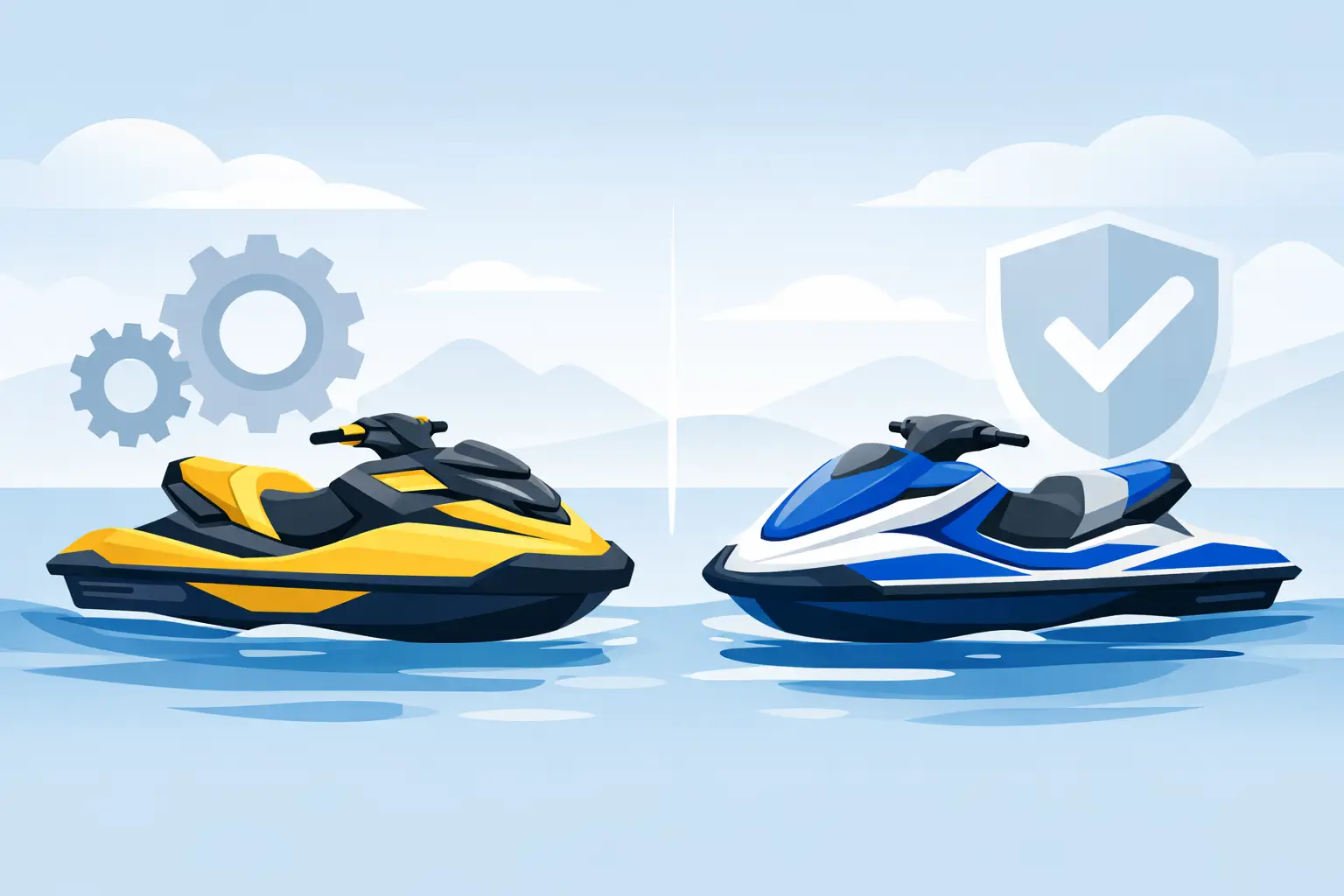
A PWC that starts every time, holds its temperature and gets you home after a hard day on the water is worth more than a brochure claim. The Sea-Doo versus Yamaha reliability question comes up constantly because both brands build capable machines, but they take different engineering paths – and both reward owners who service them properly.
For a stock recreational ski, either can deliver years of dependable use. For a supercharged craft, a heavily modified machine, or a ski ridden hard in salt water, reliability comes down less to the badge on the bonnet and more to the exact model, service history, calibration and the standard of work carried out on it.
Sea-Doo versus Yamaha reliability: the real answer
Yamaha has earned a strong reputation for conservative, durable four-stroke engineering. Its naturally aspirated 1.8-litre platform is widely respected for taking plenty of recreational use with relatively few major mechanical surprises. There is a reason Yamaha is often the default recommendation for an owner who wants a straightforward family ski, regular servicing and long-term ownership.
Sea-Doo has a different appeal. Its Rotax engines deliver strong power density, sharp acceleration and class-leading features across much of the range. The supercharged 300 and 325 platforms are serious performance packages from the factory. They are not inherently unreliable, but their higher output, tighter packaging and greater electronic complexity mean neglected maintenance shows up faster.
That does not make Yamaha automatically the reliable choice and Sea-Doo the risky one. A well-maintained Sea-Doo can be exceptionally dependable. A Yamaha run in salt water without proper flushing, ridden with contaminated fuel or serviced only when something fails can become expensive quickly. Reliability is a system, not a logo.
Where Yamaha usually has the edge
For owners comparing like-for-like naturally aspirated models, Yamaha generally wins on mechanical simplicity. The 1.8-litre engine has a proven design, and naturally aspirated models avoid the additional heat, load and servicing considerations that come with a supercharger. That matters to riders who clock up hours towing toys, cruising waterways and sharing the ski between multiple family members.
Yamaha’s hull and drivetrain layouts are also familiar to many workshops and parts availability is strong. Routine work is predictable: oil and filter changes, plugs at the correct interval, cooling-system checks, battery care, pump inspection and corrosion prevention. Kept on schedule, these skis commonly rack up substantial hours.
The trade-off is that Yamaha’s standard performance character can feel less aggressive than a high-output Sea-Doo. For some riders, that is exactly the point. For others, especially those chasing hard acceleration and tune potential, it is not.
Where Sea-Doo deserves more credit
Sea-Doo reliability is often judged through the lens of its high-performance models. That is not always a fair comparison. A 300-horsepower supercharged Sea-Doo operated at full throttle in warm salt water is being asked to do far more than a naturally aspirated cruiser. Compare it with an equivalent high-output platform, and the conversation becomes more balanced.
Modern Rotax four-stroke engines are strong when their cooling, lubrication and fuel systems are healthy. Sea-Doo also offers excellent factory handling, intelligent braking and reverse systems, and performance that appeals to riders who want more than a relaxed cruise. The key is treating the machine like the high-output marine engine it is.
On supercharged Sea-Doos, use the correct oil, maintain the intercooler and exhaust systems, inspect hoses and clamps, and keep the fuel system clean. Pay attention to any drop in boost, unusual exhaust note, warning message or change in throttle response. Small issues become costly when ignored at high cylinder pressures and high operating temperatures.
Older Sea-Doo models require particularly careful buying checks. The age of the ski, maintenance records, supercharger history where applicable, coolant condition, corrosion around exhaust components and evidence of water ingestion all matter more than low hours alone. A low-hour ski that has sat outside near the coast can be a poorer purchase than a regularly serviced machine with more use.
The failure points owners should actually watch
Salt water is the great equaliser. Corrosion affects electrical connectors, exhaust hardware, pump components, trailer fittings and steering systems on any PWC. Flushing after each salt-water ride helps, but flushing is not a substitute for washing the ski, drying vulnerable areas, checking the engine bay and addressing corrosion before it spreads.
Fuel is another major factor. Stale fuel, water contamination and poor-quality storage practices cause rough running, injector problems and hard starting. If the ski will sit for an extended period, prepare it properly rather than leaving old fuel in the tank and hoping for the best. Batteries also need attention. Low voltage can create misleading electrical faults on modern electronically controlled PWCs.
The jet pump deserves regular inspection regardless of brand. Damaged wear rings, bent impellers, fishing line around the shaft or debris damage can reduce acceleration and top speed, then place additional strain on the drivetrain. Riders sometimes chase an engine or tuning issue when the real problem is in the pump.
Supercharged models need a higher standard again. That includes correct service intervals, quality lubricants and filters, proper warm-up habits and a conservative tune matched to the hardware and fuel available. More boost and more revs can produce impressive numbers, but a tune that ignores intake temperature, fuel supply or engine condition is not a performance upgrade. It is a repair bill waiting for the wrong day.
Service history matters more than hours
When buying used, do not be distracted by a single number on the hour meter. Ask how the ski was used, where it was stored, whether it was flushed after salt water, who serviced it and what parts have been replaced. A documented history from a specialist workshop carries real value.
A proper pre-purchase inspection should cover more than a compression check. It should assess fault codes, charging voltage, oil and coolant condition where relevant, engine-bay corrosion, pump and impeller condition, carbon seal or driveline condition on applicable Sea-Doo models, supercharger operation, hull damage and signs of previous water entry. A sea trial is equally valuable because some faults only show under load.
For current owners, annual servicing is the minimum baseline for most recreational skis, with more frequent checks for hard-used, supercharged or modified machines. If you ride regularly through a Central Coast summer, do not wait until next season to investigate a vibration, warning light, power loss or water in the engine bay.
Which brand suits your use?
Choose Yamaha if your priority is proven naturally aspirated durability, straightforward ownership and a ski that will spend most of its time cruising, towing and carrying passengers. It is the sensible choice for many buyers, particularly when a clean service history is available.
Choose Sea-Doo if you value factory performance, braking and reverse technology, agile handling and a platform with serious potential. A Sea-Doo can be a highly reliable long-term ski, but it asks for disciplined maintenance and knowledgeable diagnosis, especially in the supercharged range.
For performance owners, neither brand should be modified casually. ECU tuning, intake work, intercoolers, injectors, camshafts and internal engine upgrades must work as a matched package. The best builds are based on accurate diagnostics, realistic power goals and a calibration that protects the engine rather than chasing a headline figure. VTECHTUNED sees the difference that specialist servicing and properly matched performance parts make when a machine is ridden hard.
The better purchase is not necessarily the brand with the strongest reputation online. It is the individual PWC with the right engine for your riding, evidence of careful ownership and a maintenance plan you will actually follow. Buy the clean example, fix minor issues early and give high-performance hardware the attention it demands – that is how reliability is built.



