
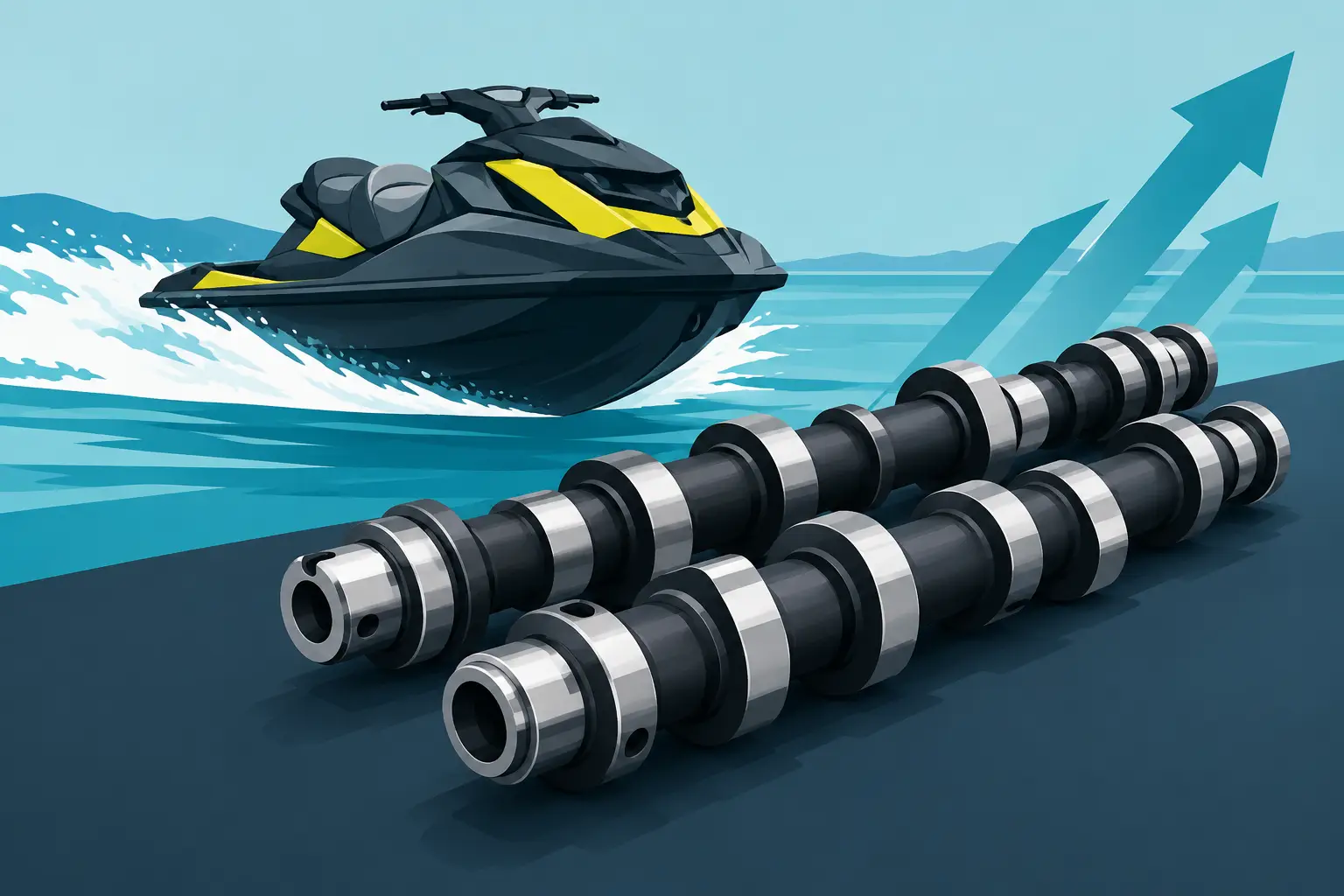
A camshaft upgrade can make a Sea-Doo feel far more alive through the mid-range and carry harder at higher RPM. But Sea-Doo camshafts are not a bolt-on shortcut to huge power. They change how the engine breathes, which means the rest of the combination – fuel, boost, RPM limit, valvetrain and ECU calibration – has to be built around them.
For riders chasing stronger acceleration, a faster race setup or a properly engineered engine build, cams can be one of the most effective changes available. Installed without the right planning, though, they can create poor idle quality, valve control issues, lean running or a combination that simply does not deliver the gains expected.
What Sea-Doo camshafts actually change
A four-stroke Sea-Doo camshaft controls when the inlet and exhaust valves open and close, and how far they open. Those details determine how efficiently the cylinder fills with fresh air and expels exhaust gases. Factory cam profiles are designed to meet broad requirements: smooth operation, emissions compliance, fuel economy, durability and predictable performance across a wide range of owners and conditions.
Performance camshafts alter that compromise. Depending on the profile, they may increase valve lift, duration or overlap. In plain terms, the engine gets more opportunity to move air at higher engine speeds. More airflow supports more fuel, and the result can be meaningful power when the engine, supercharger system and tune can use it.
The gain is rarely just a peak horsepower number. A well-matched cam package can improve throttle response, strengthen mid-range pull and help the ski continue making power where a standard setup starts to flatten out. That is particularly valuable in racing, closed-course riding and jet boat applications where the engine spends more time under sustained load.
When a cam upgrade makes sense
Camshafts suit owners with a clear performance target. If the goal is reliable recreational riding with modest power gains, an ECU tune, intake improvements and a correctly maintained supercharger may offer a better return before opening the engine. Cams become more compelling when the ski already has supporting upgrades or is progressing into a serious performance build.
They are commonly considered for supercharged Sea-Doo platforms running upgraded chargers, intercoolers, exhaust components, injectors or fuel-system improvements. These parts increase airflow potential, but the engine still needs to move that air efficiently through the cylinder head. A camshaft upgrade can remove a restriction in the overall package.
Naturally aspirated engines can benefit too, although expectations need to be realistic. Without forced induction, cam selection, compression, cylinder-head work and RPM strategy become even more important. There is no single cam that is right for every Sea-Doo. A profile that performs brilliantly in a high-boost race engine may be unsuitable for a stock recreational ski.
Choose the powerband before choosing the part
The right question is not, “What is the biggest cam available?” It is, “Where do you need the engine to make power?” A ski used for drag racing may benefit from a profile that favours high-RPM flow. A heavy offshore ski or jet boat may need torque and response through the middle of the rev range instead.
More aggressive duration and overlap can improve top-end output, but can also shift the useful powerband higher. If the engine is not turning the RPM needed to take advantage of the profile, the upgrade may feel underwhelming. Conversely, spinning an engine beyond the valvetrain’s safe control range is a fast way to turn a performance upgrade into an expensive repair.
Supporting parts are not optional
Camshaft installation should be treated as a system upgrade. The cam profile, boost level, fuel supply and ECU calibration all need to agree. A mismatch can make the engine less reliable even when every individual component is high quality.
Valve springs are one of the biggest considerations. Higher lift and higher RPM place more demand on the valvetrain. The springs must control the valves accurately without excessive pressure that accelerates wear. Retainers, keepers, followers and timing components also need close inspection, particularly in engines with high hours or previous performance work.
Fueling matters just as much. If camshafts allow the engine to ingest more air, the calibration has to supply the correct fuel volume and manage ignition timing for the new airflow. On boosted engines, injector capacity, fuel pressure and intercooler efficiency must be assessed before chasing more boost or RPM.
A practical build plan may include the following:
- Camshafts matched to the intended RPM range and use case
- Correct valve springs and valvetrain hardware for the chosen profile
- A compression, leak-down and timing-chain condition check before assembly
- Fuel-system capacity suited to the expected power level
- ECU tuning developed for the final hardware combination
- Post-installation testing to verify air-fuel ratio, knock control and engine behaviour under load
That final point is where many home-built combinations fall short. A ski can sound sharp on the trailer and still be unsafe at full throttle on the water. Proper testing under real load tells the truth.
Installation precision protects the engine
There is little tolerance for guesswork inside a high-output PWC engine. Cam timing must be set accurately, clearances checked and every timing component inspected. A worn chain, weak tensioner or incorrectly installed cam can cause poor performance at best and piston-to-valve contact at worst.
Valve clearance should be measured, recorded and adjusted where required. This is not a job for assumptions based on how the engine ran before it was pulled apart. Changes in cam base circle, valve-train wear and prior machining can all affect the final measurement.
It is also smart to inspect the engine’s overall health before fitting performance cams. A cam upgrade will not fix low compression, damaged pistons, excessive oil consumption or a tired supercharger clutch. It can expose those weaknesses sooner because cylinder pressure, RPM and heat load may all increase.
For serious builds, degreeing the cams rather than relying only on factory timing marks provides another level of accuracy. This verifies that the installed timing matches the intended cam events. It takes more time, but precision is exactly what separates a dependable engine build from one that constantly returns to the workshop.
ECU tuning is where the gains become usable
The ECU calibration ties the package together. Cammed Sea-Doo engines often need changes to fuel mapping, ignition timing, throttle strategy, boost control and RPM limits. The exact requirements depend on the model, cam profile, fuel used and supporting hardware.
A generic tune designed around a near-stock ski is not automatically suitable once camshafts, an upgraded supercharger or larger injectors are installed. The engine’s airflow characteristics have changed. Running too lean, carrying unsuitable ignition timing or removing safeguards to chase a number can damage an engine quickly under marine load.
Professional calibration should focus on repeatable performance, not one heroic pass. Water temperature, intake temperature, fuel quality and sustained throttle use all affect how a PWC behaves. A strong package needs enough safety margin to perform consistently through an Australian summer, not just when conditions are perfect.
Reliability comes from the whole combination
The best Sea-Doo camshaft build is one that matches the rider’s actual use. A recreational owner may be better served by a mild profile, conservative tune and a maintenance plan that keeps the ski dependable. A racer may accept more frequent inspection intervals in exchange for greater top-end power. Neither approach is wrong, provided the trade-off is deliberate.
Regular oil changes with the correct specification, scheduled valve-clearance checks and inspections of timing and supercharger components matter more after performance work. More cylinder pressure and RPM create more heat and load. Reliable power comes from maintaining the package, not simply fitting premium parts.
At VTECHTUNED, the focus is always on building combinations that make measurable power without ignoring the mechanical details that keep a Sea-Doo on the water. Before selecting cams, define the target, assess the engine and make sure the supporting components are ready. That is how a camshaft upgrade earns its place in a serious PWC build.



