
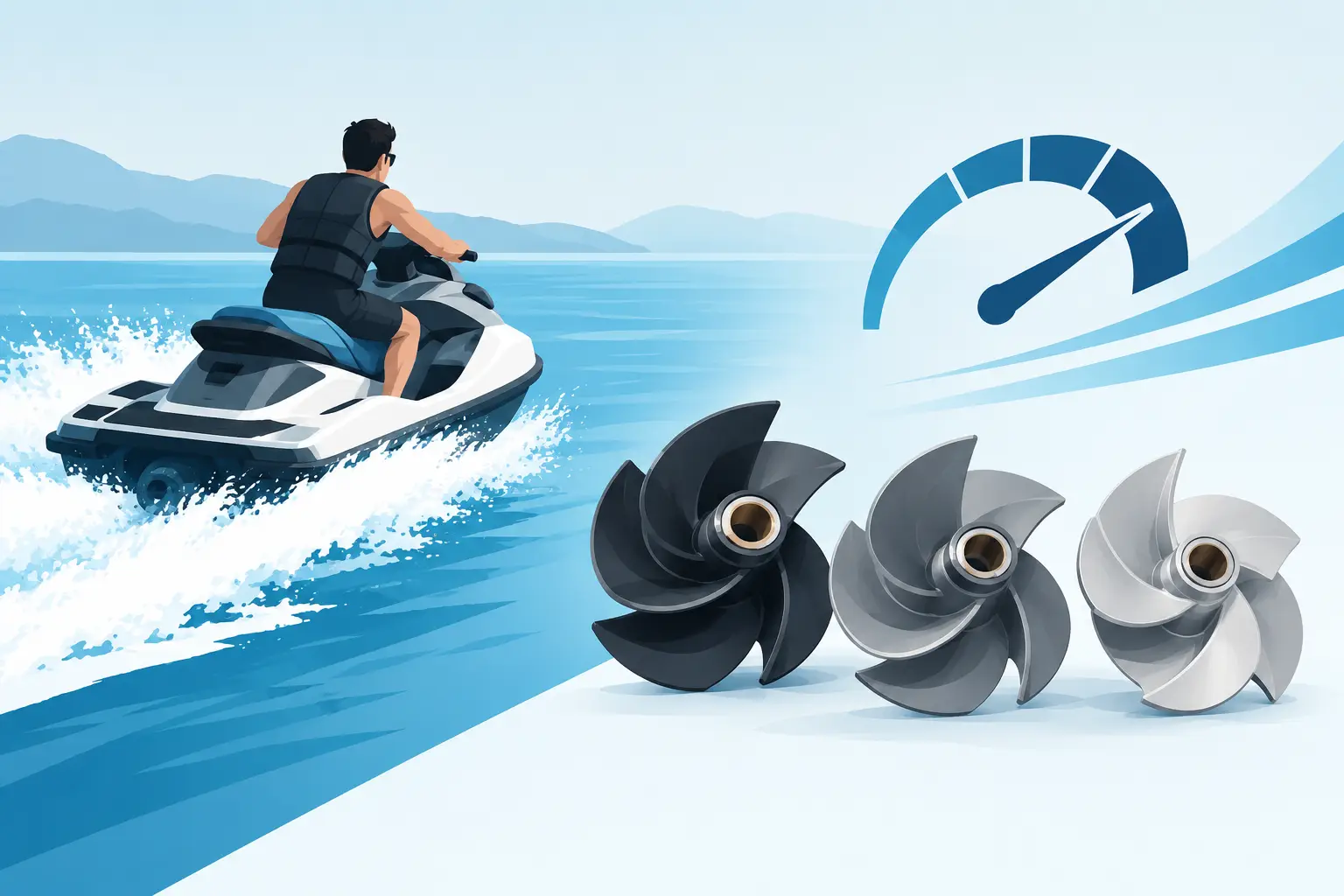
A jet ski that hits the limiter too easily, feels lazy out of the hole, or loses speed with passengers is not always short on power. The pump may simply be working outside its sweet spot. This PWC impeller pitch selection guide explains how to choose an impeller that lets your Sea-Doo, Yamaha or Kawasaki use its available power properly – with stronger acceleration, controlled RPM and dependable top-end performance.
An impeller is not a bolt-on part to choose by advertised top speed alone. Pitch has to suit the engine’s power curve, rev limiter, tune, supercharger setup, rider load and the way the ski is used. A race setup that is brilliant in flat water with a light rider can be frustrating on a loaded ski in chop. The right choice is the one that delivers repeatable results without overspeeding the engine or dragging RPM below where it makes power.
What impeller pitch actually changes
Impeller pitch describes the theoretical distance the impeller would move water in one full rotation. In simple terms, a lower-pitch impeller is easier for the engine to turn, while a higher-pitch impeller places more load on the engine.
Think of pitch as gearing for your jet pump. Drop pitch and the engine reaches RPM more quickly. Add pitch and the pump takes a bigger bite of water per revolution, provided the engine has enough torque and horsepower to carry it.
Lower pitch generally delivers harder holeshot, stronger mid-range response and higher operating RPM. It can be the right direction for a heavy ski, frequent tow-sports use, rough-water riding, high elevation operation, or a setup that is under-revving. The trade-off is that the engine can run into the limiter too early and surrender top speed if pitch is reduced too far.
Higher pitch can lower operating RPM and improve top speed potential on a powerful, correctly tuned ski. But too much pitch makes the engine labour. Acceleration softens, recovery after turns suffers and the ski may never reach its intended RPM. More pitch is not automatically faster.
Start with the target RPM, not the impeller number
The correct impeller is the one that puts the engine near its intended wide-open-throttle RPM under real riding conditions. That target depends on the platform and its modifications. Factory calibration, aftermarket ECU tuning, camshafts, intake work, supercharger upgrades and exhaust changes all affect where the engine makes its best power and where its limiter is set.
Before changing hardware, establish a clean baseline. Use reliable RPM data and test with fresh fuel, a sound wear ring, healthy pump bearings and no known mechanical faults. Check wide-open-throttle RPM on the water, not briefly on the trailer. Record water conditions, fuel level, rider load and whether the ski is heat-soaking after repeated runs.
If the ski consistently hits the rev limiter well before it reaches its best speed, it is usually under-pitched or making more power than the current impeller was selected for. If it cannot reach target RPM, it may be over-pitched, but do not jump to that conclusion until you inspect the pump and engine condition. A worn wear ring, damaged impeller edge, poor intercooler efficiency, boost leak, slipping clutch system or incorrect tune can create the same symptom.
A useful rule of thumb
One pitch step can make a noticeable RPM change, but there is no universal number that applies to every PWC. Pump diameter, blade design, cup, engine package and water conditions all matter. Treat manufacturer pitch markings as a starting point, not a guarantee.
This is why impeller selection should be driven by measured RPM and performance data. Two skis with the same model name can want different impellers when one has a high-flow intake, aftermarket tune and upgraded supercharger while the other is stock and carries two adults every weekend.
Diameter, blade design and cup matter too
Pitch is only one part of the impeller equation. Diameter changes how much water the impeller can move, blade count affects load and water control, and blade shape influences how the pump hooks up under acceleration. Cup at the trailing edge also adds load and can help reduce cavitation and improve bite.
A pitched and cupped performance impeller may behave very differently from another impeller carrying similar pitch numbers. That is why selecting by markings alone can lead to expensive guesswork. The pump tunnel, intake grate, ride plate and wear ring condition all influence the final result.
For a modified supercharged ski, pump setup becomes even more critical. Extra power exposes weak water control quickly. If the impeller is cavitating, the wear ring is worn or the intake setup is not feeding the pump cleanly, adding pitch will not solve the issue. It can make acceleration worse while disguising the actual fault.
Match pitch to how you ride
A recreational owner who rides with a passenger, carries fuel and gear, and spends time in mixed Central Coast conditions needs a different compromise from a rider chasing a clean one-way GPS pass. Be honest about the ski’s primary job.
For hard acceleration, towing and rough-water riding, choose a setup that reaches useful RPM quickly and recovers strongly after backing off the throttle. A slightly lower pitch is often the more enjoyable option because the ski stays responsive instead of feeling loaded up.
For top-speed work, the engine needs enough power to pull a higher-pitch impeller through its full RPM range in suitable water. This approach makes sense for a proven engine package with accurate tuning and proper pump preparation. It is less suitable if the ski regularly carries extra load or is ridden in chop, where the pump repeatedly unloads and reloads.
For race builds, selection is usually a test-and-refine process. Water temperature, air temperature, course layout, rider weight and class rules can all shift the ideal combination. The best race impeller is the one that delivers usable drive from the start through to the finish, not merely the largest pitch that can be fitted.
Inspect the pump before blaming the impeller
A healthy impeller cannot compensate for a damaged pump. Inspect the leading and trailing edges for nicks, bends and erosion. Check the wear ring clearance, look for liner damage, and make sure the impeller is not rubbing. Inspect pump bearings and confirm the driveline is aligned and operating correctly.
Cavitation deserves particular attention. If RPM flares but speed does not build cleanly, water may be aerating around the pump rather than being converted into thrust. Causes include worn components, a poor intake seal, debris damage, excessive clearance or a setup that does not suit the hull and riding conditions.
A damaged impeller can also distort your tuning decisions. Owners sometimes add pitch because a ski is over-revving, when the real issue is blade damage or a worn ring allowing slip. Repair the mechanical problem first, then assess RPM again.
A practical PWC impeller pitch selection guide
Use this sequence when deciding on a change. First, confirm the engine and pump are mechanically sound. Next, identify the actual wide-open-throttle RPM and compare it with the target for the current engine tune and hardware. Then account for rider weight, fuel load, passengers and typical water conditions before choosing the direction of change.
If the ski is over-revving and has clean pump hardware, move towards more pitch or a design with additional loading. If it is under-revving with a healthy engine and pump, reduce pitch or select a less aggressive loading profile. Make one considered change at a time and test it consistently. Changing the impeller, intake grate, tune and supercharger pulley together may create a faster ski, but it will not tell you which part delivered the result.
Record RPM, GPS speed, water conditions and acceleration feel after each test. A good setup should be repeatable, not just impressive during one cool-weather run with a low fuel tank.
For modified Sea-Doo, Yamaha and Kawasaki platforms, VTECHTUNED can assess the complete package rather than selling pitch by guesswork. The right recommendation comes from the ski’s mechanical condition, power level and intended use – then the hardware, calibration and pump setup can work as one system.
Choose the impeller that keeps your engine in its powerband and your pump properly loaded for the way you genuinely ride. That is where sharper response, usable speed and long-term reliability meet.



