
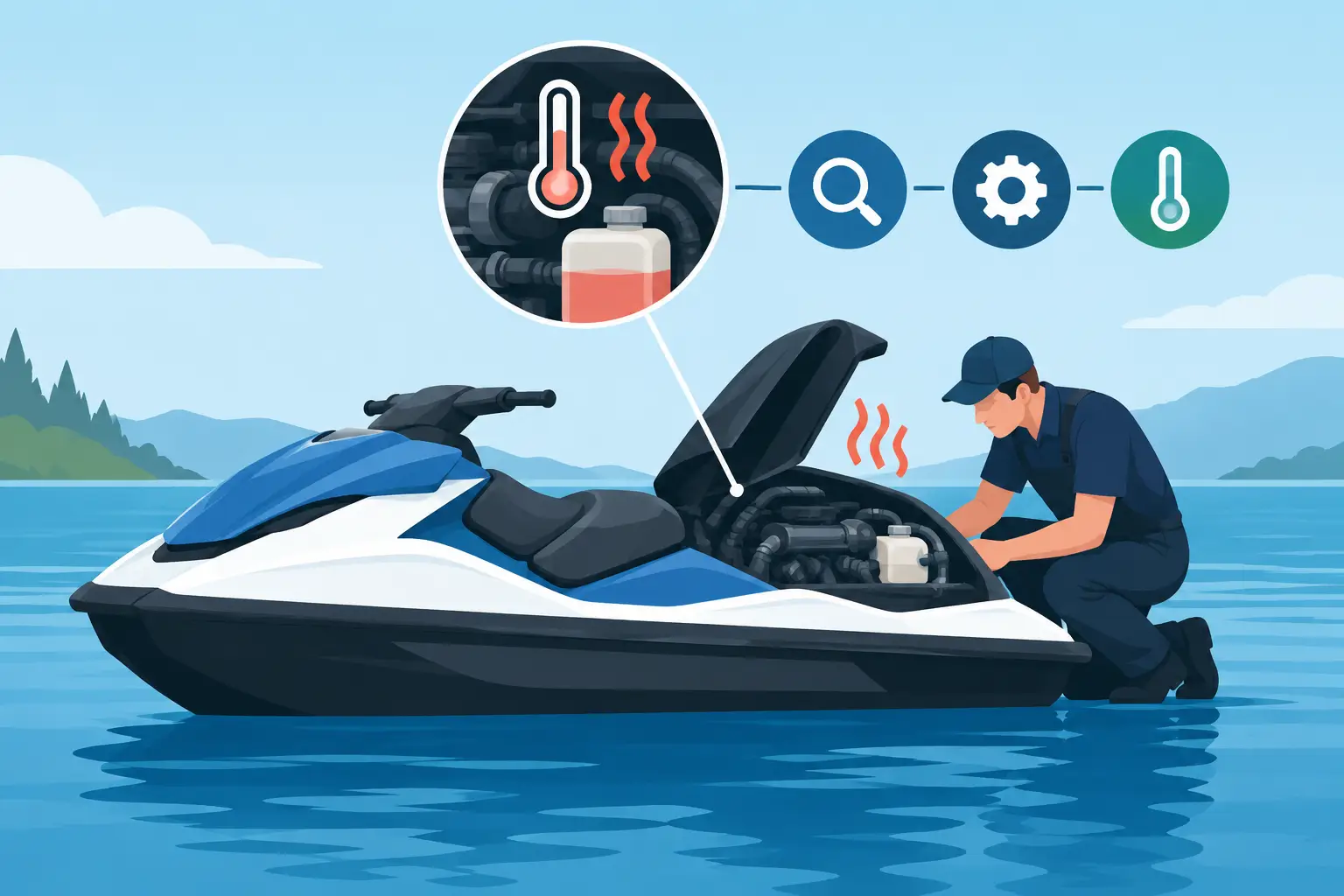
A temperature warning on the water is not a nuisance light to clear and keep riding. It is your PWC telling you that heat is building faster than the cooling system can remove it. A proper PWC overheating diagnosis protects far more than an engine – it can prevent warped components, damaged exhaust hardware, failed hoses and a very expensive recovery from a day that should have been trouble-free.
On a standard recreational ski, the cause may be as simple as weed caught in the intake grate. On a modified supercharged Sea-Doo, Yamaha or Kawasaki, the answer can involve restricted water flow, a failing wear ring, exhaust restrictions, intercooler plumbing, sensor data or a calibration issue. The right repair starts by identifying the fault, not replacing parts on a guess.
What an overheating warning is really telling you
Most PWCs rely on water moving through a carefully designed cooling circuit. Water enters through the intake area, is directed through cooling passages and heat exchangers, then exits through the exhaust or dedicated outlets. If flow drops, if the engine produces more heat than the system can handle, or if the machine is reporting incorrect temperature data, an overheat warning can appear.
The first decision is simple: reduce throttle immediately and stop the engine if the warning persists. Do not keep making high-speed passes to see whether it goes away. A ski that cools at idle but overheats under load still has a problem. Likewise, a warning that disappears after a restart may be intermittent, but it has not necessarily fixed itself.
Pay attention to the conditions when it occurs. Did it happen after riding through shallow water, weed beds or a sandy launch? Does it appear only at wide-open throttle? Has the ski recently had engine work, a pump upgrade, an intercooler installed or ECU tuning? Those details shorten diagnosis considerably.
Start PWC overheating diagnosis at the water intake
Before removing covers or ordering components, inspect the obvious water-flow path. With the engine off and the ski safely out of the water, check the intake grate, ride plate area and pump inlet for weed, fishing line, plastic, sand or shell debris. Even a partial blockage can reduce cooling flow when the engine is working hard.
Then inspect the jet pump. A damaged impeller, excessive wear ring clearance or debris inside the pump can affect both thrust and water supply. Riders often focus on the loss of speed, but poor pump efficiency can contribute to cooling issues on models that depend on pump-fed water flow.
Look for external clues around the hull and engine bay. A loose hose clamp, split hose, damaged fitting or water staining around an intercooler connection can point directly to a restriction or leak. Check that cooling outlet tell-tales are flowing where your specific model is designed to discharge water. A weak stream is worth investigating, but do not judge the entire system on one outlet alone – flow patterns vary between platforms.
If the ski has been used in salt water, scale and corrosion move higher up the suspect list. Salt residue can restrict small passages over time, especially where water sits after use. Flushing helps, but it does not always remove established mineral build-up or debris trapped in the cooling circuit.
The fault may be mechanical, not just cooling-related
Not every overheat warning begins with a blocked cooling hose. An engine that is working harder than it should creates more heat, and performance PWCs make that relationship especially obvious.
A supercharged engine with an incorrect air-fuel ratio, poor fuel delivery, ignition trouble or an unsuitable ECU calibration can run hotter under sustained load. A restricted exhaust system, damaged waterbox or failed exhaust cooling component can also push temperatures beyond normal operating range. These faults need measured diagnosis, not a generic assumption that the thermostat is at fault.
Engine condition matters too. Low compression, cylinder damage, head gasket concerns or internal coolant-system issues can produce heat-related symptoms alongside rough running, hard starting, smoke, power loss or abnormal pressure in the cooling system. On a two-stroke platform, incorrect oiling, lean fuelling or cooling passage corrosion require their own inspection approach.
Modified skis deserve particular care. More boost, aggressive timing, higher RPM limits and larger injectors can deliver serious gains when the complete package is matched correctly. But an upgrade that is not supported by suitable fuelling, intercooling, exhaust flow and calibration can create a reliability issue that looks like a basic overheating fault. Performance and reliability are built together.
Use diagnostic data before replacing parts
Modern Sea-Doo, Yamaha and Kawasaki PWCs can store fault codes and live operating information that help separate a genuine heat event from a sensor or wiring problem. A workshop scan can reveal temperature readings, warning history and related fault codes that are not visible on the dash.
That does not mean every temperature fault is electrical. It means the data should guide the physical inspection. If the ECU reports an implausible temperature immediately after a cold start, the sensor, connector or wiring may be suspect. If temperature rises steadily only under hard acceleration, the cooling flow, pump condition, exhaust cooling and engine load deserve closer attention.
A professional assessment may include pressure testing, checking flow through individual cooling passages, inspecting the pump and wear ring, assessing exhaust components, testing sensors, reviewing service history and examining ECU data. Where engine health is in question, compression or leak-down testing can provide a far clearer picture than changing cooling components one at a time.
Common mistakes that make overheating damage worse
Overheating faults often become expensive because the first response is rushed. Avoid these four habits:
- Continuing to ride after the warning clears, especially at high RPM.
- Flushing the ski and assuming the problem has been solved without finding the restriction.
- Replacing sensors, thermostats or hoses without checking actual water flow and fault data.
- Running the engine out of the water for extended periods, particularly without the correct flushing procedure for the model.
Another common mistake is treating every platform the same. Some PWCs use open-loop cooling, while others have closed-loop systems with heat exchangers and different service requirements. Supercharged models, naturally aspirated models and jet boats can also have very different cooling layouts. The workshop manual matters, but hands-on model knowledge matters just as much.
When to book a specialist inspection
A basic external blockage can sometimes be resolved at home. Repeated warnings, high-temperature alarms at speed, visible leaks, loss of power, steam, burnt smells or milky oil are not DIY trial-and-error territory. Stop using the ski and arrange an inspection before a minor restriction becomes an engine rebuild.
This is particularly true after a recent performance upgrade, engine build or accident repair. A hose routed incorrectly, clamp left loose, damaged intercooler core or calibration mismatch can be difficult to spot without systematic testing. The cheapest-looking fix is rarely the cheapest outcome if it misses the real cause.
For Central Coast owners, VTECHTUNED can assess cooling faults alongside engine condition, pump efficiency and performance hardware, so the diagnosis is based on the whole package rather than one isolated part. That approach is valuable whether your ski is a weekend family machine or a hard-ridden race build.
The best outcome is not simply getting the warning light to disappear. It is knowing why it appeared, confirming that cooling flow and engine operation are right, and heading back onto the water confident your PWC can handle the load you ask of it.



