
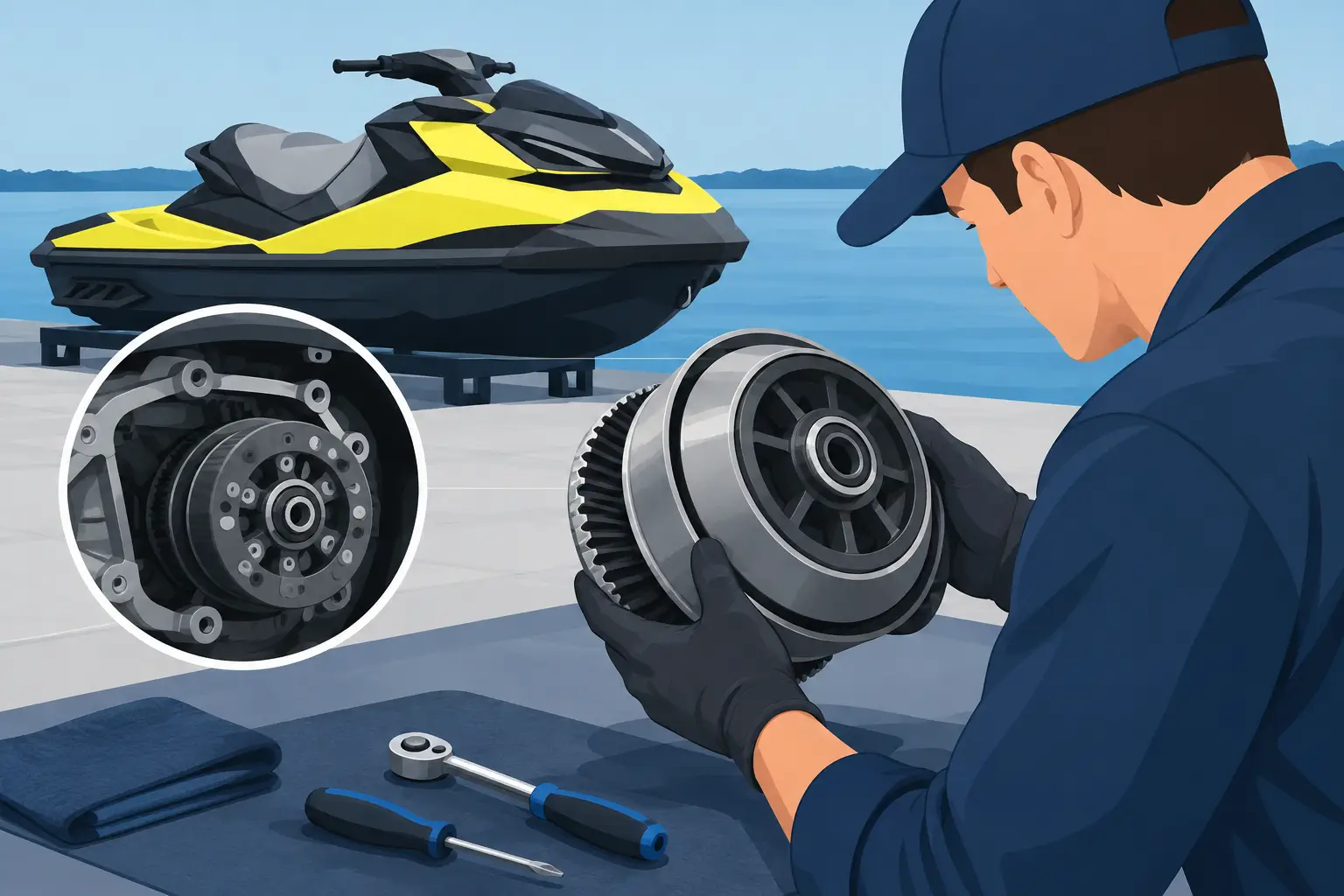
A Sea-Doo that suddenly feels flat out of the hole, revs without delivering the usual pull, or loses top-end speed may be telling you it is time to learn how to inspect supercharger clutch condition. The clutch is not a cosmetic service item. It is a calibrated protection system inside the supercharger that affects boost response, drivetrain safety and engine reliability.
On a stock recreational PWC, the issue may first show up as disappointing acceleration. On a tuned or race-built ski, clutch slip can quickly become a costly problem because the engine, ECU calibration, fuel system and impeller setup all depend on the supercharger producing predictable airflow. A proper inspection is about more than seeing whether the compressor wheel turns.
What the supercharger clutch actually does
On many supercharged Sea-Doo four-stroke platforms, the supercharger is driven from the engine through a gear train. The clutch assembly uses a calibrated friction arrangement that allows controlled slip if the supercharger experiences a sudden load or fault. That controlled slip helps protect the drive gears and related components from damage.
The trade-off is that a clutch that slips too easily can prevent the supercharger from reaching its intended speed. Less supercharger speed means less boost, weaker throttle response and a ski that may feel strangely lazy despite sounding normal. A clutch that is too tight, incorrectly assembled or modified without the right supporting parts can place unnecessary load on the drive system.
Not every Sea-Doo uses the same supercharger, clutch material or specification. Production year, engine family, factory revisions and aftermarket upgrades all matter. Earlier ceramic-washer systems, later maintenance-free designs and aftermarket superchargers need to be assessed against the correct specification for that exact setup.
Start with symptoms, service history and a clean baseline
Before removing parts, establish whether the clutch is genuinely the likely fault. A supercharged PWC can lose performance for plenty of other reasons, including cavitation from a damaged wear ring, a worn impeller, intake restriction, boost leaks, sensor faults, fuel delivery issues or an ECU safety strategy.
Ask when the supercharger was last serviced, whether the ski has been tuned, and whether the engine has had any previous mechanical work. If the ski was bought second-hand and there is no credible record of clutch inspection or supercharger servicing, treat that as a reason to check it rather than assume it is fine.
A brief on-water test can be useful when performed safely. Note throttle response, peak RPM, speed, warning messages and any abnormal whine, rumble or metallic noise. Compare the figures with known performance for that ski’s current setup, not with a random online claim. An aggressive tune, different propeller or a jet boat conversion changes what “normal” looks like.
Do not diagnose clutch slip from top speed alone. A fouled hull, poor water conditions, rider load and pump wear can all affect speed. The goal is to build a complete picture before the supercharger comes off.
How to inspect supercharger clutch condition
Work on a cold engine in a clean, well-lit area. Disconnect the battery and keep debris away from the intake tract. If there is any doubt about component identification, hose routing or torque procedures, stop and refer to the correct workshop information for the model rather than forcing parts apart.
Access requirements vary by hull and engine, but the supercharger generally needs to be removed before the clutch can be inspected properly. Take photos as you go, label hoses where required and check the condition of clamps, intake couplers and sealing surfaces during disassembly. A split coupler or loose clamp can imitate a boost fault and should not be ignored.
Once the unit is removed, begin with external condition. The compressor wheel should be clean, free of contact damage and without bent or chipped blades. Inspect the housing for witness marks where the wheel may have touched. Any contact marks, heavy corrosion, foreign-object damage or visible oil contamination deserves further investigation before the supercharger goes back into service.
Next, check bearing condition and shaft movement. The wheel should rotate smoothly without roughness, binding or a gritty feel. There should not be obvious radial play or evidence that the wheel is moving into the housing. A damaged bearing is not a clutch adjustment issue – it is a supercharger rebuild or replacement decision.
The clutch itself cannot be accurately judged by feel alone. The correct method is a controlled slip test using the appropriate holding fixture and a calibrated torque wrench. The drive gear is held with the designated tool while torque is applied in the specified direction to the supercharger shaft or compressor wheel fixture, depending on the supercharger design. The point at which the clutch slips is then compared with the specification for that exact unit.
This is where many home inspections go wrong. A general-purpose torque wrench may not be accurate at the low end of its range, an improvised holding tool can damage the gear, and the wrong direction of force can create a false result. Most importantly, there is no universal “correct” breakaway number for every Sea-Doo supercharger. Factory revisions, aftermarket clutch packs and performance builds can have different targets.
If the clutch releases below specification, it may be worn, contaminated, incorrectly assembled or fitted with unsuitable components. If it will not release within the expected range, do not simply tighten hardware to make it pass. The unit needs to be stripped, inspected and rebuilt to the manufacturer or supercharger supplier’s requirements.
What to inspect while the supercharger is out
Removing the supercharger gives you an opportunity to catch supporting faults before they become a larger repair. Check the drive gear teeth for wear, chipping or unusual polishing. Look at the oil condition and assess whether there is metallic debris around the work area. Inspect intake hoses, intercooler connections and clamps for splits, soft spots or oil residue that could point to a leak.
Also inspect the engine bay for signs of water ingress, loose fasteners and rubbing hoses. Supercharged PWCs operate in a harsh environment of heat, vibration and salt exposure. A small issue around the intake can turn into an air leak, corrosion problem or reliability concern under sustained boost.
If you find compressor-wheel contact, bearing play, damaged gears or metal contamination, avoid running the ski “just to test it”. That decision can send debris through the intake system or turn a rebuildable supercharger into a much bigger engine repair.
Stock servicing versus performance builds
For a standard recreational Sea-Doo, the best approach is to follow the relevant service schedule and inspect the supercharger whenever its maintenance history is uncertain. The correct interval depends on the engine and supercharger version, so model-specific information matters more than blanket internet advice.
Modified skis need closer attention. Higher boost, aggressive ECU calibration, increased RPM limits, freer-flowing intake systems and hard riding all raise the load placed on the supercharger system. A race or high-performance build may need inspection well before the interval that would suit a lightly used stock ski.
Aftermarket superchargers and clutch assemblies can deliver serious gains, but they need matching engine calibration, fuel capacity, intercooling and regular workshop checks. More boost is never a standalone upgrade. The reliable result comes from treating the air system, tune and engine hardware as one package.
Avoid the shortcuts that damage expensive parts
Do not use a screwdriver to jam the compressor wheel, grips on precision shafts, or an impact gun to test clutch tightness. These shortcuts can distort parts, mark gear teeth and hide the real condition of the assembly. Likewise, do not reuse damaged seals or assemble the unit with contaminated components.
A proper reinstallation matters just as much as the inspection. Use the correct seals and torque procedure, make sure all intake connections are secure, and confirm there are no tools or rags left in the engine bay. Once reassembled, verify performance carefully rather than going straight into repeated full-throttle runs.
For owners on the Central Coast who want certainty rather than guesswork, VTECHTUNED can assess the complete forced-induction system, not just one suspect part. That means checking the supercharger against the ski’s tune, engine condition and intended use – whether it is a reliable weekend machine or a purpose-built race setup.
If your Sea-Doo has lost its sharp, boosted punch or its service history is unclear, inspect it before a small slip becomes a major repair. A measured clutch test, clean assembly and realistic maintenance plan protect the performance you paid for every time you pull the trigger.



