
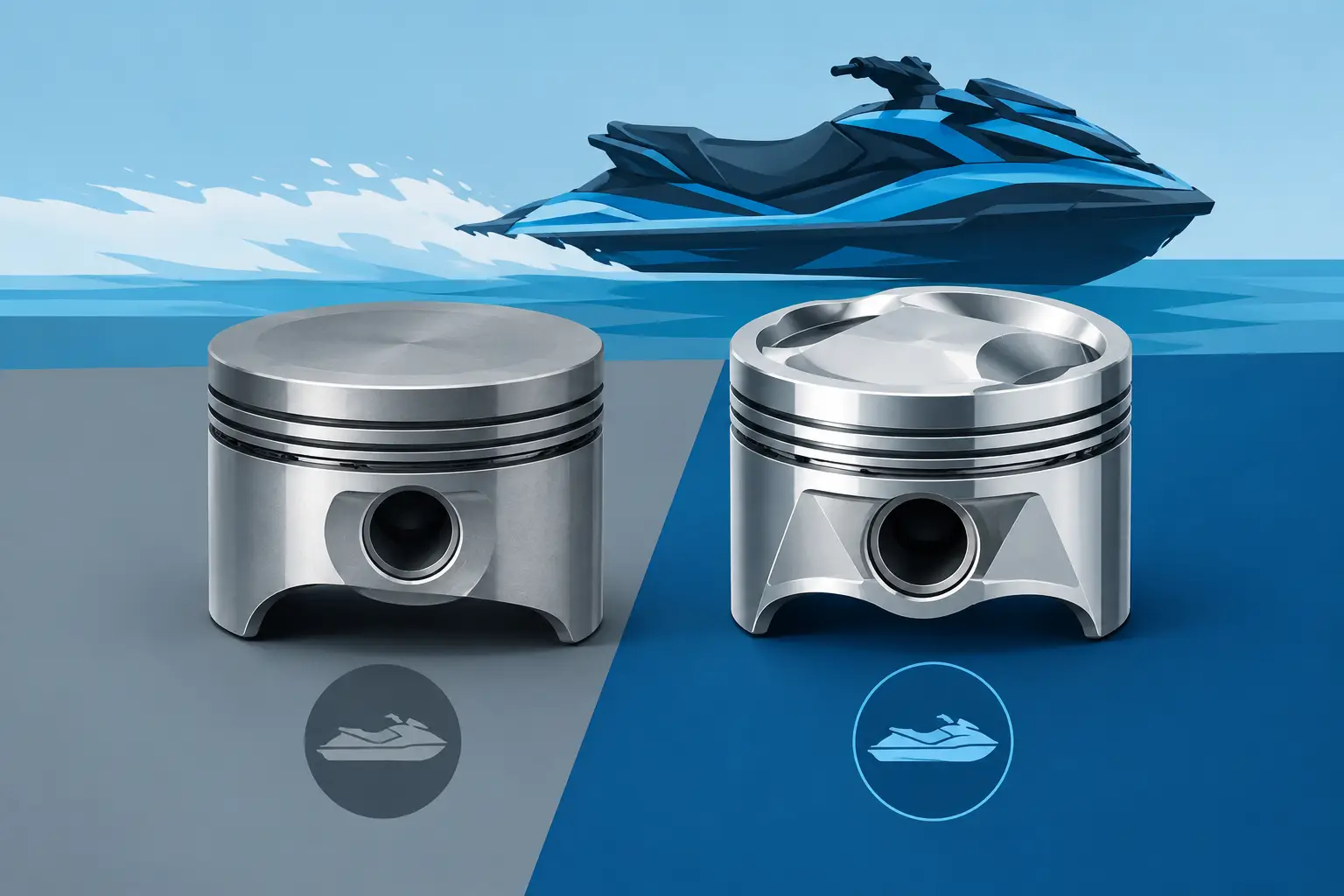
A piston failure rarely starts with a dramatic bang. More often, it begins with excess heat, detonation, a poor bore finish, incorrect clearance or a tune that does not match the hardware. This forged piston comparison focuses on what actually separates premium forged pistons in high-performance Sea-Doo, Yamaha and Kawasaki engines – and how to choose parts that suit the way your PWC is ridden.
For a stock recreational ski, the factory piston may be entirely fit for purpose. Once boost, RPM, cylinder pressure and intake air temperature climb, the piston becomes one of the engine’s most heavily loaded components. Selecting a forged piston is not simply a matter of buying the most expensive option. The right choice depends on alloy, piston geometry, ring pack, wrist pin specification, bore condition and calibration.
Forged piston comparison: forged versus cast
Cast pistons are formed by pouring molten aluminium into a mould. They are cost-effective, dimensionally stable and well suited to standard power levels. Factory manufacturers use them because they support consistent mass production, quiet cold operation and long service life within the intended tune and operating range.
Forged pistons begin as a dense aluminium billet or forging that is pressed into shape under significant force before machining. This process produces a tighter grain structure, giving the piston greater resistance to cracking and deformation under high cylinder pressure. That strength is why forged pistons are a serious consideration for supercharged engines, larger boost targets, aggressive timing, race use and engine builds expected to see sustained load.
The trade-off is expansion. Most forged alloys expand more than a typical cast piston as engine temperature rises, so the cylinder-to-piston clearance must be set correctly. Too tight and the piston can scuff or seize when the engine is worked hard. Too loose and cold-start noise, oil control and skirt wear can become issues. A forged piston build needs precision machining, not guesswork.
The alloy matters more than the marketing
The two forged piston alloys most commonly discussed are 2618 and 4032 aluminium. Neither is automatically better. Each solves a different problem.
2618 alloy for severe load and detonation resistance
2618 is widely used in hard-use, high-output applications because it is highly ductile. In practical terms, it copes well with heavy cylinder pressure and the occasional punishment that comes with a serious boosted build. It is a common choice where maximum strength and resistance to cracking are the priority.
Its weakness is thermal expansion. A 2618 piston usually requires more running clearance than a 4032 piston. Cold piston noise can be more noticeable, particularly before the engine reaches operating temperature. That is not necessarily a fault, but it does mean the bore measurement, honing process and warm-up routine matter.
For a race-focused supercharged PWC, a heavily modified jet boat or a build operating near the edge of its fuel and boost combination, 2618 can be the sensible material. It gives the tuner and engine builder a durable foundation, but it will not compensate for detonation or a lean fuel delivery issue.
4032 alloy for tighter clearances and street reliability
4032 contains more silicon, which reduces expansion and improves wear characteristics. It can run at tighter clearance, often delivering quieter cold operation and strong long-term skirt stability. For high-performance PWCs that need to start, idle, cruise and make repeatable power all season, this can be an excellent balance.
A quality 4032 piston is far from a weak option. It is suitable for many upgraded supercharged Sea-Doo, Yamaha and Kawasaki combinations when boost, fuel quality and ECU calibration are kept within an appropriate range. The key is being realistic about the power target. When cylinder pressure becomes extreme, many builders still favour the extra ductility of 2618.
The correct question is not, “Which alloy makes the most power?” Piston alloy does not create horsepower on its own. Ask which alloy suits the thermal load, intended RPM, boost level and service expectations of the engine.
Crown design and compression ratio
In a forged piston comparison, crown shape deserves as much attention as alloy. The crown controls compression ratio, combustion chamber relationship, valve clearance and heat management. A piston that physically fits the bore can still be completely wrong for the engine combination.
Higher-compression pistons can improve off-boost response and torque, but they also increase cylinder pressure and detonation sensitivity. On a forced-induction PWC, a compression increase must be assessed alongside supercharger speed, intercooling, fuel type and ignition timing. More compression is not a shortcut to a reliable fast ski.
Some forged pistons feature reinforced crowns, revised dish volumes or valve-relief pockets designed for aftermarket cams. These details matter. Insufficient valve-to-piston clearance can turn an otherwise premium engine build into an expensive repair. Deck height, head gasket thickness and cam timing all need to be checked during assembly rather than assumed from a catalogue description.
Crown coatings can also help manage heat and reduce carbon adhesion, while skirt coatings reduce friction and protect the piston during bedding-in. Coatings are worthwhile features, but they are not a replacement for correct tune, cooling system health or appropriate piston clearance.
Ring packs, pins and skirts are not minor details
The piston is only one part of the package. Ring design determines how well the engine seals combustion pressure and controls oil. Thinner performance ring packs can reduce friction and improve high-RPM response, but they may demand a more accurate bore finish and stricter assembly standards. Ring end gap must be measured for the intended application, especially on boosted engines where excessive heat closes ring gaps quickly.
A ring gap that is too tight can cause ring butting. When the ring ends touch at high temperature, the ring has nowhere to expand and can damage the ring land or cylinder wall. A gap that is too large can reduce sealing efficiency. There is no universal number that suits every PWC engine, piston alloy and boost level.
Wrist pins also deserve attention. A stronger, thicker-wall pin supports high cylinder pressure but adds reciprocating weight. A lightweight pin can improve engine response, provided it has the strength for the application. Premium piston kits are designed as a matched system, so mixing rings, pins and clips from unrelated kits is poor practice unless specifications have been verified.
Skirt design influences stability in the bore. A well-designed skirt reduces rocking at top and bottom dead centre while controlling friction. For marine engines that see repeated acceleration, extended full-throttle runs and variable water temperatures, this stability contributes directly to piston and bore life.
What should drive your piston choice?
Start with the actual build, not the biggest advertised power figure. A mildly modified recreational supercharged ski used for weekend rides has different requirements from a closed-course race machine. The recreational owner may value quiet operation, clean cold starts and a broad reliability margin. The racer may accept more frequent inspection intervals in exchange for a piston designed for very high load.
Fuel is a major factor in Australia. If the engine is calibrated around premium pump fuel, it needs a conservative enough compression and boost strategy to cope with real-world fuel variation and summer intake temperatures. An engine built around race fuel or ethanol blends requires suitable injectors, fuel system capacity and a tune written specifically for that fuel. Pistons cannot save an engine from the wrong calibration.
Also consider the condition of the block. A forged piston cannot be fitted properly to an unmeasured, worn or poorly honed bore. The workshop should inspect bore taper and out-of-round, confirm the final piston size, set clearance to the piston manufacturer’s specification and hone for the selected ring package. This is where reliable engine builds are won or lost.
Common mistakes in forged PWC builds
The first mistake is treating every forged piston as interchangeable. A piston designed for one Sea-Doo platform, Yamaha engine family or Kawasaki cylinder head configuration may differ in compression height, crown volume, valve reliefs, pin size and ring placement.
The second is copying clearance or ring-gap figures from an online forum. Those figures may relate to another alloy, bore size, fuel, power level or machine shop process. Use the piston manufacturer’s current data, then apply experienced engine-builder judgement for the exact application.
The third is fitting forged internals while leaving supporting systems behind. A high-performance piston belongs with verified fuelling, efficient intercooling where applicable, sound cooling hardware, suitable oiling, fresh bearings and ECU tuning that controls knock risk. Power and precision work together.
Finally, do not run in a fresh forged build with repeated cold full-throttle pulls. Bring the engine to temperature, check for leaks and abnormal behaviour, follow the builder’s bedding-in procedure, and monitor it closely through the first hours. Marine engines can hide problems until they are placed under sustained load.
Choosing the right forged piston package
The best forged piston package is the one engineered for your specific engine and backed by accurate machining and calibration. A 4032 piston can be a smart choice for an upgraded, regularly ridden PWC where refined operation and durable clearance control matter. A 2618 piston may be the better call for a high-boost, high-RPM or competition combination where ultimate strength under severe load is the priority.
At VTECHTUNED, the goal is not to sell an internal part in isolation. It is to match the piston, bore preparation, supporting hardware and tune so the finished engine delivers the power you paid for without gambling with reliability. Before ordering parts, define the fuel, boost, RPM target and intended use, then build the engine around those facts.



