
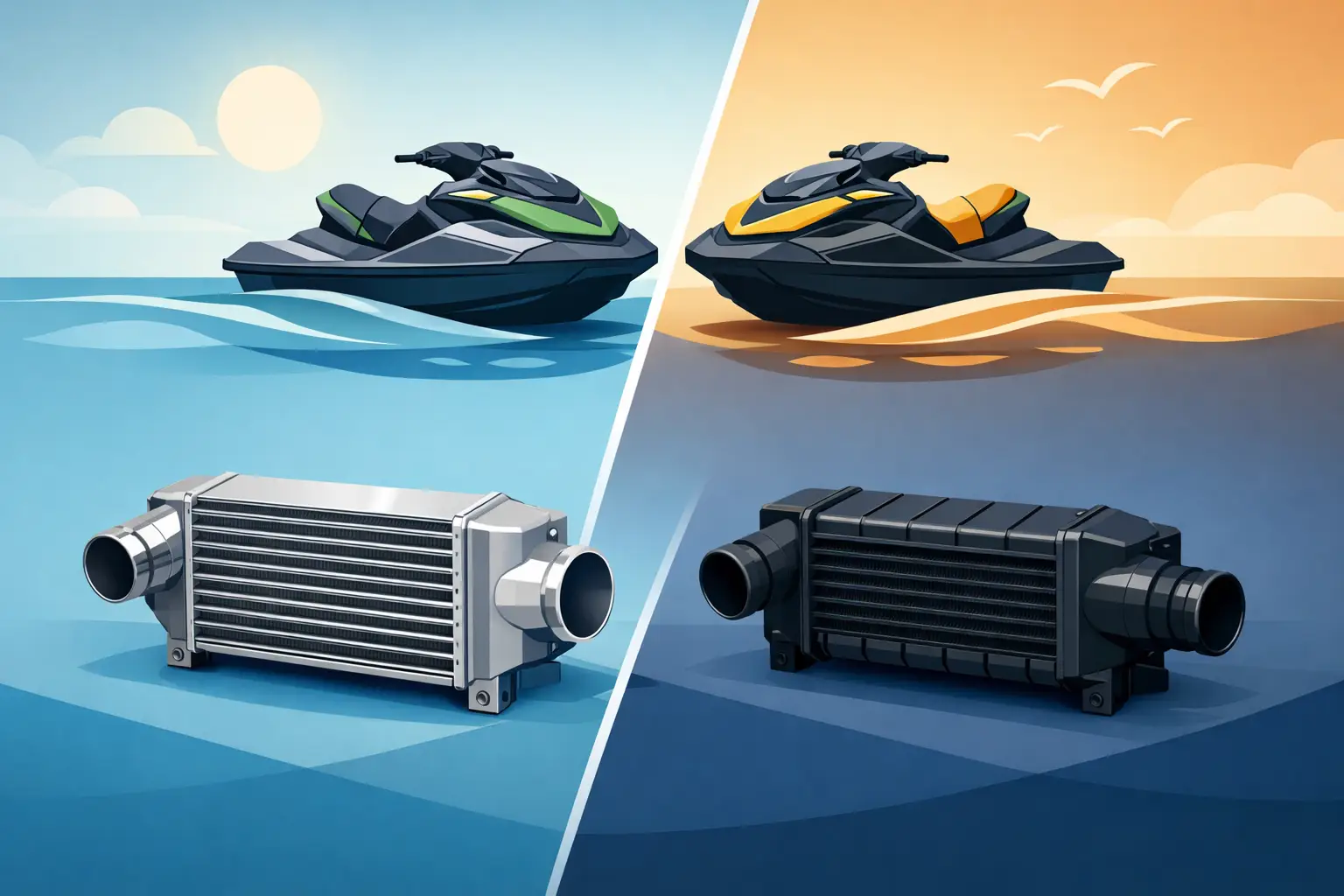
A Sea-Doo intercooler versus stock comparison is not about bolting on a shiny part for the sake of it. On a supercharged Sea-Doo, charge-air temperature directly affects how consistently the engine performs when the throttle is pinned, the water is hot and the ski is carrying fuel, passengers or race hardware. The stock intercooler is built for a standard-calibration machine. Once boost, engine speed or sustained load climbs, its limits become much easier to find.
For some owners, an upgraded intercooler is one of the smartest reliability-focused modifications available. For others, especially riders with a standard ski used for short recreational runs, the factory unit may still be the right answer. The correct choice comes down to how the ski is ridden, what other modifications are planned and whether the entire package is calibrated to work together.
What the intercooler does on a Sea-Doo
A supercharger compresses intake air before it enters the engine. Compression creates heat. Hotter intake air is less dense, which means less oxygen is available for combustion. It also raises the engine’s tendency towards knock or detonation under load.
The intercooler removes heat from that compressed air before it reaches the intake manifold. Sea-Doo’s supercharged platforms use an air-to-water charge-cooling arrangement. Incoming water absorbs heat from the compressed intake charge, then exits through the cooling system. When the intercooler can keep intake temperatures under control, the engine receives denser air more consistently and the ECU has a better environment in which to deliver safe, repeatable performance.
That word – consistently – matters. A ski can feel strong during a short blast and still lose its edge after repeated acceleration, long high-speed runs or hard laps. Heat soak is where an intercooler upgrade earns its place.
Sea-Doo intercooler versus stock: the real difference
The factory intercooler is a compromise designed around production cost, packaging, emissions compliance, intended power level and broad ownership conditions. It has to work acceptably for a large number of riders, not just the owner chasing higher boost and hard launches.
A quality aftermarket intercooler generally increases cooling capacity through a larger core, improved internal flow design or both. The aim is to remove more heat without creating an unnecessary restriction in either the charge-air path or water circuit. Better units are also built with stronger construction and corrosion-resistant materials suited to a marine environment.
The result is not always a dramatic peak horsepower figure on its own. The bigger gain is often maintaining performance where the stock system begins to struggle. Lower and more stable intake-air temperatures can support safer tuning, more consistent throttle response and stronger repeat pulls. On a modified ski, that consistency can be the difference between a setup that feels sharp all day and one that starts pulling power when conditions get tough.
There is a trade-off. A larger intercooler can add cost, installation time and plumbing complexity. It also needs to be a properly engineered unit for the specific Sea-Doo platform. Bigger is not automatically better if water flow is poor, hose routing is wrong or the core introduces an excessive pressure drop.
When the factory intercooler is enough
A healthy stock intercooler is generally suitable for a standard supercharged Sea-Doo used for normal recreational riding. If the machine is correctly serviced, operated in reasonable conditions and not being pushed through repeated wide-open-throttle passes, replacing it simply because aftermarket options exist may not deliver value.
Stock can also be the sensible option where budget is better directed towards overdue servicing. A worn supercharger clutch, tired spark plugs, poor fuel quality, blocked cooling passages, an air leak or a driveline issue will not be fixed by an intercooler. Performance upgrades should never jump ahead of basic mechanical condition.
For a standard ski, inspect the existing intercooler and cooling system during routine servicing. Saltwater use, debris, corrosion and neglected flushing can all reduce cooling efficiency. A pressure test and a proper assessment are more useful than guessing from a loss of top speed alone.
When an upgraded intercooler makes sense
An aftermarket intercooler becomes far more compelling when the ski has a modified supercharger, increased boost, a performance intake and exhaust combination, ECU tuning or engine work. These changes can move considerably more air and generate more heat than the factory system was intended to manage.
It is also a worthwhile consideration for riders who hold the ski hard on the throttle. Closed-course riding, drag-style acceleration, offshore running, towing, hot summer conditions and heavily loaded jet boats all place more thermal demand on the engine than a few quick passes near the ramp.
Australian riding conditions can be unforgiving. Warm ambient temperatures and warm water reduce the cooling system’s margin, while saltwater exposure adds corrosion risk. If your Sea-Doo is built to perform repeatedly rather than occasionally, charge-air cooling should be viewed as part of the engine’s safety margin, not merely an add-on.
An intercooler upgrade is particularly sensible before asking for a more aggressive tune. Tuning should be matched to actual hardware, fuel quality and intended use. Adding boost without adequate charge cooling is a shortcut that can produce a strong initial result and a poor long-term outcome.
Cooling capacity is only part of the job
Intercooler choice should never be separated from the rest of the build. A well-matched setup considers supercharger specification, boost level, fuel system capacity, intake and exhaust flow, ECU calibration, engine condition and the rider’s goal. A reliable 100 km/h recreational package has different requirements from a race-oriented build chasing every available gain.
The installation quality matters just as much as the core itself. Hose clamps must be secure, connections correctly sealed and cooling lines routed without kinks. Any boost leak after the intercooler can cause poor running and misleading diagnostic symptoms. Any restriction in the water circuit can undermine the benefit of the upgrade.
Before fitting an intercooler, check these areas as part of the same job:
- supercharger condition and the intended boost level
- coolant-water hoses, fittings and clamps for corrosion or damage
- intake tract sealing and manifold condition
- fuel quality and the fuel system’s ability to support the calibration
- ECU tune suitability for the complete hardware combination
This is why a package approach beats random parts purchases. More airflow, more boost and more fuel must be controlled together. The target is usable power that remains dependable, not a dyno number that creates heat and maintenance problems later.
What performance changes can you expect?
On a completely stock machine, expectations should be realistic. You may notice a firmer, more repeatable pull during extended riding, but the upgrade is not a substitute for a tuned supercharger or a full performance package.
On a modified Sea-Doo, the benefit is usually clearer. Lower charge-air temperatures provide the conditions needed for a tuner to safely optimise the calibration around the supporting hardware. Depending on the model and combination, that may translate into stronger acceleration, better high-rpm consistency and less performance fade after repeated runs.
No responsible workshop should promise a fixed power gain from an intercooler alone. Results vary with model, boost, tune, fuel, water temperature, rider load and mechanical health. What can be said with confidence is that effective intercooling gives a supercharged engine a better chance of making its intended power consistently.
Reliability: where good upgrades pay for themselves
A performance part that improves thermal control can protect the rest of the investment. High intake temperatures increase stress across the combustion process. When a ski is already operating near the limits of its tune, reducing that heat burden is a practical move towards reliability.
That does not make an upgraded intercooler maintenance-free. Flush the ski after saltwater use, follow the relevant Sea-Doo maintenance procedures and investigate any change in cooling discharge, power delivery or fault behaviour early. Corrosion, restricted water flow and damaged hoses can turn a strong performance setup into an expensive diagnosis.
For owners on the Central Coast who want the job handled as a complete package, VTECHTUNED can assess the ski’s current condition, recommend hardware that suits the target and match the tuning to the finished build. That avoids the common problem of fitting premium parts without knowing whether the system around them can support them.
Make the decision based on the build, not the hype
Choose the stock intercooler if the Sea-Doo is standard, healthy and used for casual riding without prolonged hard loading. Choose an upgraded unit when the ski is boosted, tuned, raced, ridden hard in heat or being built with long-term performance reliability in mind.
The best intercooler is not necessarily the largest one on the shelf. It is the unit with the right fitment, cooling capacity and flow characteristics for your engine package, installed properly and backed by a calibration that respects the limits of the whole machine. Build it once with a clear goal, then enjoy the throttle without wondering whether heat is taking the edge off every hard run.



