
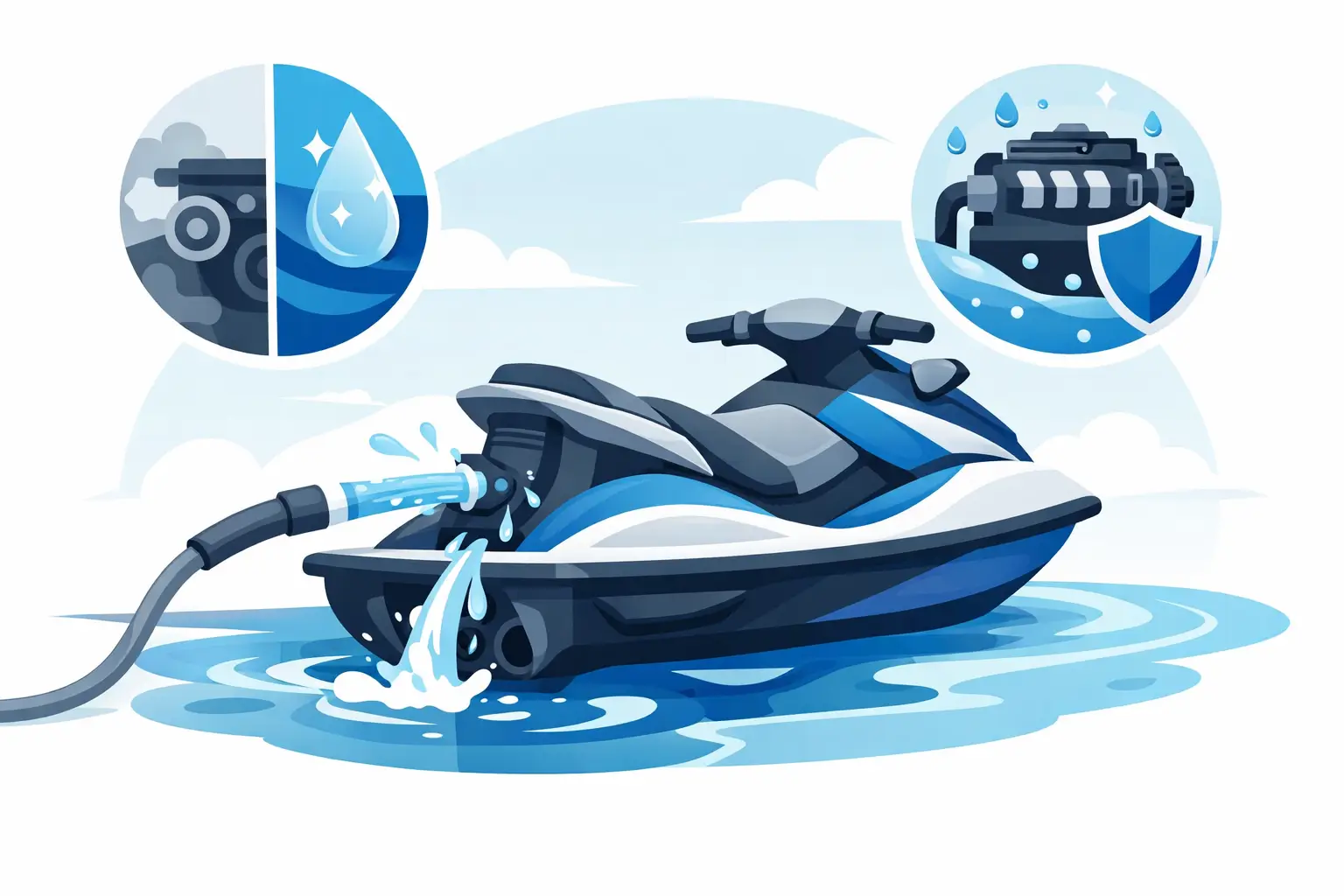
Saltwater does not need long to start attacking a PWC cooling system. If you ride in the ocean, estuary or brackish waterways, knowing how to flush JetSki engine correctly after every ride is basic reliability work. Get the order wrong, leave it too long, or run the motor dry for too long and a quick maintenance job can become an overheating, corrosion or water-ingestion repair.
Flushing is simple, but it is not a one-size-fits-all process. Sea-Doo, Yamaha and Kawasaki models use different cooling layouts, hose connections and run-time limits. Your owner’s manual always takes priority, especially on a modified or supercharged machine.
What flushing actually does
On most Yamaha and Kawasaki PWCs, raw water is drawn through the intake while riding and circulated through parts of the engine and exhaust system. In saltwater, that leaves salt crystals, sand and mineral deposits behind as the machine dries. A freshwater flush pushes that residue out before it can restrict passages, corrode fittings or damage exhaust components.
Many Sea-Doo models use a closed-loop cooling system for the engine, with coolant circulating through a heat exchanger. That does not mean you can skip flushing. Raw water still passes through the exhaust system and, depending on the model and setup, other components. You are flushing the raw-water side of the ski, not replacing the engine coolant service.
A flush will not repair existing corrosion, clear a severely blocked cooling passage or fix an overheating fault. If your ski has a temperature warning, poor power, steam, water leaking into the hull or an unusually hot exhaust, stop riding it and have the cause diagnosed before further damage occurs.
Before you flush your JetSki engine
Park the PWC on level ground with good ventilation. Make sure the trailer is stable, the rear drain plugs are removed if you are checking the hull for water, and the engine bay is free of pooled water. Never flush in an enclosed garage. Exhaust fumes build up quickly.
Use a standard garden hose with a proper PWC flushing adaptor if your model requires one. Avoid high-pressure washers or compressed air at the flush fitting. More pressure is not better – it can force water where it does not belong and can damage hoses or seals.
It also pays to inspect the hose connection before starting. Check for cracked hoses, loose clamps and corroded fittings. On performance skis, particularly supercharged Sea-Doos and modified Yamaha or Kawasaki platforms, heat management is less forgiving. A small cooling-system weakness that goes unnoticed on a stock ski can become a major issue under boost and sustained throttle.
How to flush JetSki engine the safe way
The critical rule for most PWCs is simple: start the engine before turning on the water, then turn off the water before stopping the engine. This prevents pressurised hose water from backing up through the exhaust and potentially entering the cylinders.
Connect the hose with the water off
Locate the factory flush fitting. It is usually near the rear of the hull or under a service cover, but the position varies by brand and model. Connect the hose or adaptor securely while the tap remains off. Do not leave a hose connected between rides, as accidental water pressure can cause problems.
Start the engine first
With the lanyard attached and the ski in a ventilated area, start the engine. Let it settle briefly at idle. Do not rev it hard on the trailer. Without water resistance, the engine can free-rev rapidly, and there is no benefit in trying to simulate riding conditions on the hose.
Turn on the water gently
Once the engine is running, turn on the tap. You want a steady supply, not maximum household water pressure. Water should begin exiting from the normal outlet or tell-tale point on applicable models. The outlet flow can vary by model and may not look identical at idle, so do not rely on that alone as proof of correct cooling.
Run the ski only for the period specified by its manufacturer. Many PWCs should be run for roughly 60 to 90 seconds during a flush, while some procedures allow a little longer. Do not assume extra time means a cleaner system. Extended idling on the hose adds unnecessary heat because there is no natural water flow or load condition like there is on the water.
Turn the water off before the engine
Shut off the tap first, then let the engine run for a few seconds to expel remaining water from the exhaust. Stop the engine immediately after that. This order matters. Turning the engine off while the water is still flowing creates the risk of water travelling backward through the exhaust system.
After the engine stops, disconnect the hose. Wipe down the fitting and check that its cap is secure. If the ski has been used in saltwater, rinse the hull, pump area, ride plate and trailer as well. Salt left around fasteners, wiring, intercooler plumbing and pump hardware causes its own set of expensive problems.
Do not make these common flushing mistakes
The biggest mistake is turning on the hose before starting the engine. Water pressure can fill sections of the exhaust and, in a worst-case scenario, reach the combustion chambers. Water does not compress. Attempting to crank an engine with a cylinder full of water can bend a conrod or cause serious internal damage.
The next mistake is running the engine for too long. A PWC on a hose is not operating in its intended environment. It lacks the cooling flow, exhaust back pressure and load it sees in the water. A brief flush is maintenance. Ten minutes of idling to ‘warm it up’ is needless risk.
Owners also sometimes assume every overheat warning is caused by salt. Weed, plastic bags, sand, damaged wear rings, failing pumps, blocked strainers, exhaust leaks and mechanical faults can all contribute. If a warning appeared on the water, flushing it afterwards does not make the fault disappear.
Finally, do not confuse flushing with a full post-ride inspection. Lift the seat, look for water in the hull, inspect the bilge area, and check for loose clamps or salt residue. On a supercharged ski, pay close attention to intake and intercooler plumbing. A clean engine bay makes small leaks much easier to spot before they cost a weekend on the water.
Freshwater riders still benefit from flushing
If you only ride in freshwater, flushing is still worthwhile after muddy, silty or weed-heavy conditions. It can remove debris from the cooling and exhaust pathways and gives you a regular opportunity to inspect the machine. It is especially sensible after riding in water of unknown quality, after a long trip, or before storing the ski.
For freshwater-only owners, the urgency is lower than it is after saltwater use. For ocean riders around the Central Coast, it is a non-negotiable part of putting the ski back on the trailer. Saltwater corrosion rarely announces itself early. It starts quietly at clamps, fittings, sensors and narrow passages, then shows up when reliability matters most.
Flushing before storage
A final flush should be part of any lay-up routine, but it is not the whole job. If the ski will sit for weeks or months, dry the engine bay, remove moisture from the hull, stabilise the fuel as required, maintain the battery and follow the manufacturer’s storage procedure. Engine fogging requirements vary by model and engine type, so do not spray products into an intake unless the correct procedure calls for it.
Performance builds deserve an extra level of care before storage. Higher cylinder pressures, upgraded fuel systems, aftermarket intercoolers and custom calibration all rely on a healthy supporting package. Routine maintenance is what protects the power you paid for.
If the flush fitting is damaged, water flow looks wrong, or the ski has overheated, do not keep testing it on the hose. A specialist inspection can identify whether the problem is a simple blockage or a cooling-system fault waiting to become an engine build. At VTECHTUNED, that is the difference between guessing at a repair and protecting performance, power and precision for the next ride.



