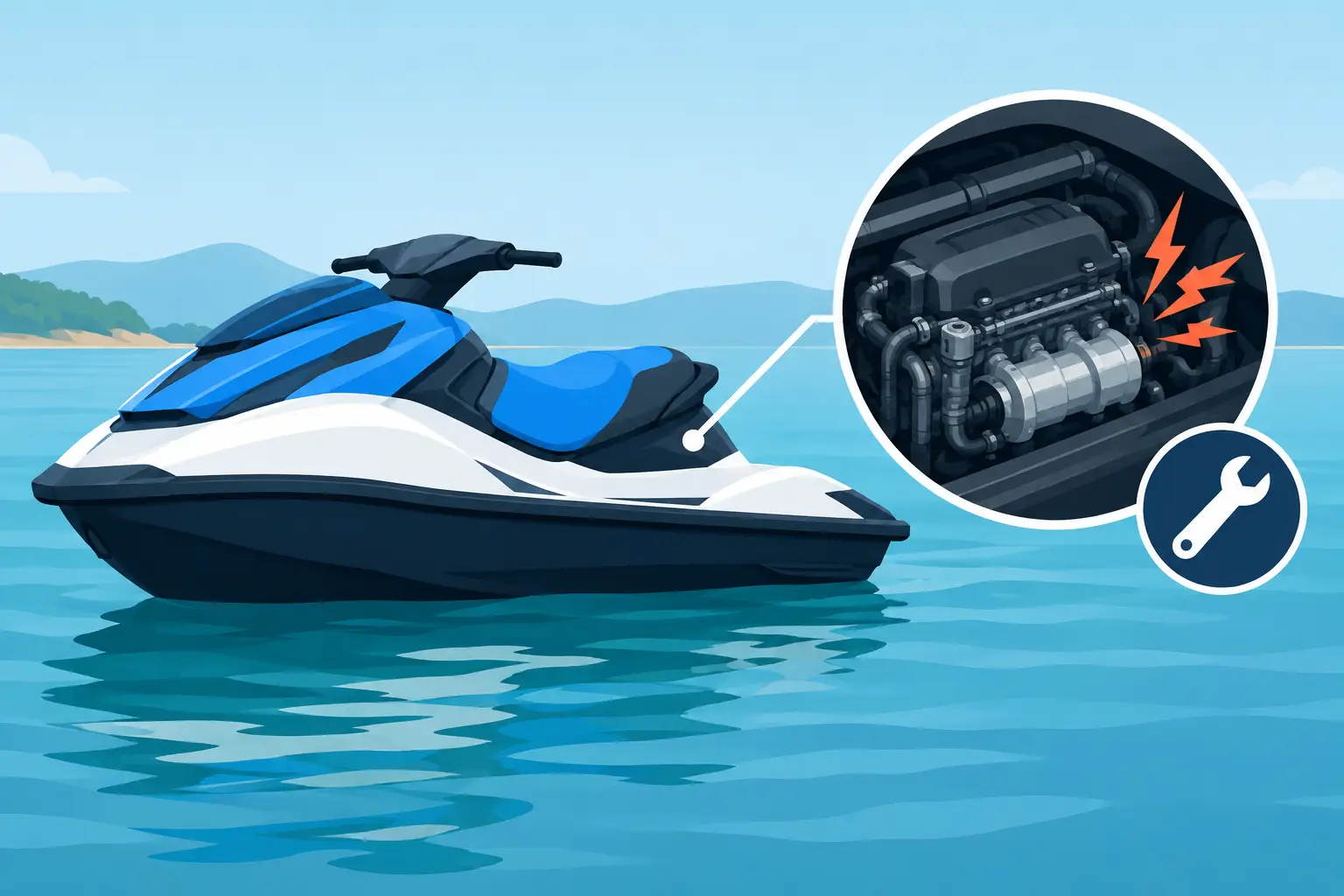
A sharp metallic rattle when you load the throttle is not a noise to ride through. If you are asking what causes JetSki engine knock, treat it as a warning that combustion, lubrication or an internal component may be outside its safe operating range. On a high-output Sea-Doo, Yamaha or Kawasaki, a few hard pulls with genuine knock can turn a manageable repair into an engine build.
The first job is to separate true engine knock from the many other noises a personal watercraft can make. A loose exhaust shield, worn engine mount, pump noise or driveline rattle can sound serious, but combustion knock and bearing knock need immediate attention. Stop riding, avoid repeated throttle tests, and get the fault properly diagnosed before more load goes through the engine.
What Causes JetSki Engine Knock Under Load?
Most riders notice knock when accelerating hard, towing, carrying passengers or holding the ski wide open. That is no accident. Cylinder pressure and engine load are at their highest, exposing a fuel, tuning, cooling or mechanical problem that may be barely audible at idle.
Detonation: the combustion knock that breaks parts
Detonation occurs when the air-fuel charge in the cylinder ignites in an uncontrolled way after the spark event. Instead of a smooth flame front pushing the piston down, combustion pressure spikes violently. The sound is often described as pinging, rattling or marbles in a tin, usually when the engine is under load.
On a naturally aspirated ski, detonation may be caused by poor fuel, excessive heat or a fuelling issue. On a supercharged or modified platform, the margins are tighter. More boost, more ignition timing and more cylinder pressure can make excellent power when the calibration, fuel and cooling system are right. Get one of those wrong and the same setup can damage pistons, rings, ring lands and head gasket sealing surfaces very quickly.
Fuel quality, octane and contaminated fuel
Low-octane fuel is one of the most common reasons for detonation. Use the minimum octane rating specified for your exact model, and understand that many supercharged PWCs and performance tunes are calibrated around fresh 98 RON premium unleaded. Running a fuel grade below the tune’s requirement is a direct path to knock.
Age matters as well. Fuel sitting in a tank, jerry can or ski through a quiet season can lose quality. Water contamination, phase separation in ethanol-blended fuel and rubbish from a contaminated fuel system can all affect combustion. A fuel sample may reveal an issue, but the entire system still needs checking if contaminated fuel is suspected. Replacing the fuel without investigating filters, injectors and the tank pickup can leave the underlying restriction behind.
Lean mixtures and inadequate fuel delivery
An engine that runs lean has too much air for the available fuel. Lean combustion raises cylinder temperature and increases knock risk. The cause may be a partially blocked injector, weak fuel pump, restricted filter, pressure regulator fault, damaged wiring or an air leak downstream of the throttle body.
This is why guessing from the sound is not enough. Fuel pressure needs to be checked against specification, injectors need meaningful testing, and the ECU data should be reviewed where available. On modified skis, injector size, fuel pump capacity and ECU calibration must work as one system. Adding airflow or boost without supplying the matching fuel is not a performance upgrade. It is an expensive gamble.
Heat, Cooling Faults and Carbon Build-Up
PWCs rely on a constant water supply and an effective cooling path. A blocked intake grate, debris in the cooling circuit, a failed thermostat where fitted, restricted hoses or a compromised intercooler can increase operating temperatures. Salt build-up can also reduce flow over time, particularly on skis used regularly in the ocean.
High inlet-air temperatures are equally important on supercharged engines. Heat-soaked intercoolers, low coolant levels in a closed-loop circuit, restricted heat exchangers or repeated hard riding without recovery time can raise charge-air temperature and make detonation more likely. The ECU may pull timing to protect the engine, but that protection is not a licence to keep pushing a ski with a cooling fault.
Carbon deposits are another contributor. Build-up in the combustion chamber can raise effective compression and create hot spots that encourage pre-ignition or detonation. It is more likely on engines that have had poor maintenance, excessive oil consumption, incorrect fuelling or a long history of low-load operation. Carbon is rarely the only fault, so avoid treating it as a simple chemical-clean fix without checking the rest of the engine.
Tuning, Boost and Ignition Problems
A performance tune should be written for the hardware, fuel and intended use of the ski. A file designed around 98 RON, a specific supercharger wheel, injector set and intercooler arrangement cannot safely be copied onto a different combination. Even two apparently similar models can have meaningful differences in sensors, compression, intake design and factory calibration.
Too much ignition advance, excessive boost or an incorrect air-fuel target can cause knock immediately. So can a tune that does not account for Australian fuel quality and real-world water temperatures. Remote tuning can deliver strong results, but only when logging, mechanical condition and the complete parts package are addressed properly.
Spark plugs also deserve attention. Incorrect heat range, wrong gap, damaged electrodes or plugs that are not torqued correctly can contribute to misfire and abnormal combustion. A plug inspection can provide clues, but it should be read alongside compression, leak-down, fuelling and ECU data. Replacing plugs may mask a symptom while the actual problem continues.
Mechanical Knock: Bearings, Pistons and Valvetrain
Not every knock is detonation. A deep, dull knock that follows engine speed, remains present off-load, or gets worse as the engine warms can point to mechanical damage. Worn connecting-rod bearings, crankshaft main bearings, piston pin wear, piston slap or a damaged piston can all create alarming noise.
Mechanical knock may follow an earlier overheating event, oil starvation, water ingestion, severe detonation or simple high-hour wear. Four-stroke PWCs depend on clean oil at the correct level and viscosity. Low oil, fuel-diluted oil, metal contamination or an oiling-system issue can destroy bearings fast. If the oil looks metallic, smells strongly of fuel or the oil pressure warning has appeared, do not restart the engine for another listen.
A top-end tick can also be mistaken for knock. Excessive valve clearance, damaged cam followers, timing-chain issues or valvetrain wear may produce a sharper tapping noise from the top of the engine. These faults still require prompt attention, but the repair path is different from a bottom-end bearing failure. Proper diagnosis protects you from replacing the wrong parts.
Don’t Confuse an Engine Knock With Driveline Noise
A PWC has plenty of components that can make noise under throttle. Worn engine mounts can let the engine move excessively. A damaged coupler, worn driveshaft splines, pump bearing fault, debris in the pump or a loose exhaust component can create vibration, clunks or rattles that change with RPM.
The key distinction is that true combustion knock normally appears under heavy cylinder load, while mechanical engine knock often tracks engine speed more consistently. Driveline noises may change when the ski is in the water, when thrust loads the pump, or when steering angle and hull movement change. Those patterns are useful, but they are not a substitute for an inspection.
What to Do When You Hear Knock
Do not keep making full-throttle passes to confirm the noise. Back off immediately, return to shore carefully if the engine is otherwise operating safely, and avoid restarting it until basic checks are made. Check for warning messages, overheating signs, fuel leaks, water in the hull and obvious loose hardware.
A specialist diagnosis should then establish whether the noise is combustion-related or mechanical. That commonly involves a scan for fault codes and logged data, fresh-fuel verification, fuel-pressure testing, cooling-system checks, spark-plug inspection, compression and leak-down testing, oil inspection and targeted checks of the pump and driveline. If metal or internal damage is suspected, further strip-down is far cheaper than allowing a bearing or piston failure to spread through the engine.
For modified and supercharged PWCs, bring the full build information to the workshop: ECU tune, fuel used, boost setup, injectors, intercooler, recent servicing and exactly when the noise began. At VTECHTUNED, that complete picture matters because reliable power comes from matching the mechanical package to the calibration, not simply chasing a bigger number.
The best outcome is catching the issue while it is still a fuel, cooling or calibration correction. The moment a JetSki starts knocking, take the warning seriously – protecting the engine now leaves more time for riding later.



