
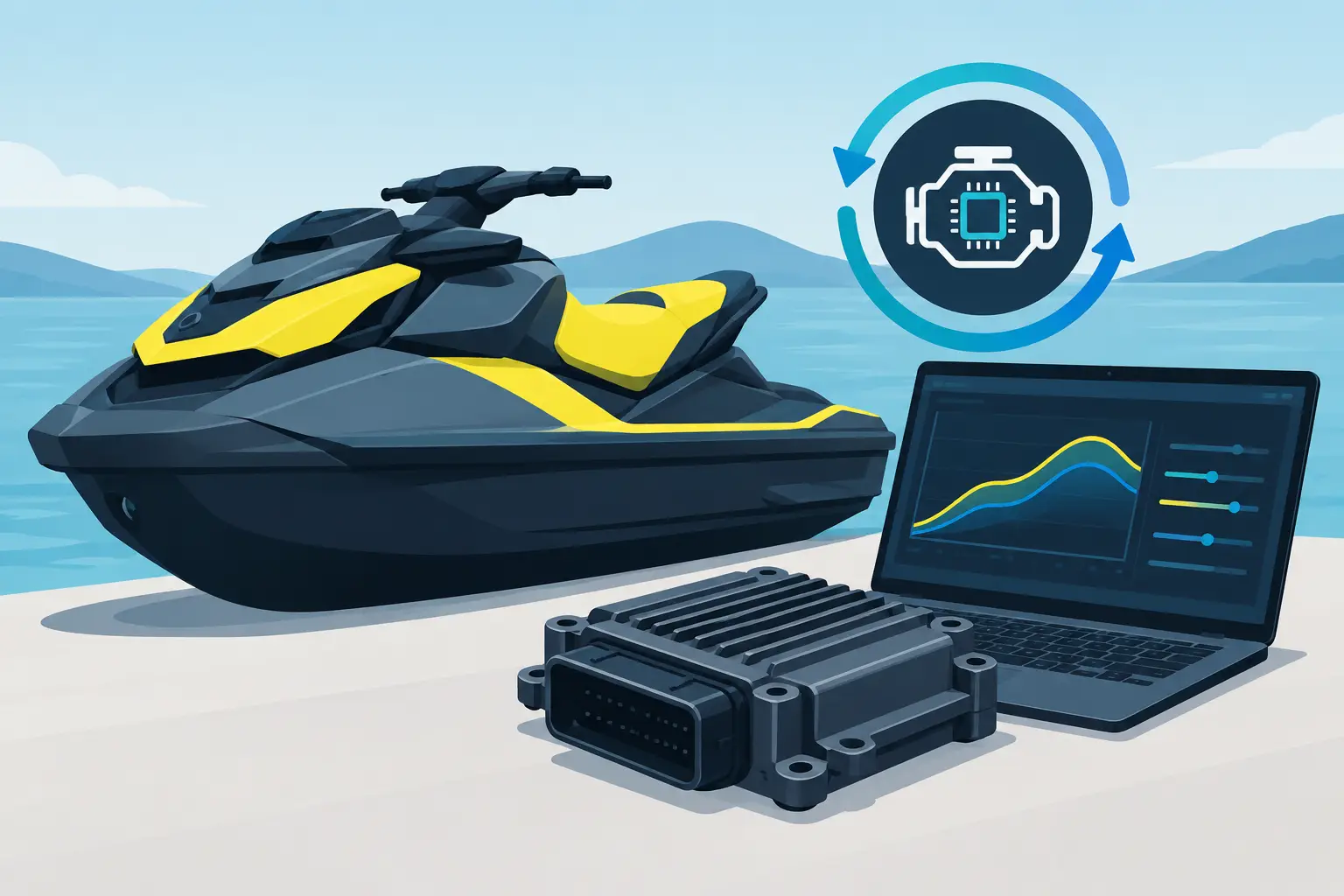
A Sea-Doo that hesitates off the trailer, surges through the mid-range or pulls fault codes is not asking for a random tune file. Knowing how to calibrate Sea-Doo ECU parameters starts with identifying whether the issue is adaptation, sensor data, software strategy or a genuine mechanical fault. Get that order wrong and a calibration can hide the real problem until it becomes an expensive one.
On a healthy performance build, ECU calibration is where the hardware begins to work as a package. Fuel delivery, ignition timing, throttle behaviour, boost control and protection strategies need to match the engine, fuel, intake and exhaust fitted to the ski. The goal is not simply more power. It is controlled, repeatable power that holds up under load on the water.
What Sea-Doo ECU calibration actually means
The word calibration gets used broadly in the PWC world. In practice, it can mean several very different jobs. A factory-level procedure may reset learned values, initialise components, update software or relearn throttle position. A performance calibration changes ECU maps and operating limits to suit a modified setup.
Those are not interchangeable jobs. Resetting adaptations will not correct a lean fuel table on a supercharged engine. Loading an aggressive performance file will not repair a weak fuel pump, failing intercooler, worn supercharger clutch or damaged sensor. Before touching the ECU, establish exactly what needs calibrating and why.
On late-model Sea-Doos, the ECU is tied into a wider electronic system. The control strategy can rely on throttle position, intake air temperature, manifold pressure, coolant temperature, crank position, knock feedback and other inputs. If one of those inputs is implausible, the ECU may reduce power to protect the engine. That can feel like a tuning fault even when the map itself is fine.
Start with a mechanical and diagnostic baseline
A proper calibration begins in the workshop, not with a laptop on the rear deck. Scan for stored and active fault codes, then inspect the data rather than clearing codes and hoping they stay away. Fault history often points to intermittent issues that are not present while the ski is sitting on the trailer.
Confirm the basics first: battery voltage and charging performance, clean terminals, sound earth connections, fresh fuel of the intended octane rating, correct spark plugs and healthy coils. On supercharged models, check the intake tract, charge-air cooling system, exhaust condition and supercharger health. A boost leak or restriction can change airflow enough to make a previously safe calibration unsuitable.
Fuel system condition matters just as much. The injectors must be clean and appropriately sized for the build, while the pump and filters need to maintain fuel supply under sustained load. A ski may idle perfectly and still run short of fuel at full throttle. That is why static testing alone cannot sign off a performance calibration.
For modified engines, compression and leak-down testing are sensible before tuning. If the engine has internal wear, a valve sealing issue or piston damage, adding load through testing is the wrong move. Reliable power begins with a mechanically sound platform.
How to calibrate Sea-Doo ECU settings safely
The exact workflow depends on the model, year, engine package and whether the machine retains factory hardware. However, the professional process follows a clear sequence.
First, record the ski’s current configuration. That includes engine model, ECU software version, impeller, intake, exhaust, air intake, intercooler, injectors, supercharger setup and fuel being used. Include recent repairs as well. A changed intercooler, exhaust restriction or fuel component can alter what the engine needs.
Next, save the original ECU file where the platform allows it and verify a stable power supply. Voltage drop during programming can corrupt a control unit. Use the correct tuning interface and software for the ECU, and never assume a file from a similar Sea-Doo is suitable. Two skis with the same hull can have materially different engine, sensor and hardware combinations.
The calibration itself should be matched to the hardware and the intended use. A recreational ski that spends long periods carrying passengers needs a different safety margin from a short-course race build. Ambient temperature, water conditions and fuel availability in Australia also affect the final strategy. A tune that looks impressive in cool conditions may not be safe during a hot Central Coast summer session.
After programming, carry out any required throttle, idle or adaptation procedures using the appropriate diagnostic equipment. Then re-scan the ECU, confirm live sensor readings are credible and inspect for leaks, warning messages or unusual behaviour before putting the ski under serious load.
Data logging is where the real work happens
A tune should be validated on the water, where the engine sees the load it was built for. Trailer testing and flushing can confirm basic operation, but they cannot replicate sustained acceleration, boost demand or exhaust back pressure at speed.
Data logs let the tuner see what the engine is doing rather than relying on how fast it feels. The useful channels vary by platform, but usually include RPM, throttle position, intake and coolant temperatures, manifold pressure or boost, battery voltage, injector behaviour and fault activity. On appropriate setups, air-fuel ratio data is equally valuable.
Make controlled runs. Bring the engine to temperature, use the same fuel, and compare repeatable acceleration and full-throttle pulls in safe conditions. If a change is required, adjust one variable at a time and log again. This makes cause and effect clear, while reducing the risk of chasing a problem created by several changes at once.
There is a trade-off in every performance calibration. More ignition timing, leaner mixtures, higher boost targets and raised RPM limits can improve output, but each one reduces the margin available when fuel quality drops, inlet temperatures rise or component wear appears. For a ski used regularly, a conservative and well-validated result is usually faster over a season than a peak number that only survives a few hard passes.
Do not tune around warning signs
A derate, limp mode or check-engine warning is a protection response, not an inconvenience to delete. If the ECU pulls power because of high temperature, implausible sensor readings, knock activity or a control-system fault, find the cause. Turning off protective strategies may leave the engine exposed precisely when it needs them.
The same approach applies to factory emissions and noise equipment. Any ECU work should comply with applicable laws, waterway rules and the ski’s intended operating conditions. A clean, reliable calibration is better for the rider, the engine and everyone sharing the water.
Be cautious with generic files too. An off-the-shelf tune can be suitable for a tightly defined, common package, but it still needs the supporting hardware, correct fuel and post-flash checks. It becomes a poor fit when the ski has an unusual combination of parts, unknown previous work, engine internal upgrades or a history of faults.
When specialist tuning is the better call
Owners who are comfortable with diagnostics can handle preliminary checks, maintenance and accurate configuration notes. ECU programming and calibration validation are different stakes, particularly on supercharged or heavily modified Sea-Doos. One incorrect assumption about fuel pressure, boost, injector scaling or sensor data can cost an engine.
A specialist workshop can assess the whole package, not just the ECU file. That means confirming the mechanical condition, fitting the right supporting parts, calibrating for the actual build and checking the result under load. VTECHTUNED takes this approach because dependable performance comes from the complete system, not a flashy number on a screen.
If your Sea-Doo has developed a fault, changed hardware or simply does not deliver the response it should, start with evidence: fault codes, service history, fuel used and a clear description of when the issue occurs. That gives the calibration process a solid foundation and gives your engine the best chance of delivering strong power every time you squeeze the throttle.



