
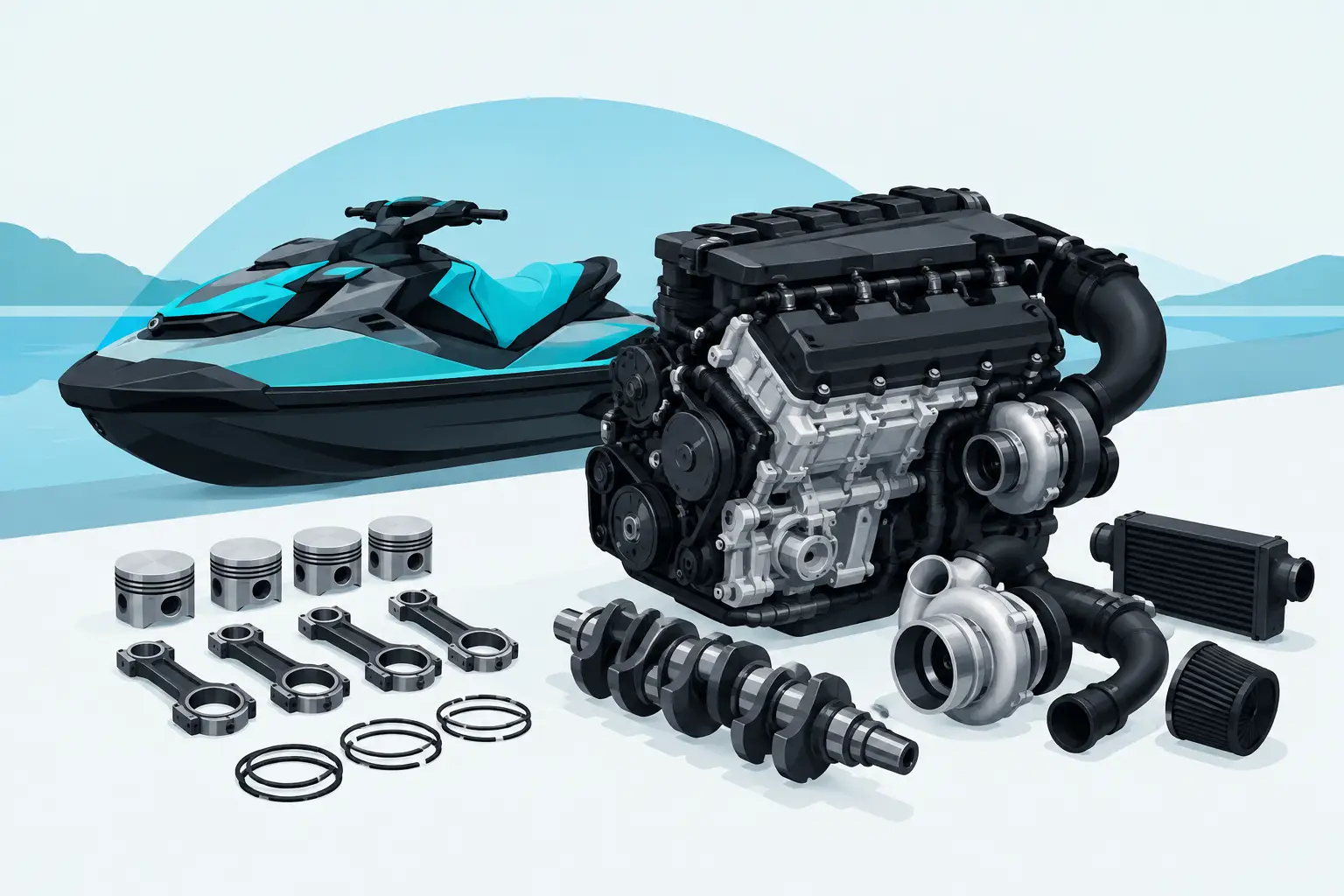
A Sea-Doo 1630 engine build example is not a shopping list of the biggest parts available. It is a matched combination built around a clear power target, the way the ski is ridden, fuel quality and the reliability expected when it is held wide open offshore. On a supercharged 1630 ACE platform, the difference between a quick ski and a dependable high-output package comes down to the details that cannot be seen once the engine is back in the hull.
For an owner moving beyond bolt-on power, this example shows the thinking behind a forged-internal build intended for strong recreational riding, aggressive lake use and occasional race-style passes. It is not a universal recipe. A 300-horsepower family ski, a closed-course race craft and a high-boost jet boat all need different compromises.
Start with the real goal, not the peak number
The Sea-Doo 1630 ACE is an exceptionally capable 1,630cc, supercharged three-cylinder engine. In standard form, it already delivers serious acceleration. Once boost, airflow and ECU calibration are increased, cylinder pressure rises quickly. That is where the build needs to become more than an intake, a pulley and a tune.
For this example, the brief is straightforward: build an engine that supports a meaningful increase in boost while retaining crisp throttle response and dependable operation through long summer sessions. The owner wants strong pull from the water, not a temperamental ski that only performs for one clean pass.
That brief determines the parts selection. A moderate-performance build may retain more factory hardware and concentrate on cooling, supercharger efficiency and calibration. A higher-output package generally calls for forged pistons and rods, upgraded valve control, a fuel system with headroom, and careful attention to the driveline. There is no value in building the bottom end for extreme boost if the intercooler, injectors or clutch arrangement are not ready for it.
Sea-Doo 1630 engine build example: the short motor
Every serious build starts with inspection and measurement. The engine is stripped, cleaned and assessed before any performance parts are ordered with confidence. Cylinder bores, crankshaft journals, bearings, deck condition and oiling components all need to be checked. A clean-looking engine is not automatically a sound foundation.
In this example, the standard pistons and connecting rods are replaced with quality forged components chosen for the intended boost and fuel. Forged pistons offer greater strength under elevated cylinder pressure, but they are not simply dropped in. Bore finish, piston-to-wall clearance, ring end gap and piston orientation must be set to the manufacturer specification and the planned operating temperature.
The connecting rods are selected to handle the load created by higher boost and repeated high-rpm operation. Rod bolts, bearing clearances and crank condition matter just as much as the rods themselves. An engine only lives as long as its oil film, clearances and fasteners allow it to live.
The crankshaft is inspected carefully and replaced or reconditioned if measurements demand it. Reusing a questionable crank to save money is false economy in a supercharged marine engine. During assembly, every critical fastener is torqued correctly, documented and checked. Precision is not a marketing line when a high-output 1630 is asked to work hard on hot water.
Compression is part of the tuning plan
Piston compression ratio needs to suit the fuel available and the boost target. Higher compression can improve response, but it narrows the tuning margin when boost and inlet temperatures climb. For an Australian recreational ski that may see inconsistent fuel quality, heat soak and long throttle pulls, a sensible compression and boost relationship is usually more valuable than chasing an aggressive dyno figure.
The right answer depends on whether the owner will consistently run premium fuel, how much boost the supercharger will produce, and whether the craft is used in salt water, fresh water or both. The calibration must be built around those real conditions, not best-case assumptions.
Head, valvetrain and airflow choices
The cylinder head is inspected for flatness, valve sealing and signs of overheating. A fresh build deserves properly seated valves and a stable valvetrain. Where engine speed and boost demand it, upgraded valve springs and retainers help maintain valve control. Valve float at high rpm can turn an otherwise well-built engine into an expensive recovery job.
Camshaft choice should match the application. More duration and lift can move the powerband and increase airflow, but a camshaft that looks impressive on paper may not suit a heavy ski, a specific pump setup or a rider who values immediate mid-range response. For many customers, a well-matched cam and calibrated supercharger package produces a faster, more enjoyable craft than an extreme cam profile that sacrifices manners.
Port work can also be useful, but it should be purposeful. Smoothing a restriction and matching airflow paths is different from removing material without a plan. Port shape, valve job quality and combustion-chamber consistency all influence how the engine responds under boost.
Supercharger, intercooler and fuel system must work together
A forged bottom end does not create power by itself. It creates the strength to support a system that moves more air and fuel safely. In this Sea-Doo 1630 engine build example, the supercharger is selected or upgraded to deliver the required airflow without being pushed beyond an efficient operating range.
Supercharger clutch condition is critical. Slip reduces boost, creates inconsistency and can leave a rider chasing a tuning issue that is actually mechanical. The clutch setup must match the boost target and be checked as part of routine maintenance, especially on a craft that sees hard launches and repeated full-throttle runs.
Charge-air cooling is equally important. Compressing air generates heat, and hot intake air increases knock risk while reducing density. An upgraded intercooler and sound water-routing strategy help maintain more consistent intake temperatures. This is especially valuable in NSW summer conditions, where warm ambient temperatures, hot engine bays and long idle periods can quickly add heat to the system.
Fuel delivery needs margin. Larger injectors, fuel pump upgrades or other fuel-system changes may be required depending on the output target. The point is not to install oversized components without reason. It is to ensure injector duty cycle, fuel pressure and fuel volume remain within a safe range when the engine is under maximum load.
ECU calibration is where the package becomes one engine
No high-performance 1630 build is complete without a calibration developed for its exact hardware. The ECU tune controls fuel, ignition timing, throttle behaviour, boost strategy, rpm limits and protection functions. A generic calibration may run, but it cannot account properly for every combination of cams, injectors, intercooler, supercharger, exhaust changes and local fuel.
A proper tune is conservative where it needs to be and responsive where the rider feels it. It should deliver clean starting, smooth throttle transition, controlled air-fuel ratios and timing that respects the fuel and inlet temperatures available. It should also retain sensible protection strategies rather than deleting safeguards to make a number look better.
Data logging and post-build checks are part of the process. Fuel pressure, boost behaviour, intake temperature, rpm and any fault activity should be reviewed under real load. Watercraft do not operate like cars on a chassis dyno. Hull load, water conditions, pump efficiency and rider input all change the demand placed on the engine.
Do not ignore the pump and supporting hardware
More engine power can expose weaknesses downstream. Impeller selection, wear ring condition, pump clearances and driveline health determine whether added horsepower becomes acceleration or simply aerated water and rev limiter activity. A ski that hooks cleanly often feels substantially quicker than one with more engine power but poor pump setup.
Exhaust components, intake hardware, hoses, clamps and cooling connections must also be inspected and upgraded where needed. A small boost leak, failing hose or loose clamp can end a ride quickly. On a marine application, corrosion protection and regular inspection are part of performance ownership, not an optional extra.
VTECHTUNED approaches these builds as complete packages because the workshop work, parts selection and tuning need to agree with each other. That gives the owner a clear path for maintenance after the build rather than a collection of parts with no accountability.
Run-in and maintenance protect the investment
The first hours after a build matter. Run-in procedures should follow the piston, ring and engine-builder requirements, with careful heat cycles and progressive load. Avoid treating the first tank as a race session. Early inspection for leaks, abnormal noise, fault codes and fluid condition can catch small issues before they become major damage.
After run-in, oil changes, supercharger inspection intervals, spark plug checks and cooling-system attention should be planned around the output level and usage. A high-performance PWC rewards owners who service it before a problem appears. It is far cheaper to inspect a clutch, replace a worn wear ring or address a lean-running issue early than to rebuild another engine.
The best 1630 build is the one that suits the rider, the fuel and the water it will actually see. Build for repeatable power, leave room for temperature and fuel variation, and make every supporting system earn its place in the package.



