
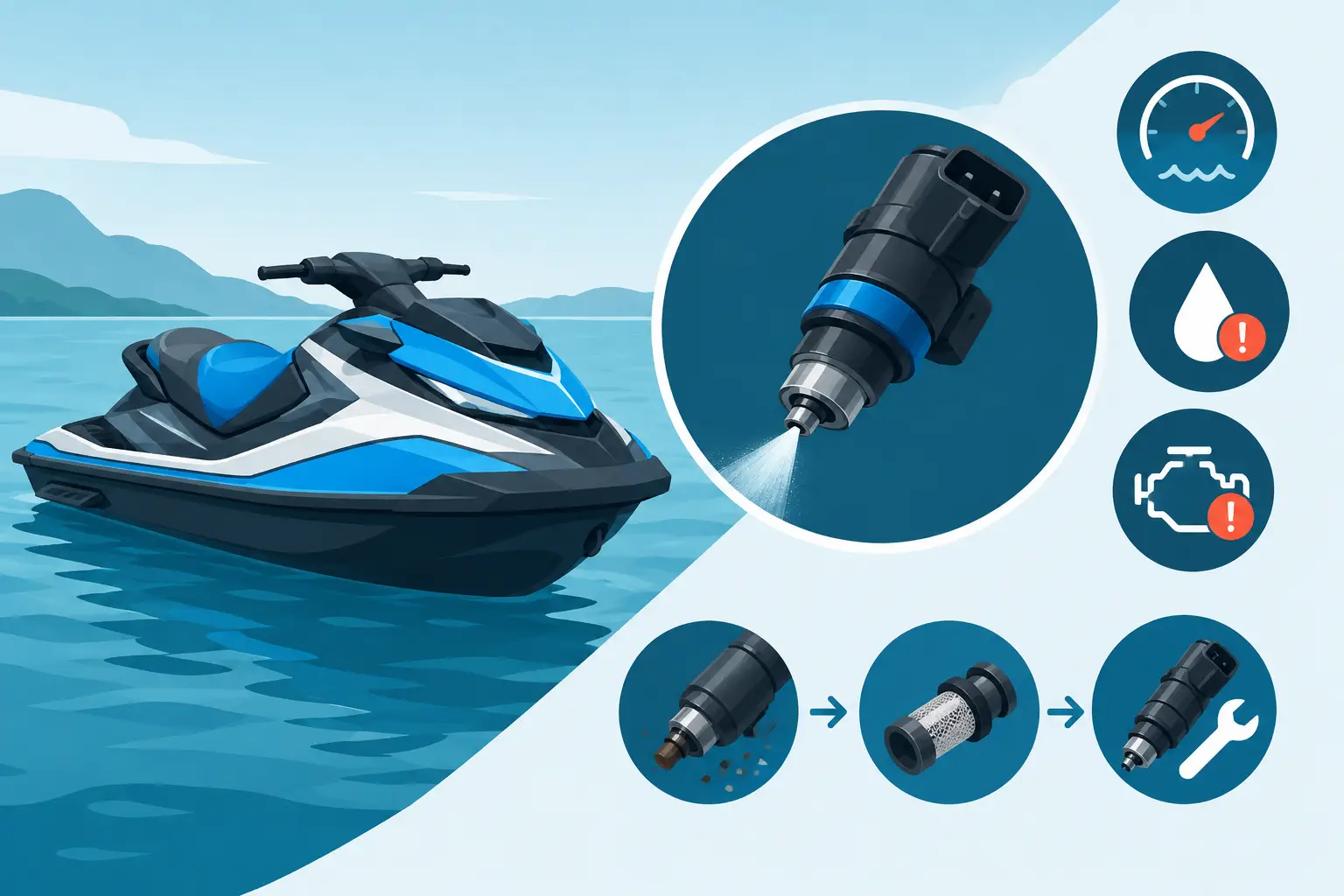
A JetSki injector failure rarely starts with a dramatic bang. More often, the ski begins to feel flat out of the hole, develops an uneven idle, surges under throttle or refuses to make the power it once did. On a high-output Sea-Doo, Yamaha or Kawasaki, ignoring those early changes can turn a relatively contained fuel-system repair into piston, valve or cylinder damage.
Injectors do one critical job: they deliver a precise amount of fuel at the precise moment the ECU commands it. When one sticks, clogs, leaks or loses its electrical signal, the air-fuel ratio is no longer under control. That is bad news for any PWC, but it is especially risky on supercharged, tuned and race-built engines where cylinder pressure and combustion temperatures are already higher.
What JetSki injector failure feels like on the water
The symptom depends on whether the injector is under-fuelling, over-fuelling or not firing consistently. A restricted injector commonly creates a lean cylinder. The engine may hesitate when you roll into the throttle, feel like it is breaking down at high rpm, or lose speed despite sounding reasonably normal at idle. In severe cases, the ski can detonate, run hotter than usual or trigger a protective fault mode.
A leaking or stuck-open injector produces the opposite problem. Expect a rough idle, hard hot starts, poor fuel economy, fuel smell, excessive smoke on some platforms, and a loaded-up feeling when you first accelerate. Fuel can also wash oil from the cylinder wall, increasing wear where you do not want it.
Intermittent injector faults are often the most frustrating. The ski may run cleanly on the trailer, then miss only after it has been ridden hard. Vibration, heat and moisture can expose a failing connector, damaged wiring or injector coil that a quick visual inspection misses.
The warning signs worth acting on
If your JetSki suddenly has a rough idle, a dead spot in the throttle, reduced top speed, a misfire under load or an engine warning, book diagnostics before another hard ride. Also take notice of spark plugs that no longer match from cylinder to cylinder, unexplained fuel use, fuel in the oil, or a piston wash pattern that suggests one cylinder is running differently.
Do not assume an injector is the culprit just because the ski is misfiring. Weak fuel pressure, a blocked filter, contaminated fuel, failing coils, worn plugs, air leaks, sensor faults and poor ECU calibration can all imitate injector trouble. Proper testing saves parts-swapping and protects the engine.
Why injectors fail in personal watercraft
Fuel quality is a major factor. Water contamination, stale fuel and debris can leave deposits around the injector inlet screen and nozzle. PWCs spend long periods parked between rides, often with heat cycling through the engine bay and fuel system. If fuel is left to deteriorate, varnish can restrict injector flow or cause an injector pintle to stick.
Saltwater use adds another layer of risk. Salt spray, corrosion and repeated wash-downs can affect injector connectors and loom terminals, particularly where a seal has been damaged or wiring has been previously disturbed. An injector may be mechanically sound but unable to operate correctly because the electrical circuit has high resistance.
Performance modifications change the equation too. Larger injectors, upgraded superchargers, camshafts and revised ECU tuning must work as a matched package. Fitting a fuel-system component without checking injector data, fuel pressure and calibration can create an unsafe mixture. More airflow without enough correctly controlled fuel is not a power upgrade – it is an engine-risk upgrade.
Mechanical contamination is another concern after an engine failure or rebuild. If debris has travelled through the fuel system, replacing a single injector without cleaning the rail, checking the pump supply and addressing the source can repeat the problem. The same applies to a failing fuel pump that sheds material or cannot maintain pressure at wide-open throttle.
How a workshop confirms injector trouble
A proper diagnosis begins with the fault history, how the ski behaves and whether the issue appears cold, hot, at idle or only under load. Scan data can reveal relevant fault codes, sensor values and cylinder-specific clues, but a code alone is not a diagnosis.
The next step is to verify the basics: fuel quality, fuel pressure, battery voltage, charging performance, injector power supply and ECU command. Injectors can then be checked electrically for coil resistance and circuit integrity. Depending on the model and fault, a technician may use a noid light, oscilloscope or targeted live-data checks to confirm the injector is receiving a correct pulse.
Where injector flow is suspected, removal and professional flow testing is the reliable path. A flow bench can compare delivery between injectors, inspect spray pattern and identify leakage. Ultrasonic cleaning may recover an injector affected by deposits, but it will not repair a damaged coil, cracked body or worn internal valve. If an injector cannot meet specification consistently, replacement is the smarter call.
On modified engines, the diagnosis should extend beyond whether the injector simply operates. The injector size, fuel pressure, duty cycle and ECU calibration must suit the engine combination. This is where a specialist performance workshop earns its keep. VTECHTUNED can assess the complete system rather than treating a high-performance ski like a standard service job.
Do not keep riding a suspected lean cylinder
A rich-running engine is untidy and can dilute oil. A lean-running cylinder can be far more destructive, particularly under sustained boost or high rpm. Detonation, melted piston edges, damaged rings and scored bores can follow quickly if the engine is pushed through a fuel-delivery fault.
If the ski has a serious misfire, warning light, overheating symptom or obvious loss of power, stop riding it. Do not keep making full-throttle test passes to see whether it clears up. Trailer it in, explain exactly when the fault occurs and mention any recent fuel, servicing, electrical work or modifications. That information can cut diagnostic time significantly.
Repair choices: clean, replace or upgrade?
Cleaning is appropriate when testing confirms the injectors are structurally sound and the issue is contamination or reduced flow. It is often worthwhile to service the injectors as a matched set, because one weak injector can indicate that the rest have seen the same fuel and storage conditions.
Replacement makes more sense where an injector leaks, fails electrically, has a poor spray pattern after cleaning or cannot deliver matching flow. Use quality injectors with the correct part number and data for the platform. Cheap, unverified injectors are a false economy on an engine that operates at high load over water.
An injector upgrade may be required for a built or boosted engine, but bigger is not automatically better. Oversized injectors can compromise low-load control if the ECU calibration and injector characterisation are wrong. The right approach is to select injectors for the target power level, confirm the rest of the fuel system can support them, then tune and validate the package.
Preventing a repeat failure
Good fuel discipline goes a long way. Use fresh fuel from a reputable servo, avoid running the tank very low where contamination is more likely to be picked up, and use a suitable stabiliser when the ski will sit for an extended period. Follow the manufacturer service schedule, but shorten inspection intervals for hard-ridden, supercharged or saltwater skis.
After saltwater use, flush the cooling system according to the manufacturer procedure and rinse the engine bay carefully without flooding electrical connections. During servicing, inspect fuel lines, clamps, rail connections and injector plugs for corrosion, chafing and leaks. Any fuel smell in the engine bay deserves immediate attention.
For tuned and modified PWCs, treat data checks and calibration reviews as preventative maintenance. A ski that feels strong is not automatically fuelling safely. Confirming the tune after major hardware changes, fuel-system repairs or unexplained running issues protects both performance and reliability.
Your JetSki should pull cleanly, idle consistently and deliver power without hesitation. If it does not, the fastest route back to reliable riding is measured diagnosis, quality parts and a repair that addresses the cause rather than masking the symptom.



