
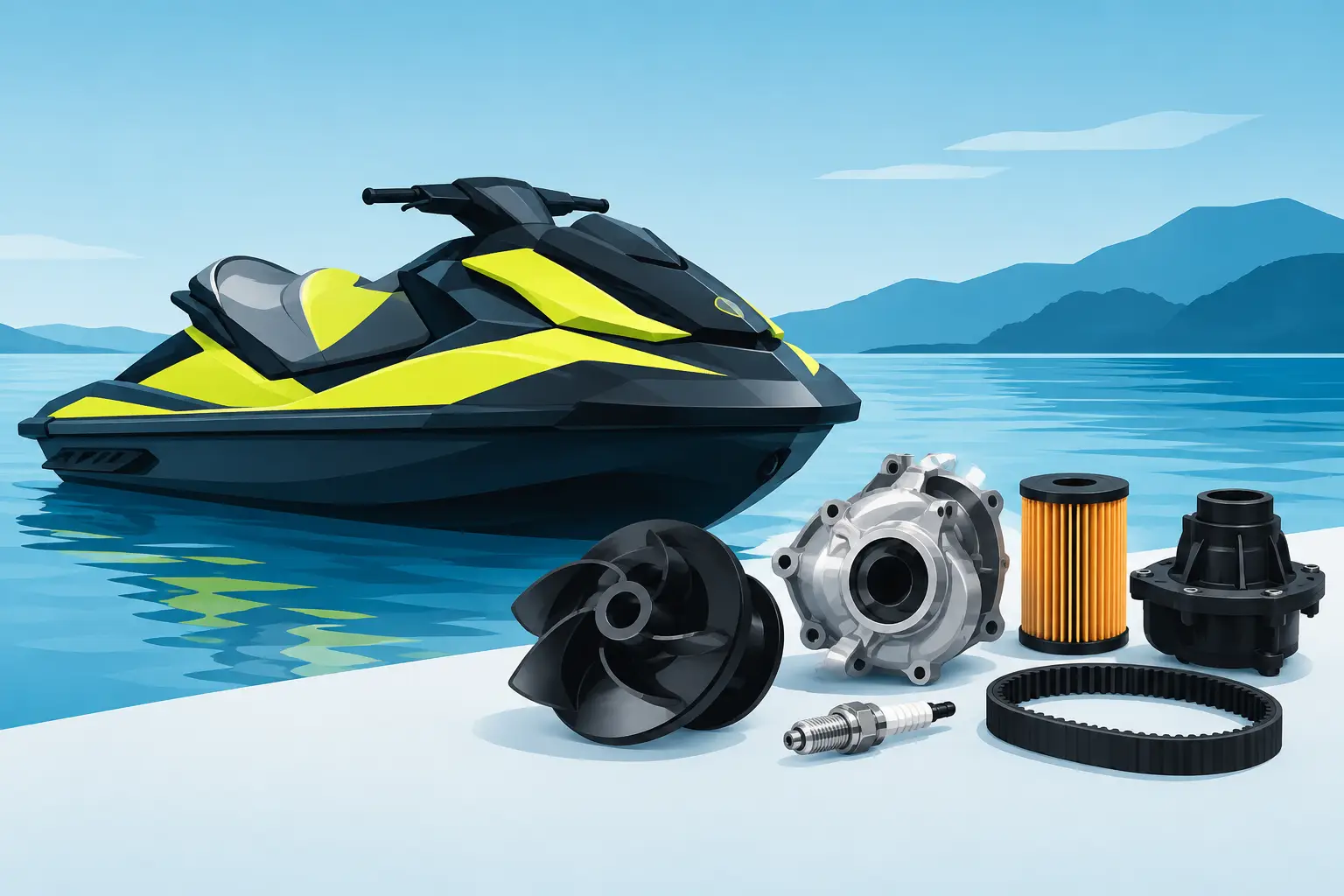
A Sea-Doo that feels flat off the throttle, runs hot after a hard session or develops an intermittent warning light rarely needs a random collection of upgrades. It needs the right Sea-Doo parts for its exact platform, condition and intended use. That distinction matters whether you are servicing a stock GTI, restoring dependable power to an RXT-X or building a supercharged race ski that must hold together under repeated full-throttle passes.
Buying parts on price alone can turn a straightforward repair into a second repair. Buying performance hardware without supporting modifications can do the same. The best result comes from treating the ski as a complete system: airflow, fuel delivery, cooling, driveline, electronics and maintenance all need to suit the power level you want to run.
Start With the Sea-Doo Parts That Match Your Platform
Sea-Doo has produced a wide range of engines, hulls and electronic systems over the years. Two skis may look similar at the ramp yet use different supercharger arrangements, intercooler plumbing, sensor connections or driveline components. Model year, engine code and whether the ski is naturally aspirated or supercharged all affect compatibility.
Before ordering anything, confirm the full model designation, year, engine configuration and hull identification details. If the ski has already been modified, identify what is actually fitted rather than assuming it remains standard. An aftermarket intake, tuned ECU, upgraded injector set or non-standard impeller changes what will work safely next.
This is especially relevant for performance builds. A camshaft selected for a boosted 300 platform has different requirements from a cam intended for a naturally aspirated engine. Likewise, an intercooler upgrade may physically fit but still require revised hose routing, clamps and a calibration that accounts for increased airflow. Correct fitment is not just about bolting the part on. It is about ensuring it performs as intended once the engine is working hard.
OEM, aftermarket and performance components
OEM replacement components are often the sensible choice for wear items and baseline reliability. Genuine seals, sensors, gaskets and service parts are designed around factory tolerances, and they can remove uncertainty during a diagnosis. For a recreational ski used with family on weekends, that certainty has real value.
Quality aftermarket Sea-Doo parts earn their place when there is a measurable improvement to be gained. A better intercooler can help control intake temperatures on a hard-ridden supercharged ski. Upgraded valve springs may be required when changing camshafts. Forged pistons and rods become worthwhile when boost, RPM and cylinder pressure move beyond the safe range of standard internals.
There is no universal rule that aftermarket is better or OEM is always safer. The right choice depends on the job. A race build needs components selected as a package, while a standard ski with a leaking seal often needs a correctly installed OEM-quality replacement and nothing more.
Build Performance Around Supporting Parts
Extra power exposes weak links. This is why a high-flow air intake or supercharger wheel should never be treated as a standalone modification. More air needs appropriate fuel delivery. More boost creates more heat. Higher engine output places greater load on the clutch, jet pump and driveline. ECU tuning is what brings those mechanical changes into a safe, usable combination.
For a supercharged Sea-Doo, the common performance path usually starts with a healthy service baseline. Compression, leak-down condition, supercharger health, cooling performance and fault-code history should be checked before chasing numbers. Once the foundation is sound, upgrades can be matched to the rider’s target: sharper throttle response for towing and recreation, stronger mid-range for offshore riding, or maximum top-end power for competition.
Fuel system components deserve particular attention. Injectors must be correctly sized, clean and calibrated for the tune. A fuel issue that appears minor at idle can become destructive under sustained boost. The same applies to spark plugs, ignition components and sensors. They are relatively small Sea-Doo parts, but their condition can determine whether an engine makes repeatable power or suffers detonation.
Cooling upgrades are also frequently misunderstood. An intercooler does not create power by itself in every situation. Its value is in reducing intake-air temperature and supporting more consistent output when the ski is heat-soaked, heavily loaded or repeatedly ridden at full throttle. For riders who only cruise occasionally, the return may be modest. For a hard-ridden boosted ski, stable temperatures can be the difference between a quick run and dependable performance all day.
The tune is part of the hardware package
An ECU calibration should match the exact mechanical specification of the ski. Generic maps and copied files create risk because fuel quality, intake configuration, exhaust changes, boost level and injector capacity can all vary. A tune that works on one setup may not suit another that appears almost identical.
Professional calibration also improves how the ski behaves, not just peak power. Clean cold starting, predictable throttle response, sensible engine protection strategies and stable fuelling matter on the water. A ski that delivers smooth, repeatable thrust is faster and more enjoyable than one that makes a big number once and then runs poorly.
Service Parts Protect the Expensive Components
Performance hardware gets attention, but routine service parts protect the investment. Oil, filters, spark plugs, sacrificial anodes, wear rings, pump bearings, carbon seals and supercharger service components all have working lives. Ignoring them is false economy, particularly in saltwater conditions common across the Central Coast.
A worn wear ring, for example, can make a healthy engine feel lazy by allowing cavitation and reducing pump efficiency. It may be tempting to pursue more horsepower when the real problem is at the jet pump. Similarly, a carbon seal or driveline issue can start as a minor leak and become a serious reliability concern if it is left unchecked.
Follow the service interval suited to the ski’s use, not only the calendar. A low-hour freshwater ski ridden gently has different needs from a boosted machine used in saltwater, launched every weekend and run hard. Flush thoroughly after saltwater use, inspect for corrosion, and address small changes in sound, vibration or acceleration before they become major repair work.
Four areas deserve regular inspection:
- Engine oil, oil filter and the correct spark plugs for the engine and tune.
- Supercharger condition, intercooler hoses, clamps and intake plumbing on boosted models.
- Jet pump wear ring, impeller, bearings and driveline alignment.
- Cooling hoses, exhaust components, anodes and corrosion-prone fasteners.
These checks are not glamour jobs, but they are the work that keeps a powerful Sea-Doo ready to ride.
Know When a Part Is Not the Actual Fault
Ordering a replacement component based on symptoms can waste time and money. A no-start issue may be caused by a battery under load, a poor earth, a relay, a sensor fault or water intrusion. Overheating may trace back to a blocked cooling passage, damaged hose, exhaust restriction or pump-related problem rather than a failed temperature sensor.
Proper diagnostics narrow the cause before parts are fitted. That usually includes a fault-code scan, battery and charging checks, compression or leak-down testing where needed, visual inspection and testing of relevant electrical or fuel systems. On modified skis, reviewing the existing tune and mechanical specification is equally important.
This approach is particularly valuable after an impact, ingestion event or insurance repair. Fibreglass damage can be obvious while hidden alignment issues, pump damage or electrical faults are not. Repairing what can be seen without checking the systems around it can leave the ski looking right but riding wrong.
Fitment Quality Matters as Much as the Part
Premium components can fail when installed without the correct tools, torque settings or preparation. Clamps need correct positioning, mating surfaces need proper cleaning, fasteners need the right torque, and hoses must be routed to avoid rubbing or collapse. On engine builds, clearances and measurements are non-negotiable.
This is where specialist workmanship pays off. VTECHTUNED approaches performance and repair work as a complete result, combining parts selection with installation, diagnostics and ECU calibration where required. That gives owners a clear line between the hardware fitted, the reason it was selected and the outcome expected on the water.
For technically confident owners, some maintenance work is practical at home. For supercharger work, internal engine upgrades, complex electrical faults or tuning changes, professional support is generally the safer investment. The cost of correcting a failed DIY install can exceed the cost of doing the job properly from the start.
Choose Sea-Doo parts with a clear purpose, install them to a proper standard and service the systems that support them. Your ski will not just make stronger power when asked – it will be far more likely to bring you back to the ramp without drama.



