
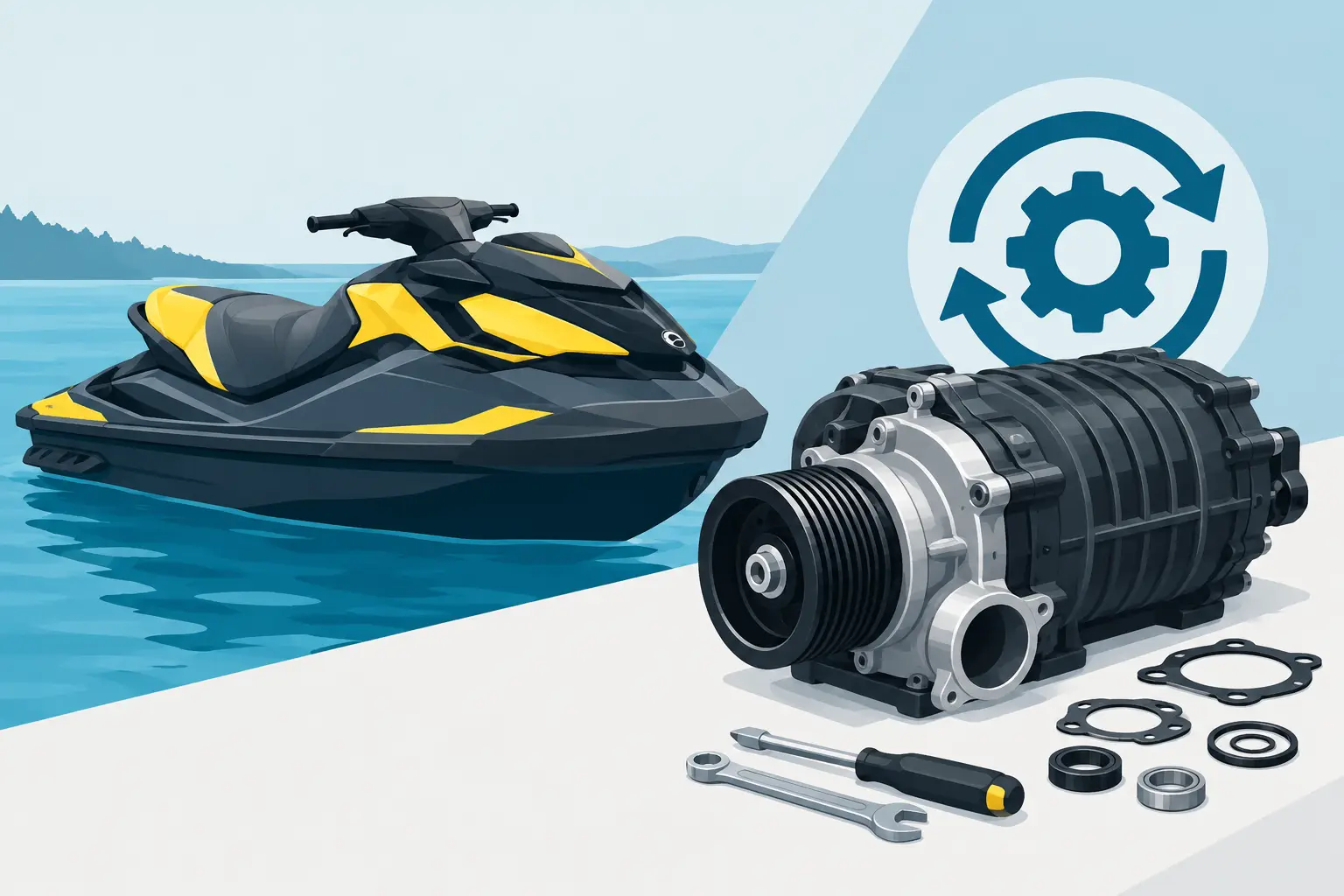
A Sea-Doo supercharger rebuild is not a job to put off until the ski feels slow. By the time boost, acceleration or top-end performance has noticeably dropped, the clutch and internal components may already be outside specification. On a supercharged 4TEC, this compact unit has a big job: it supplies the air your engine needs to make serious power. If it slips, wears out or fails, the result can range from disappointing throttle response to expensive engine damage.
For recreational riders, high-performance builds and race-focused machines alike, the right rebuild timing comes down to the exact model, its service history, the hardware fitted and how hard it is ridden. There is no one-size-fits-all interval that replaces a proper inspection.
What the Sea-Doo supercharger actually does
A Sea-Doo supercharger is belt-driven from the engine and compresses intake air before it reaches the engine. More air allows the ECU and fuel system to support more power, which is why supercharged Sea-Doo platforms deliver the sharp mid-range and hard acceleration owners expect.
The supercharger does not simply spin freely forever. Its clutch assembly is designed to control how power is transferred to the charger, while bearings, gears, shaft components and washers operate at very high speed. Heat, load, water conditions, engine modifications and sustained high-rpm riding all affect component life.
That is why a supercharger inspection belongs in a genuine maintenance plan, especially on a ski that has been tuned, fitted with an upgraded intake or intercooler, or used for repeated wide-open-throttle runs. More power is rewarding, but it also increases the need for accurate servicing.
When is a Sea-Doo supercharger rebuild due?
The manufacturer’s scheduled maintenance guidance for your specific year and model is the starting point. Older and newer 4TEC platforms can use different supercharger components and service requirements, so assumptions based on a mate’s ski can be costly. A machine with an unknown history should be treated cautiously until the charger has been properly checked.
Hours matter, but they are not the whole story. A lightly used ski that has spent years sitting may still need attention due to age, corrosion risk and degraded lubrication. At the other end of the scale, a low-hour ski used in surf, hot weather, salt water or frequent drag-style riding can see much higher load than its hour meter suggests.
A rebuild or inspection should be on the radar when service records are incomplete, the engine has been modified, the ski is being purchased second-hand, or the supercharger is approaching its scheduled service point. It is far cheaper to inspect a healthy unit than to repair the damage caused by a failed one.
Signs that need workshop attention
A slipping clutch does not always announce itself with a dramatic noise. Often, riders just notice that the ski no longer pulls with the same force. Watch for a drop in acceleration, lower-than-normal rpm under load, inconsistent power delivery, unusual supercharger or intake noises, and warning lights or fault codes.
These signs can also point to other issues, including boost leaks, fuel delivery faults, intercooler restrictions, worn wear rings, carbon seal concerns or tuning problems. That is exactly why diagnosis matters. Replacing supercharger parts without checking the wider system can leave the real cause untouched.
What a proper rebuild involves
A professional Sea-Doo supercharger rebuild is more than fitting a few parts and bolting the unit back on. The charger is removed, stripped, cleaned and inspected for wear, heat marks, corrosion and damage. The shaft, gears, bearings, clutch components and associated hardware must be measured and assessed against the correct specifications for that unit.
The clutch assembly is particularly critical. Its setup determines the torque required before it slips. Too little slip resistance can reduce boost and leave the ski flat out of the hole. Too much can create excessive load and compromise the purpose of the clutch system. Correct assembly, torque procedures and verification are not optional on a high-speed rotating component.
Any worn or questionable components should be replaced with quality parts suited to the model and intended use. This is not the place for mystery parts or shortcuts. A performance ski deserves components that match the load it will see on the water.
Once rebuilt, the unit must be reinstalled with care, including correct seals, fasteners and related checks. Depending on the job, it also makes sense to inspect intake plumbing, oil lines, cooling hardware, intercooler condition and drive-line performance. A supercharger can be in perfect condition while another restriction is holding the ski back.
Rebuild, replace or upgrade?
For a standard recreational Sea-Doo, a correctly rebuilt factory supercharger is often the sensible option. It restores the intended performance while retaining a proven arrangement. For a tuned ski, a larger charger or performance-focused setup may make sense, but only when the rest of the package can support it.
More boost is not a standalone upgrade. It can require suitable injectors, fuel-system capacity, intercooling, engine internals, exhaust flow and ECU calibration. A charger chosen without considering these supporting parts may produce heat, lean conditions, detonation risk or unreliable power.
The right question is not simply how much boost a supercharger can make. It is how much reliable power the entire engine package can handle. A well-matched build with conservative calibration will often be faster and far more enjoyable than a peak-power setup that is always one hard ride away from trouble.
Why DIY rebuilds can become expensive
Experienced owners can remove components and carry out basic checks, but rebuilding and setting up a supercharger requires specialised knowledge and equipment. Small errors in assembly, torque, cleanliness or clutch calibration can have major consequences once the charger is spinning at operating speed.
There is also the issue of identifying what caused the wear. If a unit has overheated, ingested contamination or suffered from a lubrication problem, simply rebuilding it may not prevent a repeat failure. The surrounding engine and intake system need to be assessed before the ski goes back in the water.
For second-hand purchases, a documented inspection provides real confidence. It is one of the most valuable checks on a supercharged Sea-Doo because it protects the engine investment, not just the charger itself.
Protecting your rebuilt supercharger
A rebuild is only as good as the maintenance that follows. Keep service records, use the correct oil and parts, flush thoroughly after salt-water use and investigate any change in power early. Do not assume a tuning issue is harmless, either. Poor calibration, excessive intake temperatures and inadequate fuel supply can place serious stress on a forced-induction engine.
Before chasing more power, make sure the foundations are right: healthy compression, clean fuel delivery, sound cooling, a leak-free intake tract and a verified supercharger. This order saves money and produces better results on the water.
At VTECHTUNED, supercharger work is approached as part of the complete Sea-Doo package, not an isolated repair. For riders around the Central Coast who want clear advice, accurate diagnostics and workmanship built for performance and reliability, an inspection before the busy riding season is a smart move. Catching wear early keeps your ski pulling hard when it matters, rather than sitting on the trailer waiting for an avoidable repair.



